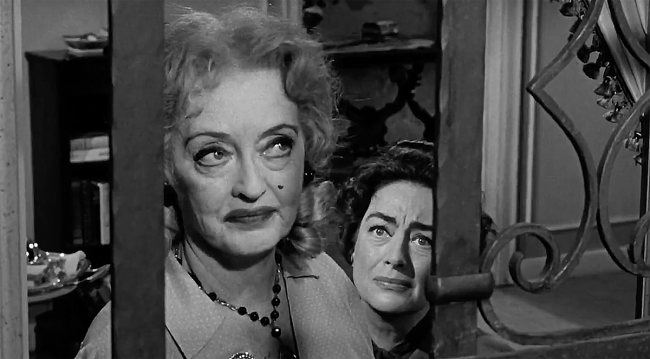
Oscar-winner Kim Basinger and Guy Pearce will participate in a Q&A at the 7:30pm, May 9th screening of L.A. CONFIDENTIAL at the Ahrya Fine Arts in Beverly Hills. Presented in 35mm.
Click here to purchase tickets.
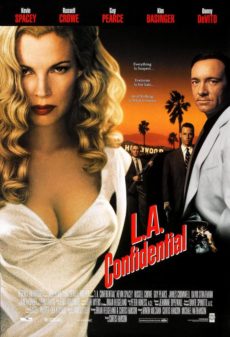 Laemmle Theatres and the Anniversary Classics Series present a tribute to Oscar-winning writer-director Curtis Hanson with a 20th anniversary screening of his film noir masterpiece, L.A. Confidential.
Based on James Ellroy’s acclaimed novel, the film focuses on Los Angeles police officers in the 1950s, whose investigations of several murders intersect with the worlds of Hollywood celebrities, scandal sheets, and organized crime.
The startling critique of police brutality and corruption remains timely and hard-hitting. Ellroy himself praised the screenwriters, saying that Hanson and Helgeland “preserved the basic integrity of the book and its main theme.”
In addition to its potent social commentary, the film represented a remarkable evocation of time and place, with major contributions by cinematographer Dante Spinotti, art director Jeannine Oppewall, and composer Jerry Goldsmith, all Oscar-nominated for their work.
Hanson, a classic film enthusiast as well as filmmaker, screened several films made in the 1950s for the cast and crew in order to encourage their dedication to authenticity.
The award-winning cast includes Russell Crowe, Guy Pearce, Kevin Spacey, James Cromwell, Danny DeVito, and Simon Baker.
L.A. Confidential has a 99 per cent positive score on Rotten Tomatoes. Roger Ebert called it “seductive and beautiful, cynical and twisted, and one of the best films of the year.”
Time’s Richard Schickel paid tribute to the film’s style: “It’s a movie of shadows and half lights, the best approximation of the old black-and-white noir look anyone has yet managed on color stock.”
The film was named best picture of 1997 by the Los Angeles Film Critics Association, the New York Film Critics Circle, the National Society of Film Critics, and the National Board of Review—one of only three films in history to win the top award from all four major critics’ groups. The film was selected for the National Film Registry in 2015.
Curtis Hanson’s many other films as director include The Bedroom Window, The Hand That Rocks the Cradle, The River Wild, Wonder Boys, 8 Mile, and In Her Shoes.
Kim Basinger co-starred in the James Bond movie, Never Say Never Again, and had one of her biggest successes as Vicki Vale in Tim Burton’s Batman in 1989. Her many other films include Barry Levinson’s The Natural starring Robert Redford, Robert Altman’s Fool for Love, the controversial 9 ½ Weeks with Mickey Rourke, Robert Benton’s Nadine with Jeff Bridges, the remake of The Getaway, The Door in the Floor, and I Dreamed of Africa. She reunited with Curtis Hanson when she played Eminem’s mother in 8 Mile, and she reunited with her L.A. Confidential co-star, Russell Crowe, in Shane Black’s The Nice Guys in 2016.
Guy Pearce first attracted attention in the Australian comedy, The Adventures of Priscilla Queen of the Desert. He had the lead role in Christopher Nolan’s influential Memento. Among his many other films are Rules of Engagement, The Proposition, Animal Kingdom, Lawless, Iron Man 3, and two Oscar-winning Best Pictures, The Hurt Locker and The King’s Speech. He co-starred with Kate Winslet in the HBO miniseries, Mildred Pierce, and recently had a key role in Dustin Lance Black’s acclaimed miniseries, When We Rise.
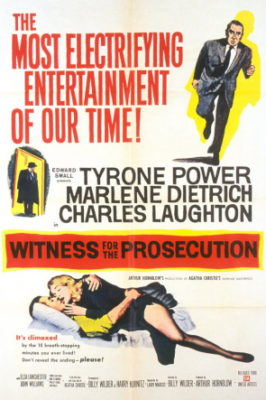 Billy Wilder, collaborating with writers Harry Kurnitz and Larry Marcus, strengthened the characterizations and added a surprise twist at the end, heightening the suspense throughout.
 Laemmle Theatres and the
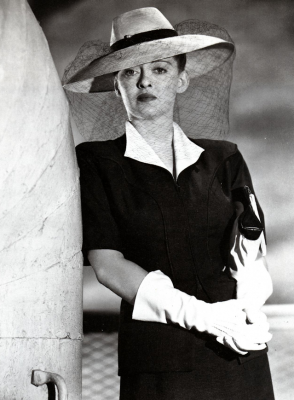
 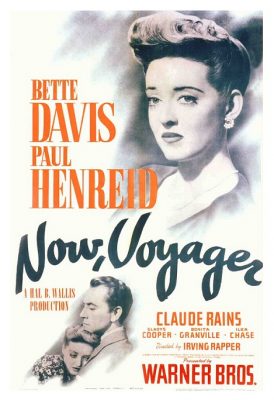 The film was nominated for 3 Academy Awards, including Davis as Best Actress as a repressed spinster who emerges from her shell in one of the screen’s most dramatic makeovers.
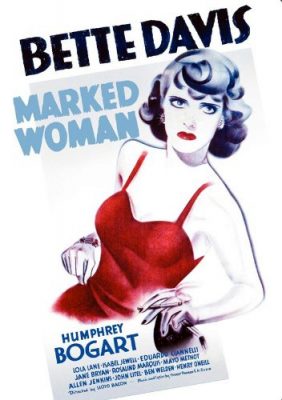 Our bonus feature, MARKED WOMAN stars Davis as a nightclub “hostess” who becomes the target of a vengeful mobster (Eduardo Ciannelli), who in turn is prosecuted by a crusading district attorney (Humphrey Bogart). Co-written by Robert Rossen (All the King’s Men, The Hustler) and Abem Finkel (Jezebel, Sergeant York), and directed by Lloyd Bacon (42 nd Street), the movie is notable for its “torn from the headlines” realism that characterized Warner Bros. style in the 1930s.
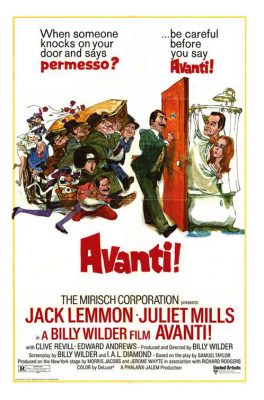 Laemmle Theatres and the Anniversary Classics Series present a 45th anniversary screening of AVANTI! (1972) followed by a Q&A with co-stars Juliet Mills and Clive Revill on Wednesday, March 29, at 7 PM at the Royal Theatre in West Los Angeles.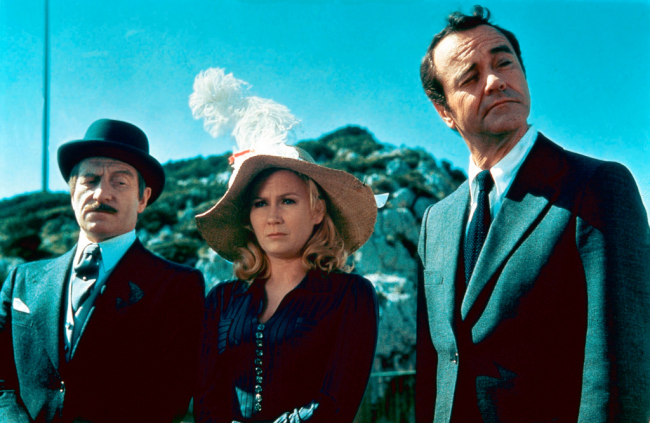
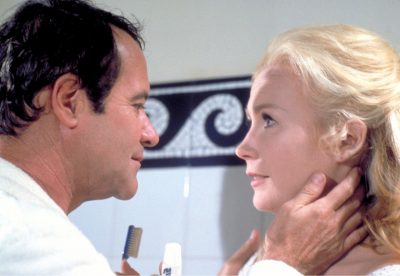 Juliet Mills is a member of one of the most distinguished British acting families. Her father, John Mills, was an Oscar winner as well as a lion of the theater. Her younger sister, Hayley Mills, the star of Disney classics Pollyanna and The Parent Trap, has also enjoyed a long career. Juliet has distinguished herself on stage, on screen, and on television. She was nominated for a Golden Globe for her performance in Avanti! and for her role on the hit television series, Nanny and the Professor. She won an Emmy for her performance in the miniseries, QB VII, and she was nominated for a Tony for her performance in Peter Shaffer’s first Broadway play, Five Finger Exercise.
 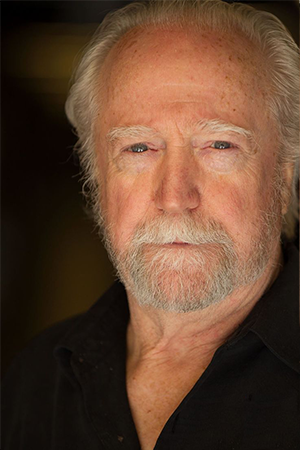 Laemmle Theatres and the Anniversary Classics Series present a 50th anniversary screening of
  In adapting the book, Brooks (the Oscar-winning writer-director of such films as The Blackboard Jungle, Cat on a Hot Tin Roof, Elmer Gantry, and Sweet Bird of Youth) resolved to be as faithful as possible to Capote’s chronicle, even filming in many of the actual locations where the events took place. With Capote’s encouragement, Brooks cast unknown actors as the two killers, and the performances of Robert Blake as Smith and Scott Wilson as Hickok earned critical raves. More established actors John Forsythe, Paul Stewart, and Will Geer filled out the supporting cast. Brooks also bucked the industry practice and decided to shoot the film in black-and-white at a time when color cinematography had become virtually mandatory for big-studio films.