The Official Blog of Laemmle Theatres.

Laemmle Theatres

Film Reviews & Previews

  • All
  • Theater Buzz
    • Claremont 5
    • Glendale
    • Newhall
    • NoHo 7
    • Royal
    • Santa Monica
    • Town Center 5
  • Q&A’s
  • Locations & Showtimes
    • Claremont
    • Glendale
    • NewHall
    • North Hollywood
    • Royal (West LA)
    • Santa Monica
    • Town Center (Encino)
  • Film Series
    • Anniversary Classics
    • Culture Vulture
    • Worldwide Wednesdays
  • Facebook
  • Instagram
  • TikTok
  • YouTube

You are here: Home / Anniversary Classics

Homoerotic Hitchcock: ‘Strangers on a Train’ at 75

June 10, 2026 by Lamb Laemmle Leave a Comment

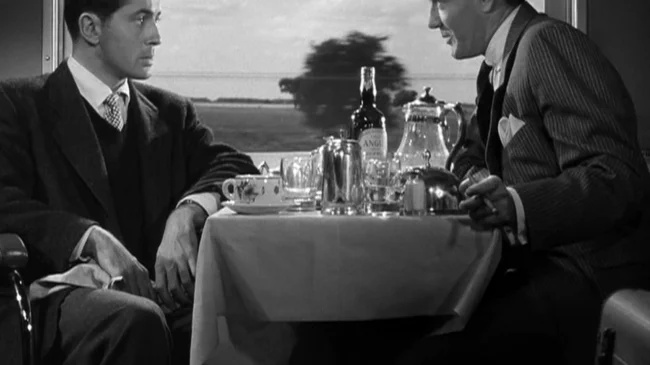
Laemmle Theatres and the Anniversary Classics Series present the movie that launched Hitchcock’s greatest decade of moviemaking, the 1951 suspense classic Strangers on a Train.

Homoerotic Hitchcock: 'Strangers on a Train' at 75

On Wednesday, June 24, at 7 p.m., attend the 75th anniversary screening at Laemmle’s Royal, complete with a Q&A with Stephen Rebello, Author of Criss-Cross: The Making of Hitcchock’s Dazzling, Subversive Masterpiece Strangers on a Train and Hitchcockian Thrillers.

Hitchcock had started his career in England with such top thrillers as The 39 Steps and The Lady Vanishes. Hollywood quickly came calling, and when Hitchcock moved to America, he won his only Best Picture Oscar for Rebecca in 1940. He continued with other classic films Foreign Correspondent, Shadow of a Doubt, Spellbound, and Notorious.

But in the late 1940s the Master of Suspense hit a dry spell, when his films The Paradine Case, Rope, Under Capricorn, and Stage Fright failed to connect with audiences. Searching for inspiration, he landed on Patricia Highsmith’s first acclaimed novel, Strangers on a Train, a story drenched in homoeroticism and perverse psychology. Highsmith, who was herself gay (she later wrote The Talented Mr. Ripley and a lesbian-themed novel, Carol, that was turned into an acclaimed 2015 film starring Cate Blanchett and Rooney Mara), provided the inspiration that Hitchcock needed.

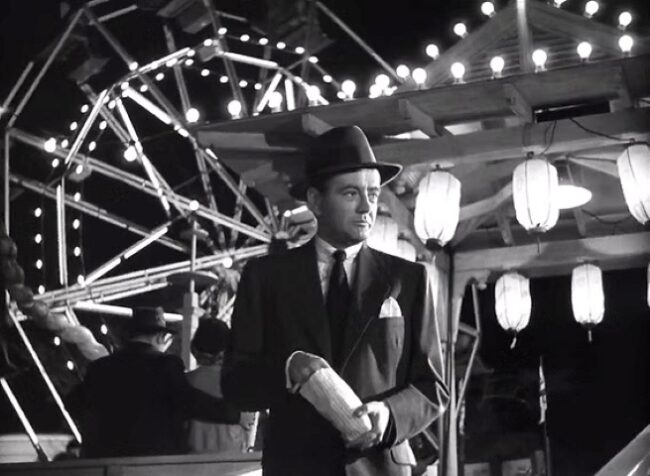
Strangers tells the story of a chance meeting between a handsome tennis star, Guy Haines, and a charming but deranged aristocrat, Bruno Anthony. Bruno has read about Guy’s problems with his estranged wife and suggests half-jokingly that if they swap murders (Bruno wants to get rid of his disapproving father), neither would have a discernible motive for the murders they commit. Guy does not take the suggestion seriously, but when Bruno kills Guy’s wife, he expects Guy to return the favor.

Homoerotic Hitchcock: 'Strangers on a Train' at 75

The screenplay is credited to acclaimed mystery writer Raymond Chandler and female writer Czenzi Ormonde, but Chandler actually contributed very little to the movie; he and Hitchcock did not get along. Nevertheless, the script is tightly structured and consistently gripping. Like many Hitchcock movies, Strangers is distinguished by several memorable set-pieces, including the murder at an amusement park, a tense tennis match, and the climax on board a carousel spinning wildly out of control. But it also has the psychological depth of the Master’s best movies. Defying the Production Code, which had a strict prohibition against depictions of homosexuality, Hitchcock and his screenwriters clearly delineate the attraction that Bruno feels toward the handsome tennis champ. Robert Walker, the star of several lighter pictures, relishes his stab at villainy, and he is well matched with Farley Granger, who had starred in Hitchcock’s Rope and was gay in real life.

Ruth Roman, Laura Elliott, Norma Varden, Leo G. Carroll, and Hitchcock’s daughter Patricia round out the cast. Robert Burks, who earned an Oscar nomination for his cinematography, went on to work with Hitchcock again on Dial M for Murder, Rear Window, To Catch a Thief, Vertigo, and North by Northwest, among others. Oscar-winning composer Dimitri Tiomkin, who had worked with Hitchcock on Shadow of a Doubt, wrote the effective score.

Stephen Rebello, who will be doing a Q&A at the screening, is the author of the best-selling Alfred Hitchock and the Making of Psycho (which was turned into a film starring Anthony Hopkins and Helen Mirren) and Dolls! Dolls! Dolls!: Deep Inside Valley of the Dolls, the Most Beloved Bad Book and Movie of All Time. He has written for Movieline, GQ, Playboy, and other publications.

Leave a Comment Filed Under: Anniversary Classics, Cinematic Classics, Featured Films, Q&A's, Royal Tagged With: Alfred Hitchcock, Farley Granger, Patricia Highsmith, Raymond Chandler, Robert Walker, Stephen Rebello, Strangers on a Train, suspense

The Needle, the Noise, the Nineties: ‘Trainspotting’ Turns 30

May 19, 2026 by Lamb Laemmle Leave a Comment

Three decades after its original release, Danny Boyle’s Trainspotting remains one of the most electrifying cinematic gut-punches of the 1990s, a film that somehow manages to be hilarious, horrifying, exhilarating, and deeply sad often within the same scene. Returning to theaters for its 30th anniversary fresh off a new 4k restoration, Boyle’s adaptation of Irvine Welsh’s cult novel still feels startlingly alive, retaining the same manic energy and confrontational honesty that made it an instant cultural landmark upon its release in 1996.

The Needle, the Noise, the Nineties: 'Trainspotting' Turns 30

Catch Trainspotting on its 30th anniversary tour beginning June 4th at the Laemmle Glendale, Newhall, and NoHo 7.

Set amid the economic stagnation and restless youth culture of Edinburgh, Trainspotting follows Mark Renton (Ewan McGregor) and his circle of friends as they drift through heroin addiction, petty crime, self-destruction, and fleeting attempts at escape. Yet what distinguished the film then, and what continues to distinguish it now, is its refusal to settle into easy moralism. Boyle never romanticizes addiction, but neither does he flatten it into a simple cautionary tale. The film understands the seductive pull of oblivion just as clearly as it does the devastation left in its wake.

Much of that awareness comes from Boyle’s direction, which exploded onto screens with a style that felt entirely novel for its time. Hyperactive editing, surreal visual detours, needle-drop music cues, and fourth-wall-breaking narration combine to plunge viewers directly into Renton’s fractured state of mind. The now-iconic soundtrack, ranging from Iggy Pop to Underworld, became inseparable from the film’s identity, helping transform Trainspotting into not merely a movie but a full-fledged cultural phenomenon.

Watching it today, it is striking how much of Boyle’s later career already seems present here in embryonic form: the propulsive momentum of Slumdog Millionaire, the visceral intensity of 127 Hours, and the restless experimentation that would come to define one of the most eclectic directing careers of the last thirty years. Since Trainspotting, Boyle has gone on to win the Academy Award for Best Director, helm the opening ceremony of the 2012 London Olympics, and cement himself as one of contemporary cinema’s most energetic and unpredictable filmmakers. But Trainspotting remains, for many, the film most inseparable from his singular artistic identity.

The Needle, the Noise, the Nineties: 'Trainspotting' Turns 30

The anniversary arrives at a moment when the story itself is once again evolving, with a stage musical adaptation of Trainspotting set to launch this July in London’s West End, bringing Renton and company back to the city where their story began. That continued reinvention speaks to the film’s enduring resonance across generations. What once felt shocking and immediate has now also become historical: a snapshot of 1990s disaffection that somehow never lost its pulse.

For all its stylization and dark humor, Trainspotting endures because beneath the bravado lies something painfully human. Renton’s famous “Choose Life” monologue lands differently at 30 than it did at 20—not merely as satire, but as the exhausted cry of someone trying, however imperfectly, to imagine the possibility of another kind of existence. So whether it’s your first-ever viewing or a stroll down memory lane, get your tickets now and prepare to be entertained.

Leave a Comment Filed Under: Anniversary Classics, Glendale, Newhall, NoHo 7, Repertory Cinema Tagged With: Dany Boyle, Ewan McGregor, Ewen Bremner, Kelly Macdonald, Robert Carlyle, Trainspotting

‘The Man Who Fell to Earth’ Returns to Big Screens Uncut

May 5, 2026 by Lamb Laemmle Leave a Comment

Laemmle Theaters and the Anniversary Classics Series present two screenings of the provocative and lyrical sci-fi classic, Nicolas Roeg’s The Man Who Fell to Earth, which marked pop superstar David Bowie’s debut in a lead role on the big screen.

David Bowie in The Man Who Fell to Earth

For the film’s 50th anniversary, it will screen Wednesday, May 20, at Laemmle’s NoHo at 7 p.m.; and Wednesday, May 27, at Laemmle’s Royal at 7 p.m. Oscar-nominated actress Candy Clark will appear at both screenings to share memories of her co-star, the director, and her long film career.

The film was adapted by Paul Mayersberg from the novel by Walter Tevis, who also wrote the novel that inspired Paul Newman’s classic, The Hustler. Rip Torn, Buck Henry, and Bernie Casey co-star in the film. Bowie plays a visitor from a distant planet who travels to Earth to find water for his dying planet. He quickly amasses great wealth as an industrialist, but his plans are scotched by a couple of devious antagonists as well as by his love affair with a good-hearted woman played by Clark.

Roeg did the celebrated 2nd unit photography on the Oscar-winning masterpiece from 1962, Lawrence of Arabia. He went on to be the chief cinematographer on such films as Roger Corman’s The Masque of the Red Death, John Schlesinger’s Far From the Madding Crowd, and Richard Lester’s Petulia, among other films. He made his directorial debut (sharing credit with Donald Cammell) on the 1970 cult favorite, Performance, which introduced another pop music icon, Mick Jagger, to dramatic filmmaking. Roeg made his solo directing debut on the exquisite Australian adventure, Walkabout, and followed with the classic thriller, Don’t Look Now, starring Julie Christie and Donald Sutherland.

David Bowie in Nicolas Roeg's THE MAN WHO FELL TO EARTH (1976). Courtesy Rialto Pictures/StudioCanal.

Cinematographer Anthony Richmond, who worked with Roeg on Don’t Look Now, joined him again on The Man Who Fell to Earth. Shot mainly in New Mexico, the film was again notable for its striking visual style. The music for the film was coordinated by John Phillips of The Mamas and the Papas, with original score by Japanese composer Stomu Yamash-ta.

Most of Roeg’s films divided the critics, and this one was no exception, though it boasted a series of extraordinary reviews. At the time of its release, Richard Eder of The New York Times declared, “There are quite a few science-fiction movies scheduled to come out in the next year or so. We shall be lucky if even one or two are as absorbing and as beautiful as The Man Who Fell to Earth.” The New Yorker’s Pauline Kael wrote a mixed review of the film in 1976 but described Bowie as “the most romantic figure in recent pictures, the modern version of the James Dean lost-boy myth.” Years later, Joshua Rothkopf of Time Out confirmed Eder’s evaluation and called The Man Who Fell to Earth “the most intellectually provocative genre film of the 1970s.”

Robert Hawkins of Variety added to the praise for the film: “Bowie’s choice as the ethereal visitor is inspired… Candy Clark, as his naïve but loving mate, confirms the winning ways that won her an Oscar nom in American Graffiti… Her intimate scenes with Bowie… are among the pic’s highlights.”

One of these sex scenes, in which the two played with guns, led the distributor to cut some 20 minutes from the film before the 1976 release. This scene and others were restored when Rialto took over the release, and Laemmle will be screening the uncut version at both anniversary screenings.

Candy Clark earned her Oscar nomination for her warm portrayal of a local girl in George Lucas’s nostalgic breakthrough film, American Graffiti, in 1973. Her other movies include John Huston’s Fat City, Jonathan Demme’s Citizens Band, Blue Thunder, At Close Range, The Informant, and a wide range of television appearances over the decades. At both screenings Ms. Clark will participate in Q&As following the screenings, and will sign and sell her recent book of star photos, Tight Heads.

Leave a Comment Filed Under: Actor in Person, Anniversary Classics, Films, NoHo 7, Royal Tagged With: based on a book, Candy Clark, David Bowie, Nicolas Roeg, science fiction, The Man Who Fell to Earth

Anniversary Classics Presents: Revisiting the Cult Classic ‘Harold and Maude’

March 18, 2026 by Lamb Laemmle Leave a Comment

Laemmle Theatres and the Anniversary Classics Series are proud to present a tribute to the late Bud Cort with a screening of his most famous movie, the offbeat romantic comedy Harold and Maude, on Wednesday, March 25th at 7:30 p.m. at the Laemmle NoHo.

Anniversary Classics Presents: Revisiting the Cult Classic 'Harold and Maude'

Cort first attracted attention in two films directed by Robert Altman, the Oscar-winning black comic hit M*A*S*H and the eccentric comedy Brewster McCloud. He also played one of the student protestors in The Strawberry Statement, one of a handful of movies about student rebellion produced in the early 1970s. Yet it wasn’t until he joined forces with Ruth Gordon, Oscar-winning co-star of Rosemary’s Baby, to play one of the oddest couples in movie history, that the talented young actor was launched into what would ultimately develop into a decades-long career.

Cort plays Harold, a death-obsessed young man determined to commit suicide, at least until he meets the vibrant 79-year-old Maude and gradually falls in love with her. Before their chance encounter, Harold spends his days staging elaborate fake suicides to shock his wealthy, emotionally distant mother and attending strangers’ funerals for entertainment, drifting through life with a morbid detachment that borders on performance art. Maude, by contrast, lives with mischievous spontaneity: stealing cars she fancies, rescuing trees slated for demolition, and approaching each moment with irreverent wonder. Their unlikely friendship grows (while sneakily developing into the most improbable of romances) through a series of adventures that gently dismantle Harold’s fascination with death, as Maude introduces him to the pleasures, absurdities, and quiet rebellions that make life worth living. Set against a rich backdrop of early-1970s countercultural whimsy, their relationship challenges social expectations and invites Harold (and, ultimately, the audience) to reconsider what it means to truly embrace being alive.

Written by Colin Higgins as the basis for his Master’s thesis at UCLA and directed by Hal Ashby, Harold and Maude was a critical and financial flop when it first opened in December of 1971. Major critics like Roger Ebert, and Vincent Canby of The New York Times, panned the film, and it struggled to find an audience. Pauline Kael gave it a mixed review, noting that it flaunted a bizarre concept, but granted that it had “been made with considerable wit and skill,” also noting the considerable impact it had on young viewers: “Many young moviegoers have returned to this eccentric film repeatedly (in 1974, one 22-year-old claimed to have seen it 138 times).” The venerable New York Review of Books called it “a philosophical black comedy for grandparents and grandchildren.”

Anniversary Classics Presents: Revisiting the Cult Classic 'Harold and Maude'

It wasn’t until 1983, twelve years after its initial release, that the film finally turned a profit, and that Cort, Gordon, and the filmmakers received their long-overdue royalty checks. In the years that followed, the critics, too, gradually gave the film a second look, and in 1997 it was tagged for preservation by the National Film Registry of the Library of Congress. By 2004, Entertainment Weekly ranked it #4 on its list of the top 50 cult films of all time. Rarely has the phrase “aged like fine wine” been a more apt descriptor for a work of art.

Ashby and Higgins, for their part, also went on to much bigger successes, the former directing a number of acclaimed, Oscar-nominated films such as The Last Detail, Shampoo, Bound for Glory, Coming Home, and Being There, while the latter penned the smash-hit comedy Silver Streak, starring Gene Wilder and Richard Pryor, followed by a successful directorial run with Foul Play and 9 to 5.

With a deep and memorable cast including Vivian Pickles and the prolific Cyril Cusack, as well as an iconic soundtrack by Cat Stevens—filling in admirably for Elton John, who recommended him for the project after dropping out—Harold and Maude has plenty to offer its viewers, whether seeing it for the first… or 139th time.

Join us in remembering Bud Cort, in his most iconic role, at Harold and Maude‘s one-night-only screening at the Laemmle Noho.

Leave a Comment Filed Under: Anniversary Classics, Cinematic Classics, Films, Repertory Cinema, Royal, Special Events Tagged With: Anniversary Classics, black comedy, Bud Cort, Colin Higgins, cult movies, Hal Ashby, Harold and Maude, romantic comedy, Ruth Gordon

Summer, Youth, and Self-Discovery: Rediscovering Satyajit Ray’s ‘Days and Nights in the Forest’

February 24, 2026 by Lamb Laemmle Leave a Comment

A journey into the countryside becomes something far richer in Days and Nights in the Forest, the quietly radiant 1970 film from Indian master Satyajit Ray. Long regarded as one of Ray’s foremost (if relatively underappreciated) achievements, this film serves as a reminder of why he remains one of world cinema’s most revered humanists—a filmmaker of uncommon grace, wit, and emotional intelligence.

Satyajit Ray's Days and Nights in the Forest

Catch the newly restored Days and Nights in the Forest beginning February 6th at the Laemmle Royal, or February 13th at Glendale.

On the surface, the premise is simple: Four young professionals from Kolkata escape the pressures of city life for a few carefree days in the forests of eastern India. They arrive with cigarettes, bravado, and a pocketful of assumptions. They bribe a caretaker to secure lodging they never reserved. They drink too much. They talk too loudly. They treat the rural landscape as backdrop to their own amusement. Ray sketches these early episodes with a light touch that feels almost casual, airy, even playful. But a closer inspection reveals that what seems effortless is in fact exquisitely composed.

Ray builds the film from contrasts: urban and rural, privilege and poverty, men and women, innocence and experience. His camera often frames characters in medium groupings, encouraging us to observe them in relation to one another rather than as isolated heroes. There is no single protagonist here; instead, we’re invited to study a small social ecosystem. Time passes gently. Conversations drift. Meaning accumulates.

Satyajit Ray's Days and Nights in the Forest

When two women vacationing nearby, Aparna and Jaya, enter the men’s orbit, the film’s tone subtly shifts. Banter gives way to vulnerability; posturing reveals insecurity. Ray’s women, clear-eyed and self-possessed, register the men’s arrogance with bemusement rather than outrage. The flirtations and conversations that follow are modest on their face—a walk, a game of badminton, shared laughter—yet they carry the quiet charge of lives tilting off course.

The film’s most celebrated sequence arrives during a picnic, when the six characters play a memory game, each adding the name of a famous figure to an ever-growing list. It might sound inconsequential, but in the rhythms of hesitation and recall, in the glances exchanged and the names chosen, whole inner worlds flicker into view. Ray orchestrates the scene with the delicacy of chamber music. Nothing is underlined; everything resonates.

What makes Days and Nights in the Forest endure is its refusal of easy symbolism or tidy moralizing. Ray does not punish his characters, nor does he absolve them. He simply watches with compassion, irony, and patience as they brush up against their own limitations. The revelations are often small, but they linger. Only after viewing the entire film do you realize just how much it has revealed: about class and conscience, about love and pride, and about the uneasy passage from youth toward self-knowledge.

Leave a Comment Filed Under: Anniversary Classics, Cinematic Classics, Films, Royal Tagged With: Days and Nights in the Forest, India, rereleases, restorations, Satyajit Ray

Roommates, Revolution, and Reverie: Rediscovering Visconti’s ‘Conversation Piece’

February 17, 2026 by Lamb Laemmle Leave a Comment

This month, a revival worth savoring is headed back to the big screen: Conversation Piece, the late-period chamber drama from acclaimed Italian filmmaker Luchino Visconti, returns in a new 4K restoration courtesy of Kino Lorber. If you’ve never encountered this strange, elegant, faintly scandalous film, this theatrical reissue is the ideal way to step inside its rarefied, decaying world.

Roommates, Revolution, and Reverie: Rediscovering Visconti’s 'Conversation Piece'

Catch Conversation Piece in its much-anticipated re-release beginning February 20th at the Laemmle Royal.

Set almost entirely inside a grand Roman apartment—a practical concession to Visconti’s waning health—the film unfolds like a live-in painting: fitting, since its unnamed protagonist, a retired American professor played by Burt Lancaster, specializes in collecting “conversation pieces,” those intimate group portraits of domestic life. His own life, however, is all but sealed off: books, art, routine, and a heavy dose of solitude. That carefully controlled environment is suddenly upended when the Countess Bianca Brumonti (played with Circean glamour by Silvana Mangano) bullies her way into renting the upstairs flat, bringing along her daughter, her daughter’s boyfriend, and her volatile young lover Konrad, portrayed by longtime Visconti muse Helmut Berger.

What follows is less a traditional narrative than an all-out invasion, as noise, sex, politics, emotional turbulence, and generational upheaval flood the professor’s cloistered existence. Renovations begin without permission; parties erupt; strangers roam the halls. The professor protests (albeit mildly), yet inexorably finds himself drawn into their disorder, especially toward Berger’s Konrad, whose swaggering vulgarity and wounded intelligence combine to create a dangerous gravitational pull.

Roommates, Revolution, and Reverie: Rediscovering Visconti’s 'Conversation Piece'

Visconti, working after a debilitating stroke and reportedly directing portions of the film from his wheelchair, turns such limitations into style. The film’s confined setting becomes a pressure cooker of class tension, erotic charge, and ideological debate. At times it plays like tragic farce, at others like philosophical confession, resulting in a tonal high-wire act—stately composition colliding with emotional disarray—that gives the movie its peculiar, lingering power.

Lancaster’s casting is part of the fascination. Long associated with physical dynamism and outward force, here he is turned inward: restrained, observant, aching. Whether you view the performance as daringly subdued or intriguingly misaligned, it’s impossible to look away. Berger, by contrast, is all sharp edges and dangerous charm, strutting and smirking through the film like a beautiful provocation.

Conversation Piece is about aging, envy of youth, sexual politics, class hypocrisy, and the uneasy coexistence of radical ideas with decadent taste. It’s also, not incidentally, wickedly funny in stretches, with Visconti allowing the absurdity of his characters’ self-justifications to show through the gilt frame.

Seeing this film restored in 4K reveals the tactile richness of its interiors—fabrics, paintings, skin, candlelight—while accentuating the painterly intent behind every composition. Like the artworks the professor cherishes, this restoration rewards close viewing and theatrical scale.

In short: a film about people who shouldn’t live together, restored so beautifully that you’ll be very glad they do.

(At least for two hours.)

Leave a Comment Filed Under: Anniversary Classics, Cinematic Classics, Featured Films, Films, Repertory Cinema, Royal Tagged With: Burt Lancaster, Conversation Piece, Luchino Visconti

Anniversary Classics Presents: Revisiting Henry & June With Philip Kaufman

December 31, 2025 by Lamb Laemmle Leave a Comment

First on the 2026 docket for Laemmle Theatres’ Anniversary Classics Series comes Philip Kaufman’s Henry & June, a film that helped redraw the boundaries around what American cinema could openly explore. Released in 1990, it was the first film to receive the NC-17 rating, a designation that became inseparable from its reputation, but which only partially explains its lasting appeal. More than a provocation, Henry & June is a lush, literary meditation on desire, authorship, and the porous line between lived experience and art.

Fred Ward and Maria de Medeiros in Henry & June

Get your tickets today to see Henry & June on Sunday, January 11th, 2026 at the Laemmle Royal, kicked off by a pre-screening discussion with director Philip Kaufman moderated by Stephen Farber, ex-president of the Los Angeles Film Critics Association (which will be honoring Kaufman with their Career Achievement Award the day prior) and host of Reel Talk at Laemmle Theatres.

Set in 1930s Paris, the film draws from the diaries of Anaïs Nin, whose encounters with the fledgling writer Henry Miller (still working on his masterpiece-to-be Tropic of Cancer) and his enigmatic wife June catalyze both personal and creative awakenings. Kaufman treats this triangle less as a conventional erotic drama than as a shifting constellation of gazes and power. Anaïs, played with quiet intensity by Maria de Medeiros, begins as an observer—absorbing, recording, translating sensation into language—before gradually stepping into her own erotic and artistic agency. Fred Ward’s Henry is all swagger and verbal excess, while Uma Thurman’s June is an apparition, at once muse, manipulator, and mirror for the myriad desires projected onto her.

What distinguishes Henry & June is its attention to interiority. Kaufman visualizes thought and memory as tactile experiences: ink bleeding across paper, shadows pooling in lamplit rooms, bodies framed as if already being remembered. The film’s eroticism is inseparable from its interest in writing itself, in how confession, exaggeration, and performance shape identity. Sex here is never reduced to spectacle for its own sake, but a language through which the characters attempt to define themselves.

Maria de Medeiros, Fred Ward and Uma Thurman in Henry & June

Following Henry & June’s release, the controversy surrounding its NC-17 rating often obscured how carefully crafted the film really is. Its sensuality is deliberate and measured, rooted in atmosphere rather than shock, while its emotional core lies in Anaïs’s struggle to reconcile intimacy with autonomy. Kaufman resists easy moralizing, allowing contradictions to coexist: freedom and dependency, inspiration and exploitation, love and self-invention.

Seen today, Henry & June feels less like a boundary-pushing outlier than a throwback to a brief moment in time when American studios were willing to support adult, intellectually curious filmmaking that trusted audiences to engage with such complexity. Its frankness remains striking, but so does its elegance, as well as its belief that erotic experience can be cinematic without being reductive or vulgar. More than three decades on, the film endures as a portrait of artists in formation and as a sensual inquiry into how stories—especially the ones we tell about ourselves—come into being.

Leave a Comment Filed Under: Anniversary Classics, Awards, Filmmaker in Person, Reel Talk with Stephen Farber, Royal Tagged With: Anniversary Classics, Fred Ward, Henry & June, Maria de Medeiros, Philip Kaufman, Stephen Farber, Uma Thurman

Anniversary Classics Presents: Power, Politics, and Passion in Nixon and Doctor Zhivago

December 2, 2025 by Lamb Laemmle Leave a Comment

This holiday season, Laemmle Theatres and the Anniversary Classics Series present two sweeping cinematic epics: Oliver Stone’s Nixon and David Lean’s Doctor Zhivago, the latter celebrating its 60th anniversary. Though separated by three decades and worlds apart in style, these films form a captivating double feature: one a feverish psychological portrait of American power, the other an expansive romantic epic set against the convulsions of revolutionary Russia. Together, they reflect cinema’s enduring ability to illuminate the human stakes behind history’s most turbulent eras.

Get your tickets today to see Nixon on December 21st, featuring an in-person Q&A with director Oliver Stone alongside author Tim Grieving to discuss his new book on legendary composer John Williams, or Doctor Zhivago on December 30th, both playing at the Laemmle Royal.

Anniversary Classics Presents: Power, Politics, and Passion in Nixon and Doctor Zhivago

Oliver Stone’s Nixon (1995) remains one of the filmmaker’s boldest achievements. Rather than approaching Richard Nixon as a political symbol, Stone crafts a bruised, haunted character study of a man who carried childhood wounds into the Oval Office. Anthony Hopkins delivers a mesmerizing performance as Nixon, capturing him in all his yearning, paranoia, cunning, and profound isolation. Then there’s John Williams’ brooding, elegant score, which guest speaker Tim Grieving argues ranks among the composer’s most underrated works. His and Stone’s post-screening conversation promises an illuminating look into the film’s creation, its political resonance, and the musical architecture that gives it shape.

Seen nearly three decades after its release, Nixon feels startlingly contemporary, its themes of secrecy, ambition, partisan rage, and the weight of personal demons on public decision-making continuing to echo. Stone’s approach, blending documentary grit with operatic intensity, constructs not a straightforward biopic but a cautionary American tragedy.

Anniversary Classics Presents: Power, Politics, and Passion in Nixon and Doctor Zhivago

If Nixon examines a presidency from the inside out, Doctor Zhivago (1965) offers a radically different but equally powerful meditation on individuals swept into history’s path. Even sixty years after its making, David Lean’s adaptation of Boris Pasternak’s Nobel Prize–winning novel remains one of cinema’s most beloved epics: a story of love, revolution, and moral endurance set during Russia’s collapse into modernity. Omar Sharif gives one of his finest performances as Yuri Zhivago, a poet and physician who is forced to navigate the conflicting directives of loyalty, passion, and survival, while Julie Christie’s luminous turn as Lara elevates the film into mythic territory.

Lean’s filmmaking—full of painterly compositions, sweeping landscapes, and meticulous craftsmanship—creates a world that feels both intimate and vast. The film’s visual grandeur is matched by Maurice Jarre’s iconic score, whose themes have become synonymous with cinematic romance. Yet for all its beauty, Doctor Zhivago is fundamentally a story about how political upheaval reshapes the contours of private life, and how love endures even as the world fractures.

Screened across consecutive weekends at the Laemmle Royal, these Anniversary Classics invite audiences to rediscover the emotional, historical, and artistic power of these two landmark films. Whether exploring the shadows of American politics or the passions of a Russia in revolt, Nixon and Doctor Zhivago remind us why great cinema remains one of the profoundest tools we have for understanding both our past and our present.

Leave a Comment Filed Under: Anniversary Classics, Featured Films, Filmmaker in Person, Royal

  • 1
  • 2
  • 3
  • …
  • 27
  • Next Page »

Search

Instagram

This is the way. 🍿 Exclusive Mandalorian & Grogu p This is the way. 🍿 Exclusive Mandalorian & Grogu popcorn tins and collectible figurines. Yours with a Mando Combo purchase! Very limited supply. 

@LaemmleNewhall & @LaemmleNoHo

🎟️Tickets: laem.ly/4aoKwRb
🖌️Sandwich board art by @mikaelparis_

#StarWars #TheMandalorian #Grogu
☘️ WEAR GREEN ☘️ $AVE GREEN ☘️ $2 OFF your concess ☘️ WEAR GREEN ☘️ $AVE GREEN ☘️ $2 OFF your concessions order!

⭐ St. Patrick's Day! Tuesday March 17th Only!

-Movie ticket purchase not required
-Like and show this post!
🎟️ laemmle.com/discounts
🚀 PROJECT HAIL MARY, AN EPIC PRIZE PACK GIVEAWAY! 🚀 PROJECT HAIL MARY, AN EPIC PRIZE PACK GIVEAWAY!
👉 ENTER in BIO!

#ProjectHailMary — starring Academy Award® nominee Ryan Gosling and directed by Academy Award®-winning filmmakers Phil Lord & Christopher Miller. Based on Andy Weir's New York Times best-selling novel.

🎟️ GET TICKETS in BIO!
For the 21st consecutive year, Laemmle will be scr For the 21st consecutive year, Laemmle will be screening the Oscar-Nominated Short Films, opening on Feb. 20th. Showcasing the best short films from around the world, the 2026 Oscar®-Nominated Shorts includes three feature-length programs, one for each Academy Award® Short Film category: Animated, Documentary and Live Action.

ANIMATED SHORTS: (Estimated Running Time: 83 mins)
The Three Sisters
Forevergreen
The Girl Who Cried Pearls
Butterfly
Retirement Plan
 
LIVE ACTION SHORTS (Estimated Running Time: 119 minutes)
The Singers
A Friend Of Dorothy
Butcher’s Stain
Two People Exchanging Saliva
Jane Austin’s Period Drama

DOCUMENTARY SHORTS (Estimated Running Time: 158 minutes)
Perfectly A Strangeness
The Devil Is Busy
Armed Only With A Camera: The Life And Death Of Brent Renaud
All The  Empty Rooms
Children No More: “Were And Are Gone”

Please note that some films may not be appropriate for audiences under the age of 14 due to gun violence, shootings, language and animated nudity.
Follow on Instagram


Laemmle Theatres

Laemmle Theatres
Tickets: http://laemmle.com/film/artfully-united | Subscribe: http://bit.ly/3b8JTym | ARTFULLY UNITED is a celebration of the power of positivity and a reminder that hope can sometimes grow in the most unlikely of places. As artist Mike Norice creates a series of inspirational murals in under-served neighborhoods in and around Los Angeles, the Artfully United Tour transforms from a simple idea on a wall to a community of artists and activists coming together to heal and uplift a city.

Tickets: http://laemmle.com/film/artfully-united

RELEASE DATE: 10/17/2025
Director: Dave Benner
Cast: Mike Norice

-----
ABOUT LAEMMLE: Since 1938, Laemmle [Theatres] has been showing the finest independent, arthouse, and international films.

Subscribe to Laemmle's E-NEWSLETTER: http://bit.ly/3y1YSTM
Visit Laemmle.com: http://laemmle.com
Like LAEMMLE on FACEBOOK: http://bit.ly/3Qspq7Z
Follow LAEMMLE on TWITTER: http://bit.ly/3O6adYv
Follow LAEMMLE on INSTAGRAM: http://bit.ly/3y2j1cp
Tickets: http://laemmle.com/film/brides | Subscribe: http://bit.ly/3b8JTym | Nadia Fall's compelling debut feature offers a powerful and empathetic look into the lives of two alienated teenage girls, Doe and Muna, who leave the U.K. for Syria in search of purpose and belonging. By humanizing its protagonists and exploring the complex interplay of vulnerability, societal pressures, and digital manipulation, BRIDES challenges simplistic explanations of radicalization.

Tickets: http://laemmle.com/film/brides

RELEASE DATE: 9/24/2025
Director: Nadia Fall

-----
ABOUT LAEMMLE: Since 1938, Laemmle [Theatres] has been showing the finest independent, arthouse, and international films.

Subscribe to Laemmle's E-NEWSLETTER: http://bit.ly/3y1YSTM
Visit Laemmle.com: http://laemmle.com
Like LAEMMLE on FACEBOOK: http://bit.ly/3Qspq7Z
Follow LAEMMLE on TWITTER: http://bit.ly/3O6adYv
Follow LAEMMLE on INSTAGRAM: http://bit.ly/3y2j1cp
Tickets: http://laemmle.com/film/writing-hawa | Subscribe: http://bit.ly/3b8JTym | Afghan documentary maker Najiba Noori offers not only a loving and intimate portrait of her mother Hawa, but also shows in detail how the arduous improvement of the position of women is undone by geopolitical violence. The film follows the fortunes of Noori’s family, who belong to the Hazaras, an ethnic group that has suffered greatly from discrimination and persecution.

Tickets: http://laemmle.com/film/writing-hawa

RELEASE DATE: 10/8/2025

-----
ABOUT LAEMMLE: Since 1938, Laemmle [Theatres] has been showing the finest independent, arthouse, and international films.

Subscribe to Laemmle's E-NEWSLETTER: http://bit.ly/3y1YSTM
Visit Laemmle.com: http://laemmle.com
Like LAEMMLE on FACEBOOK: http://bit.ly/3Qspq7Z
Follow LAEMMLE on TWITTER: http://bit.ly/3O6adYv
Follow LAEMMLE on INSTAGRAM: http://bit.ly/3y2j1cp
Subscribe

Recent Posts

  • Haifaa Al-Mansour’s ‘Unidentified’ and the Women Hidden in Plain Sight
  • Homoerotic Hitchcock: ‘Strangers on a Train’ at 75
  • The First Artists: Herzog’s ‘Cave of Forgotten Dreams’

Archive

Featured Posts

An “embrace of what makes us unknowable yet worthy of forgiveness,” A LITTLE PRAYER opens Friday at the Claremont, Newhall, Royal and Town Center.

Leaving Laemmle: A Goodbye from Jordan