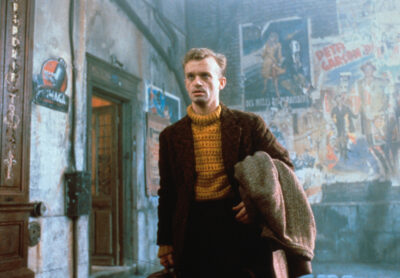
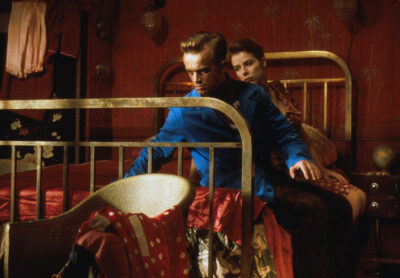
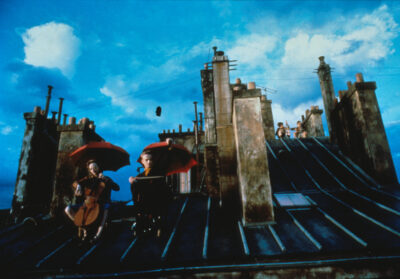
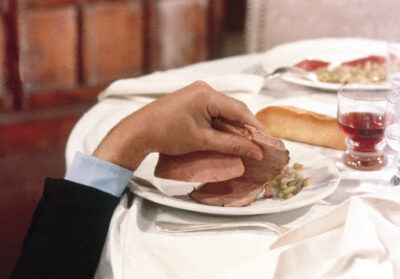
DELICATESSEN 30th Anniversary screenings at three Laemmle locations August 31.
Laemmle Theatres and the Anniversary Classics Series present the latest installment of the popular Anniversary Classics Abroad series, the 30th anniversary of the U.S. release of the international cult classic, DELICATESSEN. The surrealist black comedy about the inhabitants of a post-Apocalypse French city was the collaboration of tyro feature filmmakers Marc Caro and Jean-Pierre Jeunet, who co-directed and co-wrote, with a writing assist by Gilles Adrien.

The story centers on three characters, the owner of an apartment building with a ground floor delicatessen (Jean-Claude Dreyfus); his daughter (Marie-Laure Dougnac); and a former clown hired to be the dilapidated building’s maintenance man (Dominique Pinon). They inhabit a world in which food is scarce and lentils are used as currency. The landlord/butcher lures job seekers, murders them, and then prepares “delicacies” to sell to his odd tenants. His daughter falls in love with the latest victim and tries to foil her father’s scheme with the aid of the “lentil-men,” underground rebels.

The film’s hybrid mix of genres had critics and audiences somewhat bewildered and equally delighted amidst generally favorable reviews. Critic Emmanuel Levy provided appropriate praise: “Part macabre humor, part romantic drama, part childlike fable, this ingeniously original French farce defies categorization, but is successful on all these levels.” Janet Maslin of the New York Times cited its “fun-house atmosphere,” calling it “weirdly hilarious” and “lightweight but a sometimes subversively stylish farce.” Stephen Rea of the Philadelphia Inquirer found it “indescribably wild,” and Michael Wilmington in the Los Angeles Times noted “the whole movie has been conceived in grandiose, garishly witty comic book images,” along with the advisory, “out-shocks and outplays the American horror comedies at their own game…a nasty, childlike, murderously funny show.”

Jeunet handled directing the actors, while Caro was responsible for design and effects, and the two would tap into their fervid imaginations again for THE CITY OF LOST CHILDREN, another provocative fantasy, in 1995. Their talents were recognized by Hollywood when they were hired as the director (Jeunet) and design supervisor (Caro) for ALIEN: RESURRECTION in 1997. Jeunet went onto international acclaim for the more conventional romantic comedy AMELIE (2001), nominated for five Academy Awards, including best foreign language film and a screenplay nod for Jeunet. But all this success started with DELICATESSEN, which will be presented for one night only Wednesday, August 31 at 7:00 pm at three Laemmle locations: Glendale, Newhall, and the Royal in West Los Angeles.

A parable of power, the slickly entertaining Javier Bardem film THE GOOD BOSS opens August 26.
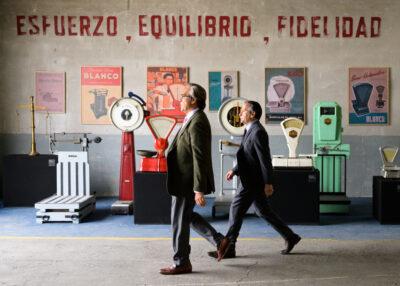
One of the most magnetic movie stars in cinema, Javier Bardem’s new workplace comedy-drama The Good Boss starts August 26 at the Royal. We’ll expand it to our other theaters in the subsequent weeks. The film is about Básculas Blanco, a Spanish company producing industrial scales in a provincial Spanish town, as it awaits the imminent visit from a committee which holds the firm’s fate in their hands: will they honor Básculas with a local Business Excellence award? Everything has to be perfect for the visit. Working against the clock, the company’s proprietor, Blanco (Bardem) pulls out all the stops to address and resolve issues with his employees, crossing every imaginable line in the process.

“Reminiscent of the Coen brothers’ trademark cinematic sarcasm… slickly entertaining.” ~ Jordan Mintzer, Hollywood Reporter

“It’s Javier Bardem’s show as he reunites with Fernando Leon de Aranoa for this parable of power.” ~ Jonathan Holland, Screen International
a
“Javier Bardem gives a powerhouse performance.” ~ David Stratton, The Australian
Here’s a clip from the film:
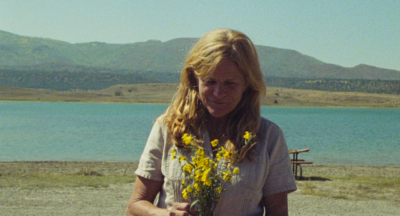
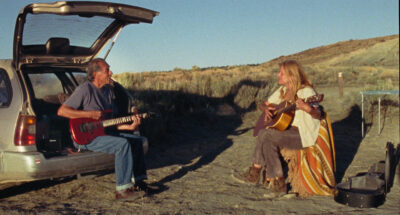
A LOVE STORY: Veteran character actor Dale Dickey shines in the role of her career.
“Like a coy, concise short story you might remember having read years ago, A Love Song is the simplest of tales, but there’s a complex universe of longing contained within it.” ~ Bilge Ebiri, New York Magazine/Vulture

“It’s well-photographed, unobtrusively edited, full of wondrous sights, and acted by a couple of masters of warm underplaying.” ~ Glenn Kenny, RogerEbert.com

“Death will cease to be absolute.” THREE MINUTES: A LENGTHENING opens August 19 with the director in person.
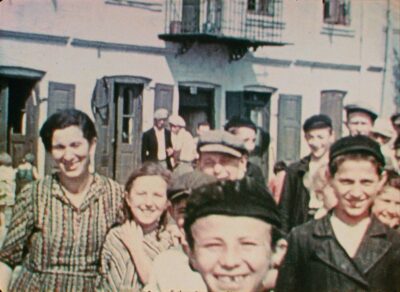
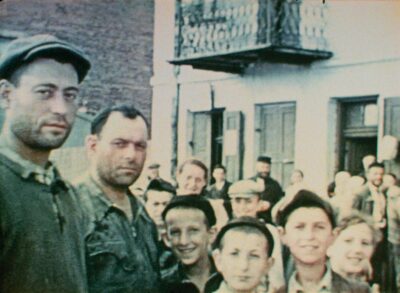
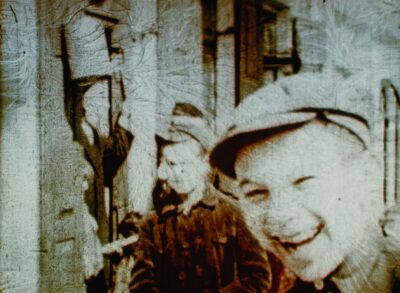
The beautiful new documentary feature Three Minutes: A Lengthening is based on a mere three minutes of footage, shot by David Kurtz in 1938, that are the only moving images remaining of the Jewish inhabitants of Nasielsk, Poland before the Holocaust. Director Bianca Stigter takes those three minutes and expands and explores them to create “an original and incisive meditation on history, memory, memorials and the very nature of celluloid.” (Alissa Simon, Variety) We open the film August 19 at the Royal and August 26 at the Town Center. The August 16 at the Royal will be hosted by the Los Angeles Jewish Film Festival and followed by a discussion with Ms. Stigter and author Glenn Kurtz. Scholar Michael Berenbaum of American Jewish University will moderate.
Director Bianca Stigter’s statement:
“As a child, David Kurtz emigrated from Poland to the United States. In 1938 he returned to Europe for a sightseeing trip and whilst there he visited Nasielsk, the town of his birth. Specifically for this trip, he bought a 16mm camera, then still a novelty rarely seen in a small town never visited by tourists. Eighty years later his ordinary pictures, most of them in color, have become something extraordinary. They are the only moving images that remain of Nasielsk prior to the Second World War. Almost all the people we see were murdered in the Holocaust.

“On Facebook, I stumbled upon a book written about this film, Three Minutes in Poland by Glenn Kurtz. The title fascinated me. I ordered the book and watched the footage, which can be found on the website of the United States Holocaust Memorial Museum. While watching, I wondered: could you make those three minutes last longer, to keep the past in the present?
“For this film essay, I examined the footage in the fullest detail, to see what the celluloid would yield to viewers almost a century later. The footage is treated as an archaeological artifact to gain entrance to the past.

“I contacted Glenn Kurtz, traveled to Nasielsk to see if any traces remained from the past, and went to Detroit to speak with survivor Maurice Chandler and his family.
“After this extensive research, I edited the footage in different ways to bring to life as many of the facts and stories about Nasielsk as possible. A few seconds of the recording of a café becomes a dance scene, a single shot of the market square tells the story of the deportation of its Jewish citizens. All the faces that appear in the film are singled out and magnified to pay homage to the people of Nasielsk. The old images of the Polish town are combined with the way Nasielsk sounds today, creating a tense fusion of the past and the present.

“Three Minutes: A Lengthening is an experiment that turns scarcity into a quality. Living in a time marked by an abundance of images that are never viewed twice, we do the opposite here: circle the same moments again and again, convinced that they will give us a different meaning each time. The film starts and ends with the same unedited found footage, but the second time you will look at it quite differently.
“Three Minutes: A Lengthening investigates the nature of film and the perception of time. Through the act of watching, the viewers partake in the creation of a memorial.”
“When apparatuses like these are available to the public, when everyone can photograph those who are dear to them, not only their posed forms but their movements, their actions, their familiar gestures, with words at the tip of their tongues, death will cease to be absolute.’’ ~ The French newspaper La Poste, 30 December 1895, after the Lumières’ first public showing of a film in Paris.
#BringBackMovieReviews: Marketplace on Nashville’s Belcourt Theatre
The journalists at the American Public Media business and economic news radio program Marketplace do in-depth reporting by repeatedly profiling and interviewing people, establishing long-term relationships they return their listeners to. One such person is Stephanie Silverman, executive director of the Belcourt Theatre, a non-profit movie theater in Nashville. Kai Ryssdal, the host and senior editor of Marketplace, recently spoke with Silverman again about adjusting to the pandemic and streaming. She is an extremely articulate advocate for the theatrical experience and what she said in the interview — “studios are understanding that the long tail for their movie happens when it starts in exhibition…it needs the word-of-mouth energy that only exhibition spaces can give it” — relates directly to what we’ve been advocating for recently in regards to the L.A. Times film section. Traditionally, talented, knowledgeable film critics guide moviegoers to culturally and artistically important films they might have otherwise missed. Filmmakers and film lovers alike rely on the critics for this and the film critics rely on big platforms like the Times. It is a crucial step in the process that makes unique, fine films and their L.A. theatrical exhibition possible. If the paper of record in the movie capital of the world abdicates its role, film culture suffers. We run the risk of a monoculture consisting of superheroes and sequels. #BringBackMovieReviews
“An exotic and brilliant hothouse flower of a film,” Buñuel’s ‘The Discreet Charm of the Bourgeoisie’ is back in theaters this Friday.
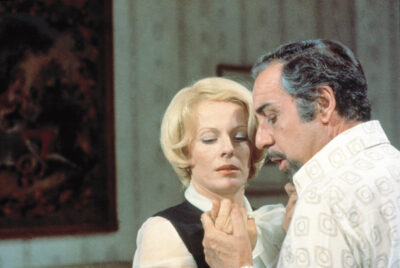
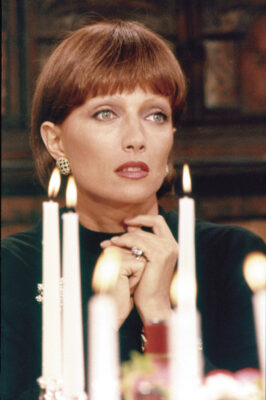
We are thrilled to open the new 50th anniversary 4K restoration of Luis Buñuel’s The Discreet Charm of the Bourgeoisie (1972) this Friday at our Royal, Claremont, Glendale and Town Center theaters. The 1973 Academy Award winner for Best Foreign Film and 1974 BAFTA Award winner for Best Actress and Best Screenplay, Discreet Charm is one of surrealist master Buñuel’s late career triumphs, now fully restored and ready to meet a new audience craving the director’s particular flair for the anarchic skewering of ruling elites.
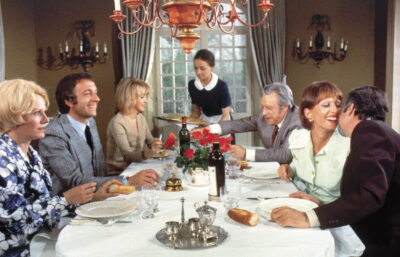
An ambassador and his bourgeois pals try to dine together again and again as circumstances, carnal and otherwise, intervene. Starring major French actors and Buñuel stalwarts Fernando Rey, Jean-Pierre Cassel, Stéphane Audran, Paul Frankeur, and Delphine Seyrig, with a screenplay written by Buñuel and long-time collaborator Jean-Claude Carrière (Diary of a Chambermaid, La Piscine), Discreet Charm brims with humorous satire and incisive criticism expressed in ways that can only be described as “Buñuelian.”
“Frightening, funny, profound, and mysterious…Luis Buñuel’s 1972 comic masterpiece, about three well-to-do couples who try and fail to have a meal together, is perhaps the most perfectly achieved and executed of all his late French films.” ~ Jonathan Rosenbaum, Chicago Reader

“Extraordinarily funny and perfectly acted.” ~ Vincent Canby, The New York Times
“Buñuel’s art is as insolent as ever. The Discreet Charm of the Bourgeoisie is a deeply funny movie, as a viewing experience it’s like walking across a perilous, sway little bridge whose guide rails periodically snatched away.” ~ David Denby, The Atlantic
“I had forgotten just how spooky the dream scenes are; Buñuel could have been a master of horror, or a great farceur. As it was, he was simply Bunuel, which is cause enough for celebration.” ~ Anthony Lane, The Independent

“Dreams nest within other dreams like so many Chinese puzzle boxes, while no dream belongs exclusively to a single dreamer, as though Bunuel were toying with the Jungian notion of the collective unconscious.” ~ Budd Wilkins, Slant Magazine
“An exotic and brilliant hothouse flower of a film.” ~ Peter Bradshaw, The Guardian
“Manages to be totally surreal yet totally approachable. Quite amazing.” ~ David Jenkins, Little White Lies

“Take a look again at its dream sequences, especially the nocturnal one involving the young man in the side street, and you will see a master disturber still at work.” ~ Peter Rainer, New York Magazine/Vulture
“An absurdly comic assault on the meaningless social rituals and polite hypocrisies of the upper middle class.” ~ Gary Dowell, Dallas Morning News
“This has to be one of the most completely realized comedies ever made, and, in its odd way, one of the most civilized.” ~ Charles Taylor, Salon.com

“Strange, wacky, funny, and tragic — and, on an incidental personal note, Discreet Charm is the movie that made me realize I was in love with movies.” ~ Marjorie Baumgarten, Austin Chronicle
“It combines a masterful command of the medium with a mischievous, anarchic sense of imaginative freedom.” ~ A.O. Scott, New York Times
“Boasts one of the best titles in movie history and a cast to match.” ~ J. Hoberman, Village Voice
Promote the general welfare: mask against COVID.
From Laemmle Theatres President Greg Laemmle:
- « Previous Page
- 1
- …
- 35
- 36
- 37
- 38
- 39
- …
- 110
- Next Page »