Please note: this year neither the animated nor live action short programs are appropriate for children.
With the fifth wave of the pandemic fading, we’re ready to restart Anniversary Classics Abroad, our repertory series of great foreign films. First up is the raucous sex comedy THE SEDUCTION OF MIMI. A tribute to Lina Wertmüller, who recently passed away and was the first female director to be nominated by the Academy, the film provides the best medicine, copious laughter. We’ll follow that up with Almodóvar’s TALK TO HER, Truffaut’s JULES & JIM and the Liv Ullmann-Max von Sydow drama THE EMIGRANTS. We are planning eight more films for the rest of 2022, titles to be announced!
03/02/22 – THE SEDUCTION OF MIMI
03/23/22 – TALK TO HER
04/13/22 – JULES & JIM
05/11/22 – THE EMIGRANTS
We’ll screen them all at our Glendale, Newhall, Pasadena and West L.A. theaters.
For inspiration, here’s Greg Laemmle’s Top 10 list:
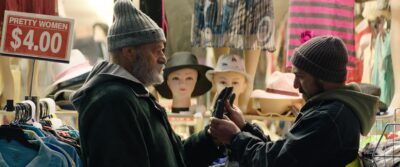
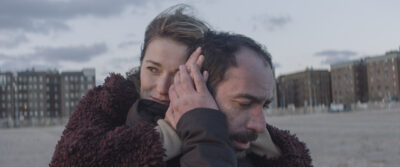
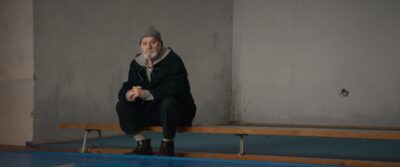
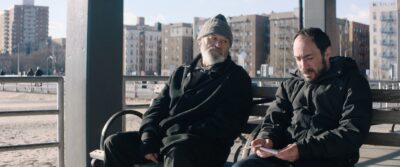
In this portrait of parental sacrifice and the love of a father for his son, former wrestler Kakhi (played by real-life Olympic champion Levan Tediashvili) embarks on a journey from his home in the Republic of Georgia to visit his son Soso (Giorgi Tabidze) in the Russian-speaking neighborhood of Brighton Beach, Brooklyn. There he finds him living in a shabby boarding house populated by a colorful group of fellow Georgian immigrants. Soso is not studying medicine, as Kakhi believed, but is working for a moving company and has accrued a $14,000 gambling debt to a local Russian mob boss. Kakhi sets his mind to helping his hapless son out of his debt, leading to situations as often comic as they are dire. Lensed by Oscar®-nominated cinematographer Phedon Papamichael (The Trial of the Chicago 7, Nebraska), Levan Koguashvili Brighton 4th won three major awards at the Tribeca Film Festival – Best International Film, Best Actor, and Best Screenplay – and is Georgia’s official submission to the 94th Academy Awards®.
Laemmle Theatres is proud to open Brighton 4th on February 11 at our Encino, Pasadena and West L.A. theaters.
“Touchingly absurd and absurdly touching… A slow-burn family drama infused with welcome doses of deadpan dark humor.” ~ Frank Scheck, The Hollywood Reporter

“A tragicomedy that sneaks up on you stealthily before flooring you with an emotional sucker punch in the final reel.” ~ Matt Fagerholm, RogerEbert.com

“The melancholy-infused narrative neatly balances rueful humor with genuine sweetness.” ~ Alissa Simon, Variety

“A near-perfect, semi-comic portrait of the low-rent Georgian enclave in Brighton Beach.” ~ Michael Atkinson, The Village Voice

“A touching and surprising exploration of masculinity that features a stunning central performance from former Olympic wrestling champion Levan Tediashvili.” ~ Kaleem Aftab, Cineuropa

“Koguashvili deftly blends tones in his vividly realised snapshots of Georgian manhood.” ~ Wendy Ide, Screen Daily
“A compelling portrait of the Eastern European community that exists in Brighton, [featuring] a great performance by Tediashvili, in his first film role.” ~ Christian Gallichio, The Playlist
Michael Ordona’s piece in today’s L.A. Times Calendar section — headlined “Movie theater safety during COVID, the sequel: This time it’s personal” —
and the latest newsletter from the National Association of Theatre Owners got Laemmle Theatres President Greg Laemmle thinking about the state of American arthouse exhibition:
“In addition to #CinemaSafe measures, Laemmle Theatres is providing a one-seat lateral buffer even though this is not required. You never have to share an armrest with someone who isn’t part of your party. And in addition to the distancing benefit, the reduced capacity also likely enhances the ability of the ventilation system to clear the air.
“For those who are vaxxed and boosted, there’s arguably a greater risk to one’s health in driving to the theatre than the likelihood of getting sick from an infection acquired while in the theatre (or other “regular” activity). And that’s not me saying that. See journalist David Leonhardt’s quote in the New York Times daily email for January 25, 2022:
“It’s a remarkable disconnect between perception and reality. A majority of the boosted say they are worried about getting sick from Covid. In truth, riding in a car presents more danger to most of them than the virus does.”
“If people want to wait another week or two to let numbers continue to drop, I can’t argue with that. But with Oscar nominations coming on February 8, and absent a new variant, now is the time to show that arthouse audiences still want to support the theatrical experience. With that show of support, distributors will feel confident that movie theatres are back for all audiences and all types of films. Without that show of support, you can expect a future where going to a movie theatre is just for blockbusters like SPIDER-MAN: NO WAY HOME.”
Learn more about Laemmle Theatres’ health and safety measures to combat the pandemic here.


“A batshit farce. See is on a big screen with an audience to bask in their outrage.” ~ Alex Winter, actor-director, Zappa, Bill & Ted Face the Music
“An eyeball-slicing polemic by a bomb-throwing provocateur.” ~ Josh Kupecki, Austin Chronicle
“Amid so many earnest, forgettable COVID-era and COVID-acknowledging movies around the world, here’s one that truly goes for it.” ~ Michael Phillips, Chicago Tribune

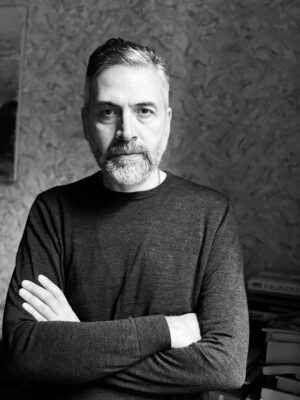
“The film first appeared out of long discussions with friends. On a few occasions we discussed real-life stories from Romania and other countries, of teachers being expelled from schools where they were teaching because of what they were doing in their private lives: live-cam sex chat or posting amateur porn recordings on the internet. The discussions were so heated, it made me think that although the topic seems trivial and shallow, there must be a lot more behind it if reactions to it are so powerful. Then I decided to make a film – so now I have the last word in front of my friends, they cannot come up with something like that.

“The film has three parts which engage each other in poetic ways – understanding “poetic” according to Malraux’s definition: “Without doubt all true poetry is irrational in that it substitutes, for the ‘established’ relation of things, a new system of relations.”
“While the film title is mostly self-explanatory, its subtitle, ‘a sketch for a popular film’, could benefit from an explanation. Malraux once noted that “Delacroix, though affirming the superiority of the finished painting over the sketch, kept many of his sketches, whose quality as works of art he considered equal to that of his best paintings.” The idea struck me as relevant and I decided to apply it in filmmaking and try to see what a film would look like if its form was left open, unfinished, like a sketch. And yes, “popular”, since I believe the film could be easy like a summer breeze and because of its tabloid-like topic. But it is not a real popular film. Only a sketch of a possible one.”

On shooting in COVID times:
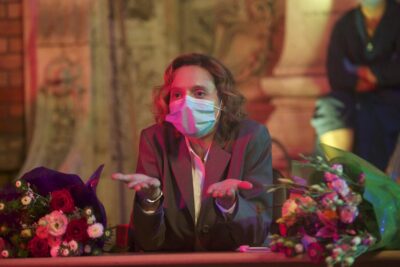
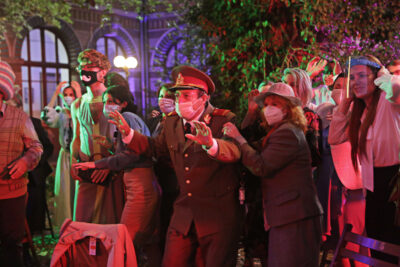
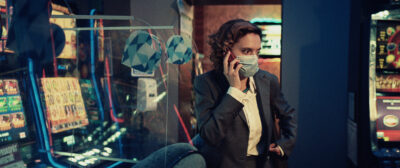
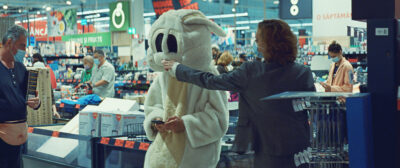
“The first lockdown ended in Romania at the end of May and we were supposed to film in October and November. When we saw that the second wave of Covid-19 was coming (at the beginning of July), me and the producer Ada Solomon had to decide: either we stick to the plan (which meant also applying for extra funding), with the risk of postponing the shooting in case the crisis worsens, or we film sooner with the money we have. We opted for the latter and started to prepare the film. The number of cases was rising, so I had also to decide how to interact with people. I strongly believe that, as a director, you have a certain responsibility towards the cast and crew.

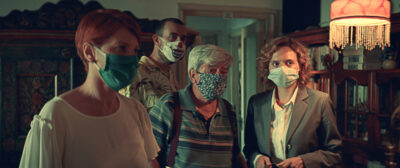
“When I was young, I really admired all the crazy shoots I read about: Way Down East, Aguirre, Apocalypse Now etc. I still admire them, but I am too weak: I try not to risk the life or health of anybody when it comes to shooting. I don’t think any film in the world is worth someone contracting even a common cold, and my bad films – even less. With these in mind, I did all the casting, and all the rehearsals on Zoom and decided to have the crew wearing masks. And also, even the cast. Firstly, because the film was supposed to be contemporary and the masks were part of our daily life and I wanted to capture this moment, to find the anthropological aspect of the mask-wearing. Secondly, because I cared about the health of the people involved. You know, many of them are in the film at my invitation. I was the host and I felt responsible. Most of the people agreed with these safety regulations. Some of them, more vulnerable, agreed to do the film only because I promised them that the rules of social distancing and protection will be severely respected. We all tested for Covid-19 before shooting and two times more.
“If you went down on the street during this time, the signs that remained — posters for concerts, empty restaurants, and so on and so forth — were already signs of a non-existent reality. Cinema has this possibility to capture things, to capture the signs of the time passing, to make a capsule of the moment in many ways.
“In the first shooting day, Ada Solomon, our producer, explained to everyone that wearing the mask is mandatory on set for the whole film, that we must change it every 4 hours (they were provided free by the production), that we have only sandwiches as catering (for obvious reasons). Everybody (literally: everybody) agreed. And most of us respected the rules, although it was exhausting, and wearing a mask in severe heat for 12 hours a day can be horrible. Then, there were some crew or cast members sometimes not respecting the rules, which made our shoot more challenging than it could have been. I am not against people who break the rules, on the contrary, if it involves only their bodies. I am against breaking the rules when you endanger or harm others. The great thing on a film set (or on my sets, anyway) is that everyone has the same rights as everyone else: the same working hours (apart from special situations, like a more time-consuming make-up etc.), the same food, the same accommodation or transport. So, it was quite disappointing to have a few people every day taking off the mask whenever they could. I see it as a lack of respect for their colleagues, a kind of “Fuck you, I don’t care about anyone else, I want to feel good even if I can infect you.” This sometimes made the atmosphere on the set tense, but that’s it. I felt relieved when the shooting ended, and we were all healthy.”
Themes
“What is obscene and how do we define it? We are used to acts which are much more obscene, in a way, than small acts like the one that set off the uproar we see in the film.
“This was my idea — to clash these two types of obscenity, and to see that the one so-called obscenity in the porn video is nothing compared with what is around us, but that we don’t pay attention to.
“The film tells a contemporary story, a small one, a little story. If history and politics are part of the film, that is because the story itself has a deeper meaning if we see it in a historical, societal and political context.
“Obscenity is the theme of this film and the viewers are constantly invited to compare the so- called obscenity of a banal amateur porn video with the obscenity around us and the obscenity we can find in recent history, whose traces are all around. So, the viewers should make this montage operation. Georges Didi Huberman wrote something very important regarding montage and it could apply to our film as well:
“Le montage sera précisément l’une des réponses fondamentales à ce problème de construction de l’historicité. Parce qu’il n’est pas orienté simplement, le montage échappe aux théologies, rend visibles les survivances, les anachronismes, les rencontres de temporalités contradictoires qui affectent chaque objet, chaque événement, chaque personne, chaque geste. Alors, l’historien renonce à raconter ‘une histoire’ mais, ce faisant, il réussit à montrer que l’histoire ne va pas sans toutes les compléxités du temps, toutes les strates de l’archéologie, tous les pointillés du destin.” *
* “Montage will be precisely one of the fundamental responses to this problem of constructing historicity. Because it is not oriented towards simplicity, Montage escapes theologies, and has the power to make visible the legacies, anachronisms, contradictory intersections of temporalities that affect each object, each event, each person, each movement. Thus, the historian renounces telling ‘a story’, but in doing so, succeeds in showing that history cannot be, without all of the complexities of time, all the archaeological strata, all of the perforated fragments of destiny.”
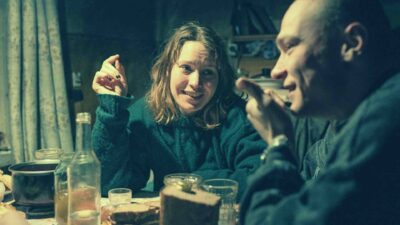
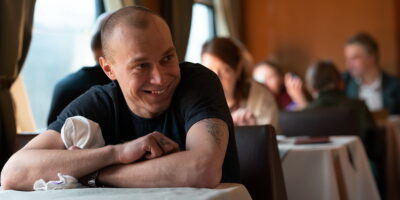
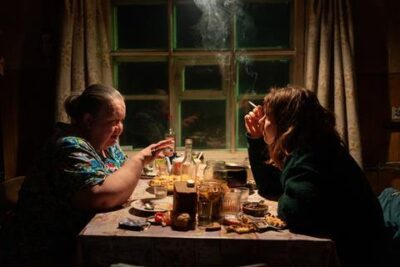
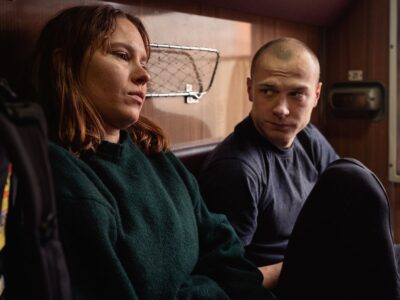
We love a movie set on a train and are excited to open an excellent new addition to the genre, the acclaimed new Finnish movie COMPARTMENT NO. 6. (We may be hosting the filmmaker for a Q&A; check our website for news.) The film follows a young woman who escapes an enigmatic love affair in Moscow by boarding a train to the Arctic port of Murmansk. Forced to share the long ride and a tiny sleeping car with a larger than life Russian miner, the unexpected encounter leads the occupants of compartment no. 6 to face major truths about human connection. In addition to the Royal engagement starting Wednesday, January 26, we’ll expand the film to Encino and Pasadena on February 4. The Academy has short-listed the film for its Best International Feature Oscar and prompted some glowing reviews:
“An engrossingly offbeat rail movie…the two leads…walk us through the human condition with the nuances of a big Russian novel.” ~ Deborah Young, The Film Verdict

“It makes for a take on the love story as fresh, resonant and honest… as you’ll find in a contemporary film.” ~ Robert Abele, L.A. Times

“As bleak as the settings may be, it has a delicious black comic streak and shares the buzz of personal re-awakening without ever feeling obvious or cheap. It turns out to be a beacon of warmth amid a frozen wasteland.” ~ Dave Calhoun, TimeOut

“COMPARTMENT NO. 6 evokes a powerful nostalgia for a type of loneliness we don’t really have any more, and for the type of love that was its cure.” ~ Jessica Kiang, Variety

“Seida Haarla gives a winning, intelligent performance as a naturally very clever person made to feel small and helpless in a strange land. But Yuriy Borisov pops from the first moments you see him.” ~ Mark Asch, Little White Lies

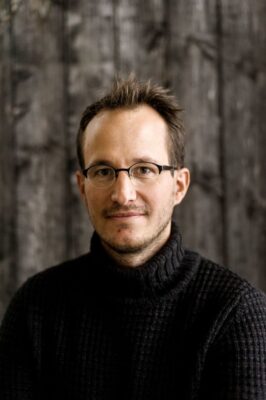
Director/co-screenwriter Juho Kuosmanen penned the following about his film:
“COMPARTMENT NO. 6 is an Arctic road movie, perhaps it could be seen as a clumsy attempt to find harmony and peace of mind in a world of chaos and anxiety. The core of the story lies in the notion of acceptance. It’s a hard duty to accept that you are part of this chaotic world, and that you exist as you do. Our hero, Finnish student Laura, takes a long train ride to visit some ancient petroglyphs. She quotes a man she met: “To know yourself, you need to know your past.” She would like to be an archaeologist who gets fulfilment out of these kind of things, petroglyphs and such. But is she really that person? Or is this just a stolen dream from a person she would like to be?
“On the train she meets Ljoha, an annoying Russian miner who follows her like a shadow. She wanted to know her past, and Ljoha is the embodiment of it. It’s unpleasant and banal, but it is what it is.
“Road movies are often about freedom. In a car you can go where you want, every crossroad is a possibility. But I tend to think that freedom isn’t an endless number of options but rather, the ability to accept your limitations. A train ride is more like destiny. You can’t decide where to go, you just have to take what it gives you.”
The passing of Sidney Poitier, regal, graceful giant of American cinema, rightly sparked a great deal of focus on the powerful pair of Poitier films released in 1967, GUESS WHO’S COMING TO DINNER and IN THE HEAT OF THE NIGHT (which we’ll be screening in October). Greg Laemmle wanted to put in a plug for his personal Poitier favorite, the film for which he won his first Oscar, LILIES OF THE FIELD, which Greg called “a beautiful meditation on what can happen when religion moves us toward a place of love and compassion and away from division.” People everywhere, including world leaders, were moved to pay tribute to Poitier, including Oscar-winning actress-filmmaker Halle Berry. She wrote a terrific remembrance in Variety, which we’ll excerpt and link to:
“I grew up idolizing Sidney Poitier.
“I was around 9 when he flickered into my world on a television replay of GUESS WHO’S COMING TO DINNER. I was a latchkey kid in Cleveland, daughter of a white, single mother and a Black father — whose union their parents had frowned upon. In the film, Sidney and his co-star, Katharine Houghton, play an interracial couple whose parents also struggle with their children’s relationship. There I sat in front of my mom’s old console, mesmerized, as I watched my family’s dynamic play out. For the first time in my childhood, I felt seen. Understood. Validated. The world already knew Sidney, who died last week at 94, as a formidable performer. But I first experienced him as a mirror.
“I watched that film over and over again, through my middle-school years and beyond. By then, my mother had moved our family from a Black enclave in Cleveland’s inner city to the suburbs, where I became one of a few Black students in a sea of Caucasian faces. I was a child who, like my parents’ interracial relationship, never quite fit in. In those years, it was rare to see Blacks in leading roles, much less have our narratives celebrated or even acknowledged. Cicely Tyson and Diana Ross were on the scene, as was the fresh memory of Dorothy Dandridge, the Black actress I idolized as much as I did Sidney. Back then, their mere presence was itself a form of protest. A challenge to the notion of whiteness as humanity’s high-water mark. Still, those images were scarce. As a child born to a white woman and a Black man, I felt alone and misunderstood. GUESS WHO’S COMING TO DINNER, as great art does, was an affirmation that I mattered. Also, it gave others a window into my reality, of what it felt like to navigate the world with both Black and white parents.
“Sidney’s impact on me did not end there. Over the years, I looked to him as a sterling example, as a template of manhood and all that is honorable. I was just 4 when my parents separated, when my father’s alcoholism upended our family. As imperfect as my dad was, as deep of a wedge as his fury drove between us, I loved him, missed him, longed to have him close. In my mind’s eye, and in my father’s absence, Sidney epitomized what a man should be: unflappable and courageous, eloquent and proud, charming and handsome. He even physically resembled my father. I wasn’t yet born in 1964 when Sidney became the first Black man to win an Academy Award for best actor for his role in “Lilies of the Field.” But years later, when I witnessed the moment in a Black History class, I could not look away. Sidney’s grace and poise, the intention with which he spoke, the dignified way he carried himself — all of it resonated with me. Though I hadn’t met him, and did not dream that I ever would, I felt strongly connected to him.”