
What does it mean to look at a landscape not as scenery, but as evidence? In Our Land (also known as Landmarks), acclaimed filmmaker Lucrecia Martel turns her attention to terrain that carries the weight of centuries, where questions of ownership, memory, and identity remain unsettled. Best known for her formally adventurous fiction work, Martel takes au uncharacteristically direct approach here, but this shift in style reveals a different kind of precision, one rooted not in ambiguity but in accumulation. What begins as a seemingly isolated account of violence gradually expands into a meditation on how history persists, often invisibly, through the ground beneath our feet.
Catch Our Land in theaters beginning May 8th at the Laemmle Monica.
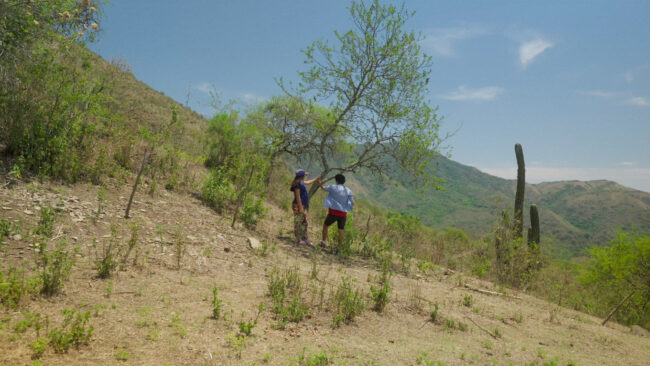
Set in Argentina’s Tucumán Province, the film centers on the 2009 killing of Indigenous community leader Javier Chocobar and the long-delayed trial that followed. Yet Our Land resists the conventions of a straightforward procedural, as rather than guiding the viewer step-by-step through an endless slog of legal arguments, Martel immerses us in a dense, sometimes disorienting flow of testimony, observation, and lived experience. The effect is less about clarifying every detail than about placing us inside a complex system in which power, prejudice, and historical erasure shape not only outcomes, but the very terms of understanding.
What emerges most vividly is the presence of the Chuschagasta community itself. Through a blend of interviews, archival photographs, and extended moments of reflection, the film builds a layered portrait of a people whose connection to the land predates the structures now used to dispossess them. Chocobar’s widow, Antonia, becomes a central voice, articulating both her own personal loss as well as the broader history that too often gets excluded from official narratives. Her testimony, clear-eyed and unsentimental, anchors the film’s emotional core while opening outward onto questions that extend far beyond this particular case.
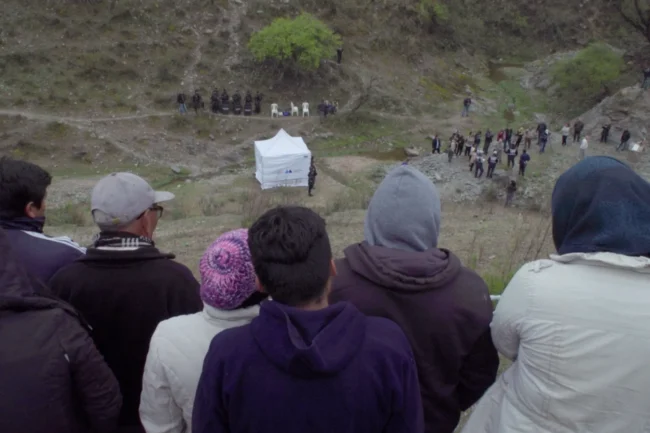
Visually, Martel finds unexpected ways to animate this history. The film’s recurring drone imagery, at once fluid, searching, and occasionally unstable, transforms the landscape into something both expansive and contested. These sweeping aerial views do more than situate the story geographically; they suggest a perspective that hovers between observation and implication, as if the land itself were bearing witness to its own methodical desecration. Even moments of disruption—a sudden collision, an abrupt descent—feel integrated into a larger design, reinforcing the tension between control and unpredictability that runs throughout the film.
If Our Land departs from the formal experimentation of Martel’s earlier work, it does so in service of clarity rather than compromise. The film’s restraint and refusal to simplify nuanced issues becomes a quiet strength, allowing the voices at its center to carry the full weight of the story. In doing so, it transforms what might initially appear as a specific legal case into an enduring record of resistance, a reclamation of narrative, and a reminder that the past is rarely as distant as it seems.
“A slow-burning, increasingly incensed unraveling of a horrific murder case underpinned by colonialist privilege and prejudice.” – Guy Lodge, Variety
“Above all, [Martel] lets the people tell their own story.” – Jonathan Romney, Screen Daily
“A searing and detailed chronicle of murder, bigotry and robbery on a massive scale.” – Jordan Mintzer, The Hollywood Reporter