The Official Blog of Laemmle Theatres.

Laemmle Theatres

Film Reviews & Previews

  • All
  • Theater Buzz
    • Claremont 5
    • Glendale
    • Newhall
    • NoHo 7
    • Royal
    • Santa Monica
    • Town Center 5
  • Q&A’s
  • Locations & Showtimes
    • Claremont
    • Glendale
    • NewHall
    • North Hollywood
    • Royal (West LA)
    • Santa Monica
    • Town Center (Encino)
  • Film Series
    • Anniversary Classics
    • Culture Vulture
    • Worldwide Wednesdays
  • Facebook
  • Instagram
  • TikTok
  • YouTube

Modern Love, Unfiltered: The Bold Charm of ‘Two Women’

April 28, 2026 by Lamb Laemmle Leave a Comment

There’s a mischievous spark at the heart of Two Women, a film that takes a familiar setup—restless relationships, suburban routines—and flips it into something unexpectedly playful, warm, and quietly subversive. Directed with a light but assured touch by Chloé Robichaud, this Montreal-set comedy finds humor and honesty in the messiness of modern love.
Modern Love, Unfiltered: The Bold Charm of 'Two Women'

Catch Two Women in theaters beginning May 1st at the Laemmle Monica and Town Center, followed by a special screening and Q&A hosted by Not Your Daddy’s Films following the 7:10 p.m. show on May 2nd at the Monica.

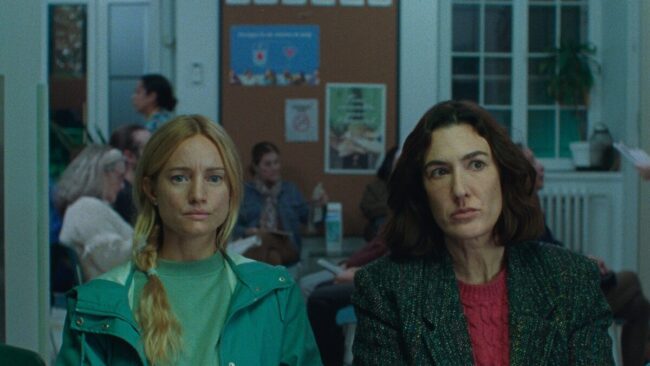
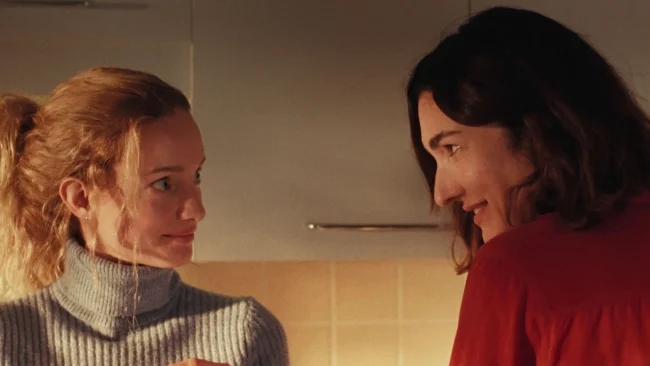
The story centers on two neighbors, Violette and Florence, who form an unspoken bond over their shared dissatisfaction at home. Violette, adjusting to new motherhood, finds herself adrift in a marriage that has lost all sense of intimacy, while Florence, navigating her own partner’s lack of libido, feels similarly disconnected. Their apartments may only be a balcony apart, but emotionally, they’ve both been stranded for some time.

What follows isn’t subtle: both women begin having affairs, embarking on a string of clandestine hookups that quickly spiral into something both comedic and unexpectedly revealing. Yet what might sound like a setup for moralizing instead plays out with a surprising lightness, for rather than framing this infidelity as purely destructive, Two Women treats it as a catalyst—messy, impulsive, and often funny—for the characters to confront what’s missing in their lives and to begin to discover what they actually want.

At the center of it all are two standout performances. Karine Gonthier-Hyndman brings a subtle emotional evolution to Florence, charting her journey from quiet detachment to a more awakened, self-assured presence. Opposite her, Laurence Leboeuf gives Violette a lively, layered warmth, balancing the character’s natural humor with an undercurrent of vulnerability. Together, they create a dynamic that feels genuinely lived-in, less like a traditional movie friendship and more like something instinctive and real.
Modern Love, Unfiltered: The Bold Charm of 'Two Women'

Robichaud’s direction keeps the tone buoyant even as the film brushes up against larger questions about relationships, expectations, and autonomy. There’s a sense that Two Women is less interested in offering definitive answers than in simply letting its characters explore the questions themselves. That openness extends to the film’s humor, which leans into awkwardness and absurdity without ever losing sight of its characters’ humanity.

Ultimately, Two Women is a film about connection: between friends, between partners, and (perhaps most importantly) with oneself. It’s playful without being trivial, thoughtful without being heavy, and anchored by performances that make every twist feel earned. In a landscape where stories about relationships often follow well-worn paths, this one finds its own rhythm—and invites audiences to enjoy the ride.

“[The film’s] reflections on modern relationships are engagingly comical, cynical and ultimately tender. ” – Allan Hunter, Screen Daily

“[Two Women is] unafraid of sex and female pleasure in a way that feels so rare in modern films.” – Jesse Saunders, Movie Jawn

Leave a Comment Filed Under: Featured Films, Monica Film Center, Q&A's, Santa Monica, Town Center 5 Tagged With: Canadian, Chloé Robichaud, comedy, French, Karine Gonthier-Hyndman, Laurence Leboeuf, romance, Two Women

‘Our Land’ and the Weight of History

April 28, 2026 by Lamb Laemmle Leave a Comment

What does it mean to look at a landscape not as scenery, but as evidence? In Our Land (also known as Landmarks), acclaimed filmmaker Lucrecia Martel turns her attention to terrain that carries the weight of centuries, where questions of ownership, memory, and identity remain unsettled. Best known for her formally adventurous fiction work, Martel takes au uncharacteristically direct approach here, but this shift in style reveals a different kind of precision, one rooted not in ambiguity but in accumulation. What begins as a seemingly isolated account of violence gradually expands into a meditation on how history persists, often invisibly, through the ground beneath our feet.

'Our Land' and the Weight of History

Catch Our Land in theaters beginning May 8th at the Laemmle Monica.

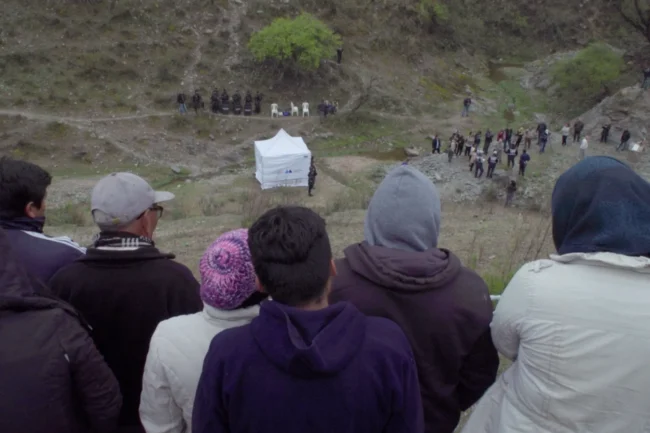
Set in Argentina’s Tucumán Province, the film centers on the 2009 killing of Indigenous community leader Javier Chocobar and the long-delayed trial that followed. Yet Our Land resists the conventions of a straightforward procedural, as rather than guiding the viewer step-by-step through an endless slog of legal arguments, Martel immerses us in a dense, sometimes disorienting flow of testimony, observation, and lived experience. The effect is less about clarifying every detail than about placing us inside a complex system in which power, prejudice, and historical erasure shape not only outcomes, but the very terms of understanding.

What emerges most vividly is the presence of the Chuschagasta community itself. Through a blend of interviews, archival photographs, and extended moments of reflection, the film builds a layered portrait of a people whose connection to the land predates the structures now used to dispossess them. Chocobar’s widow, Antonia, becomes a central voice, articulating both her own personal loss as well as the broader history that too often gets excluded from official narratives. Her testimony, clear-eyed and unsentimental, anchors the film’s emotional core while opening outward onto questions that extend far beyond this particular case.

'Our Land' and the Weight of History

Visually, Martel finds unexpected ways to animate this history. The film’s recurring drone imagery, at once fluid, searching, and occasionally unstable, transforms the landscape into something both expansive and contested. These sweeping aerial views do more than situate the story geographically; they suggest a perspective that hovers between observation and implication, as if the land itself were bearing witness to its own methodical desecration. Even moments of disruption—a sudden collision, an abrupt descent—feel integrated into a larger design, reinforcing the tension between control and unpredictability that runs throughout the film.

If Our Land departs from the formal experimentation of Martel’s earlier work, it does so in service of clarity rather than compromise. The film’s restraint and refusal to simplify nuanced issues becomes a quiet strength, allowing the voices at its center to carry the full weight of the story. In doing so, it transforms what might initially appear as a specific legal case into an enduring record of resistance, a reclamation of narrative, and a reminder that the past is rarely as distant as it seems.

“A slow-burning, increasingly incensed unraveling of a horrific murder case underpinned by colonialist privilege and prejudice.” – Guy Lodge, Variety

“Above all, [Martel] lets the people tell their own story.” – Jonathan Romney, Screen Daily

“A searing and detailed chronicle of murder, bigotry and robbery on a massive scale.” – Jordan Mintzer, The Hollywood Reporter

Leave a Comment Filed Under: Films, Monica Film Center, Santa Monica Tagged With: crime, documentary, Indigenous, Lucrecia Martel, Our Land

All the Right Notes: ‘Two Pianos’ and the Music of Complicated Love

April 21, 2026 by Lamb Laemmle Leave a Comment

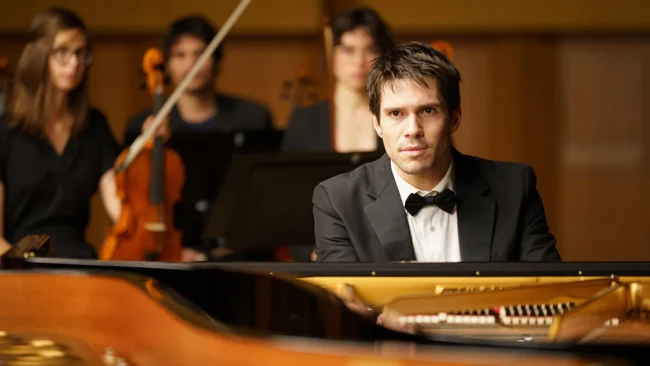
There’s a certain kind of cinematic romance that doesn’t just tug at the heartstrings: It yanks them, bends them, and occasionally snaps them altogether. Two Pianos, a lush and emotionally charged drama from Arnaud Desplechin, belongs squarely in that tradition, treating love, memory, and music with the same heightened intensity as a symphony reaching its crescendo.

All the Right Notes: 'Two Pianos' and the Music of Complicated Love

Catch Two Pianos in theaters beginning May 1st at the Laemmle Royal.

At the film’s center is Mathias, a gifted pianist whose return to his hometown of Lyon sets multiple strands of his life into motion at once. Played with sensitivity and restraint by François Civil, Mathias is a man caught between multiple versions of himself: the rising talent he once was, the underachieving teacher he has become, and the artist he might still be. His reunion with his formidable former mentor Elena—brought to life with imperious precision by Charlotte Rampling—pulls him back toward the stage, even as his personal life threatens to spiral in less controlled directions.

That personal life arrives with a jolt in the form of Claude, an old flame whose sudden reappearance sends the film into a kind of emotional overdrive. Nadia Tereszkiewicz plays her as mercurial and magnetic, someone who can shift from vulnerability to volatility in a heartbeat. What follows between her and Mathias is less a rekindling than a collision, two people circling unresolved feelings with a mixture of longing, regret, and lovestruck impulsivity.

Desplechin leans fully into this heightened register, crafting a story that moves with the unpredictability of memory itself. Chance encounters carry the weight of destiny; small gestures erupt into grand declarations. There are even fleeting touches of the uncanny, as Mathias becomes fixated on a young boy who seems to mirror his own past, adding another layer to the film’s fascination with doubling.

All the Right Notes: 'Two Pianos' and the Music of Complicated Love

Yet for all its dramatic flourishes, Two Pianos remains grounded by its deep connection to music. The performances, both literal and emotional, are inseparable from the rhythms of the score, which pulses through the film with a restless energy. Classical pieces intertwine with an evocative original composition, creating a soundscape that cleverly mirrors the turbulence of the characters’ inner lives.

Visually, the film is just as expressive. Cinematographer Paul Guilhaume captures Lyon in rich, shifting tones, moving from shadowy interiors to crisp autumnal light, as if the city itself were responding to the characters’ emotional journeys. The effect is immersive without being overstated, allowing the story’s intensity to breathe and stretch its versatile narrative limbs.

If Two Pianos feels like it’s playing multiple melodies at once, that’s part of its design. It’s a film about divided selves and second chances, about the pull of the past and the risk of moving forward. And like any memorable piece of music, it lingers—not because it resolves every note, but because it dares to play them at full volume.

“Desplechin draws something liminal from a specific sense of place.” – Sheri Linden, The Hollywood Reporter

“[An] earnestly inflamed tale of art, grief, betrayal and all-consuming amour.” – Guy Lodge, Variety

Leave a Comment Filed Under: Films, Royal Tagged With: Arnaud Desplechin, Charlotte Rampling, François Civil, French, Nadia Tereszkiewicz, romance, Two Pianos

A Life Unfiltered: ‘I Swear’ and the Story of John Davidson

April 21, 2026 by Lamb Laemmle Leave a Comment

There’s a familiar shape to many “inspiring true story” films, but I Swear finds a way to delicately reshape that mold into something more personal, more unpredictable, and ultimately more humane. Based on the life of Tourette syndrome advocate John Davidson, this BAFTA award-winning film traces one man’s journey from confusion and isolation to self-acceptance and public advocacy without ever reducing him to a symbol.

A Life Unfiltered: 'I Swear' and the Story of John Davidson

Catch I Swear in theaters beginning April 24th at the Laemmle Royal, Newhall, and Town Center locations.

What distinguishes I Swear is its commitment to portraying not only what John experiences, but how he experiences it. His Tourette syndrome isn’t treated as a narrative device or a source of easy sentiment, but as a constant, complicated presence. The film allows for laughter, but never at the expense of John’s dignity. Instead, it invites audiences to sit with the uneasy tension between humor and hardship, asking when we laugh, why we laugh, and who gets to decide.

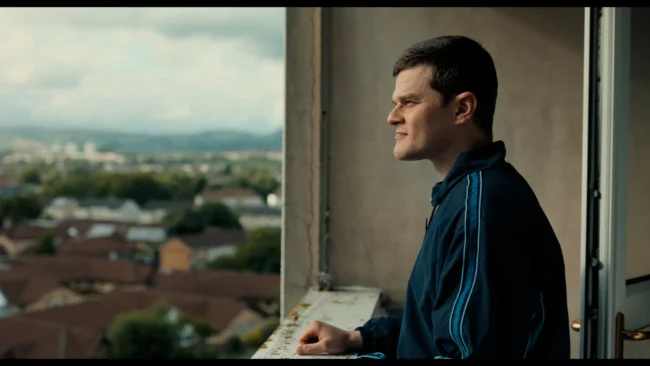
At the film’s center is Robert Aramayo, delivering a performance of remarkable sensitivity and control. He captures both the physical unpredictability of John’s condition and the emotional steadiness that defines him, creating a character who feels fully lived-in rather than performed. It’s a balancing act that could easily tip into caricature, but Aramayo keeps it grounded, ensuring that John’s inner life remains front and center.

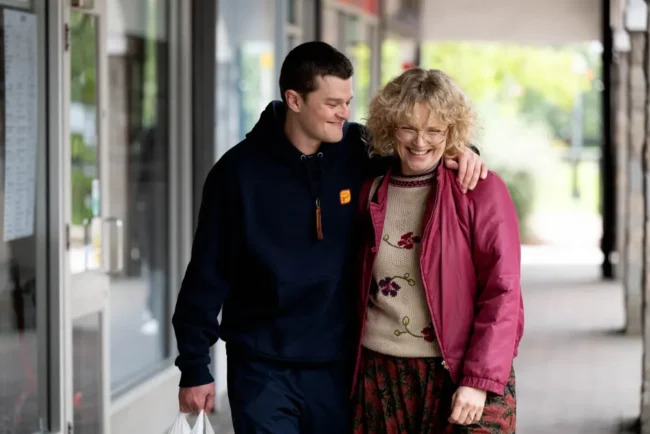
Director Kirk Jones approaches the material with a clear respect for both his subject and the audience. The storytelling is straightforward, but never simplistic. Moments of pain—whether social rejection, misunderstanding, or outright cruelty—are counterbalanced by instances of connection and support. The film is especially attuned to the role that community plays in shaping John’s life, highlighting the people who choose empathy over judgment and, in so doing, help redefine what’s possible.

A Life Unfiltered: 'I Swear' and the Story of John Davidson

In the end, I Swear is less about overcoming than it is about being seen. It’s about carving out space in a world that isn’t always ready to make room, and about finding strength not in silence, but in expression, however unpredictable that expression may be.

“The film wrestles enthusiastically and mostly successfully with the potential pitfalls of making a funny yet respectful project about a condition that sometimes lends itself to laughter, even as it wreaks havoc with Davidson’s life in serious ways.” – Catherine Bray, Variety

“Its mix of compassion and clarity allows it to avoid the easy sentimentality of similar tales.” – Ross McIndoe, Slant Magazine

“Aramayo’s sensitive portrayal of the man and Jones’ unflinching dedication to showing some of Davidson’s most painful moments… add up to an insightful biopic that chronicles a very worthy subject.” – Kate Erbland, IndieWire

Leave a Comment Filed Under: Awards, Films, Newhall, Royal, Town Center 5 Tagged With: biopic, drama, I Swear, Kirk Jones, Robert Aramayo, Tourette syndrome

Laemmle Theatres Reacquires the NoHo 7, Securing the Future of Independent Film in North Hollywood

April 15, 2026 by Lamb Laemmle Leave a Comment

We at Laemmle Theatres are proud to announce that we have reacquired the Laemmle NoHo 7, restoring the theater to family ownership and reaffirming our long-standing commitment to showcasing independent, foreign, and arthouse cinema throughout Los Angeles.

Laemmle Theatres Reacquires the NoHo 7, Securing the Future of Independent Film in North Hollywood
“North Hollywood” by Jeremy Thompson on Flickr

Though we were fortunate enough to continue operating the NoHo 7 throughout its sale and subsequent ownership transition (something many moviegoers may not have even realized), this moment marks our renewed investment in a theater that has remained an active and cherished part of our local circuit.

While navigating the unprecedented challenges of the COVID-19 pandemic, when uncertainty loomed over the exhibition industry as a whole, we made the difficult decision to sell the property. At the time, with theaters shuttered and recovery far from guaranteed, the move felt necessary to stabilize operations and protect the company’s future.

“We were under immense pressure to reduce debt and preserve equity… There was no relief in sight,” said Greg Laemmle, Owner and President of Laemmle Theatres, while reflecting on the original sale. “As much as I hated to let [the NoHo 7] go, at the time it felt like the only way to keep the business afloat. Thankfully, it was a risk that seems to have paid off.”

In the years since, the site’s new owners explored various redevelopment plans, even securing approvals for a mixed-use residential and retail project. Meanwhile, we continued operating the theater on a short-term basis, often without much clarity beyond a couple of months at a time. “It was a precarious stretch for sure,” admitted general manager Guy Valdez. “I’m definitely looking forward to not having to wonder whether someone might step in and pull the plug on us.”

Late last year, following the sale of our Claremont location, we began exploring opportunities to reinvest in a new property. Around that same time, discussions with the NoHo 7’s ownership resumed. While it wasn’t immediately clear that a deal could be reached, momentum built quickly until by early March 2026 we had finalized an agreement to bring the theater back into the Laemmle family—or ‘faemmle’, as we like to say.

“This reacquisition represents more than a real estate transaction,” Laemmle went on. “It’s a reaffirmation of purpose. With ownership comes stability, and with stability comes the ability to plan ahead: to book films with confidence, to host festivals and special screenings, and to deepen our ties to the filmmaking community and audiences alike.”

“Most immediately, it is great knowing that we are back in control, and that we can commit to films, screenings, and festivals beyond just a 60-day window,” added Senior Vice President Jay Reisbaum. “Our commitment to NoHo is rooted in a long-standing belief in the neighborhood itself. The theater’s proximity to the North Hollywood Metro station makes it one of the most accessible venues in our circuit, and we’ve long seen the neighborhood’s lofty potential as a cultural hub. So while the district is still finding its footing post-pandemic, we remain optimistic about its future and are excited to continue growing alongside it.”

For the real-life family behind this long-enduring family business, this moment also carries a deeper emotional significance in the wake of patriarch Robert Laemmle’s passing in January 2025. A lifelong champion of independent and international cinema and predecessor to his son Greg at the company’s helm, Bob helped shape Laemmle Theatres into one of the most respected exhibition platforms of its kind. Reacquiring the NoHo 7 is, in many ways, a tribute to that legacy, a commitment to ensuring that filmmakers have a place to share their work, and audiences a place to discover it.

Looking ahead, our focus is simple. There are no plans to redevelop the site or change its purpose. The NoHo 7 will remain what it has always aimed to be: a home for movies that might not otherwise have one. With your support, we believe the NoHo 7 can continue to be a vibrant destination for independent film in Los Angeles and a cornerstone of the NoHo Arts District’s ongoing renaissance.

“We will be showing movies,” Laemmle put it best. “That’s what Laemmles do.”

Leave a Comment Filed Under: Moviegoing, News, NoHo 7 Tagged With: Announcements, NoHo

No Silence, No Sponsors: Amy Goodman and ‘Steal This Story, Please!’

April 15, 2026 by Lamb Laemmle Leave a Comment

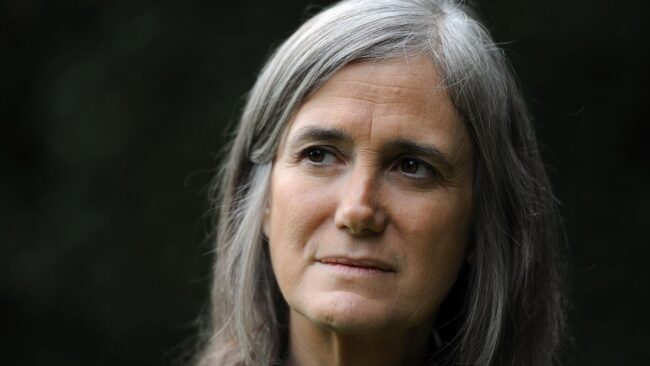
At a moment when the boundaries of journalism feel increasingly unstable, Steal This Story, Please! makes a compelling case for returning to the fundamentals. The documentary follows Amy Goodman across decades of reporting, but it resists the familiar arc of a career retrospective. Instead, it focuses on the daily discipline of the work itself: the persistence required to ask difficult questions, to verify what others would rather obscure, and to keep attention fixed where it is most needed. Directors Carl Deal and Tia Lessin frame their subject not as an outlier, but as a practitioner, someone committed to a method in a media landscape that often rewards speed over substance.

Amy Goodman in Steal This Story, Please!

Tune into Inside the Arthouse to catch Amy Goodman and co-directors Carl Deal and Tia Lessin discuss their latest work with co-hosts Greg Laemmle and Raphael Sbarge, or come see it live beginning April 15-17th at the Laemmle NoHo, Royal, and Glendale theaters, kicked off by a series of post-viewing Q&As.

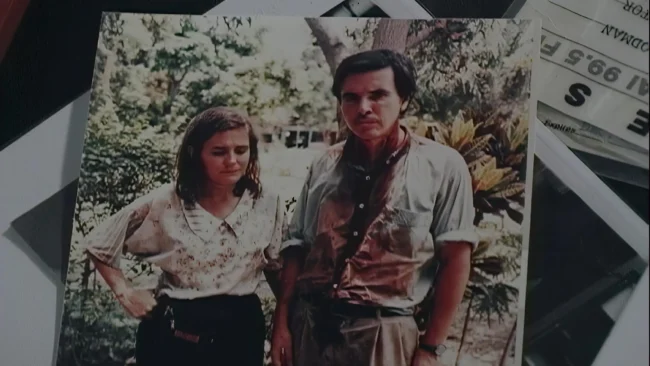
What distinguishes the film is its emphasis on process. Rather than assembling a greatest-hits reel, it lingers on how reporting actually gets made: the calls, the research, the careful construction of segments piece by piece. This attention to labor grounds the film, turning “independent media” from an abstract label into something concrete and observable. Through archival footage and present-day scenes, the documentary collapses time, suggesting that the pressures journalists face—political, corporate, cultural, and more—are less cyclical than continuous.

The portrait that emerges is neither hagiographic nor detached. Goodman’s on-air clarity is paired with glimpses of the toll such work can take: the physical risks of field reporting, the emotional weight of bearing witness, the constant recalibration required to maintain focus in a shifting news environment. Yet the film also makes space for the little moments of humor, collaboration, and shared purpose that sustain such work over time. The newsroom is not presented as a platform for a single voice, but as a collective effort shaped by many hands.

Amy Goodman in Steal This Story, Please!

Running beneath it all is a larger argument about what journalism is for. The film challenges the notion that neutrality requires distance, instead suggesting that rigor and empathy can (and perhaps must) coexist. By centering those most affected by policy and power, Goodman’s approach offers a different kind of orientation, one that prioritizes context over spectacle and accountability over access.

If the title carries a note of provocation, the film earns it. Steal This Story, Please! is less concerned with ownership than with circulation, an insistence that information only matters if it continues to move, to be tested, and (ideally) to ripple outward. In that sense, the documentary functions as both portrait and invitation: a reminder that the work of journalism is ongoing, collective, and, at its best, indispensable.

“A profile in courage, presenting Goodman as an unrelenting voice of the voiceless who is never afraid to get arrested or make an enemy in her pursuit of telling her truth.” – Christian Zilko, IndieWire

“Steal This Story, Please!… builds a convincing case for the ability of dogged, courageous reporting to mobilise pressure against injustice and effect change.” – Lee Marshall, Screen Daily

Leave a Comment Filed Under: Filmmaker in Person, Glendale, Greg Laemmle, Inside the Arthouse, NoHo 7, Royal Tagged With: Amy Goodman, Carl Deal, documentary, Greg Laemmle, Inside the Arthouse, political, Raphael Sbarge, Steal this Story Please, Tia Lessin

The Art of Taking: Soderbergh’s ‘The Christophers’

April 7, 2026 by Lamb Laemmle Leave a Comment

If there’s a quiet thrill in encountering a late-period film from the great Steven Soderbergh, The Christophers delivers it almost immediately. Set largely within the cluttered confines of a once-great artist’s London home, the film trades spectacle for something knottier and more intimate: a duel of personalities, ideas, and unresolved histories.

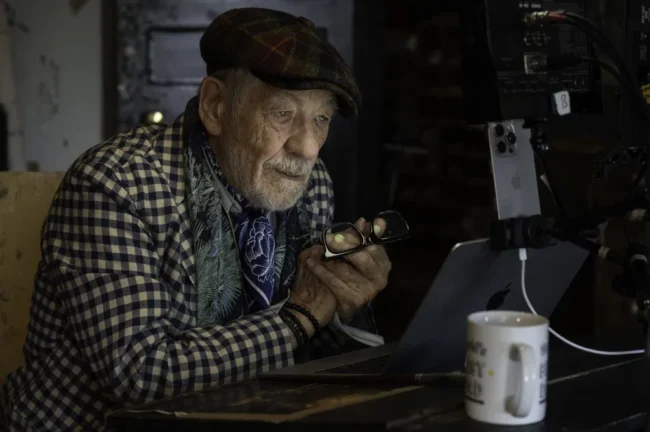
Ian McKellen in The Christophers

Catch The Christophers in theaters beginning April 17th at the Laemmle Monica, NoHo, Town Center, and Glendale locations.

At its center is Julian Sklar, played with ferocious precision by Ian McKellen. A celebrated painter turned cultural relic, Julian has retreated into a self-made mausoleum of past successes and private grudges. McKellen inhabits him as both tyrant and ruin: acerbic, theatrical, and faintly ridiculous, yet never less than human. His performance resists easy sentiment; whatever sympathy he manages to arouse is accomplished in spite of Julian’s relentless abrasiveness, not because of any softening.

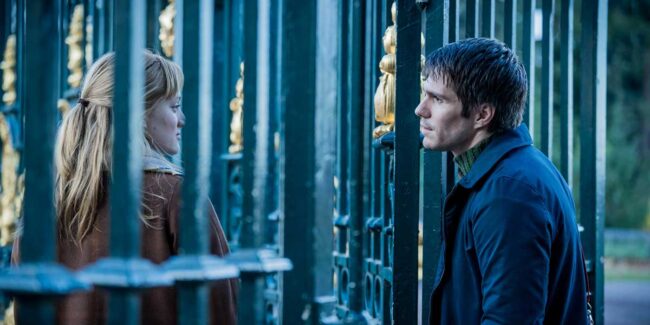
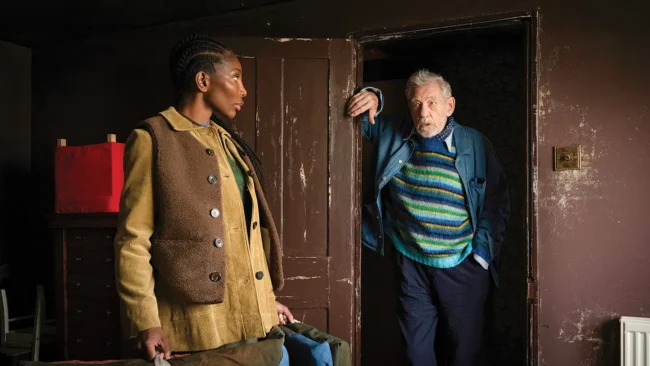
The premise initially suggests a familiar caper. Julian’s estranged children, eager to secure their inheritance, recruit Lori Butler, an art restorer who moonlights in forgery, to infiltrate his home and complete a set of unfinished paintings that could be worth a fortune. But the film quickly pivots away from such familiar Soderberghian mechanics and toward something more elusive as what unfolds between Julian and Lori (played by an electric Michaela Coel) is less a traditional con than a prolonged negotiation of identity and authorship.

Soderbergh, working with a script by Ed Solomon, keeps the narrative in constant motion—not through action, but through nonstop reversals of power. Conversations shift, allegiances blur, and what begins as manipulation gradually takes on the contours of recognition. Lori is not merely an intruder in Julian’s world; she is, in certain respects, his reflection. Both are artists stalled in different ways, each confronting the uneasy distance between creation and self-worth.

Formally, the film is deceptively loose. The camera drifts, lingers, and reacts, giving the impression of spontaneity while maintaining a careful sense of rhythm. The confined setting only heightens the sense of volatility, as if any exchange might tip into revelation or collapse. It’s a reminder of how much Soderbergh can do with minimal space when the material gives him something to push off against.

Ian McKellen and Michaela Cole in The Christophers

What ultimately distinguishes The Christophers is its preoccupation with legacy—not as a settled inheritance, but as something negotiated in real time. Who owns a work of art? Who gets to define its meaning? And what do we really leave behind: objects, or impressions? These questions animate every scene, giving the film a momentum that extends far beyond its deceptively contained setting. Anchored by two exceptional performances and a script that relishes every turn of the knife, The Christophers is a sharp, engaging showcase for Soderbergh at his most quietly confident.

“The Christophers feels as rich and expansive as anything Soderbergh has ever done.” – Seth Katz, Slant Magazine

“[The Christophers] bats about ideas pertaining to art, commerce, ownership and legacy with dexterous aplomb and boasts two equally superb leads who make the material crackle.” – David Rooney, The Hollywood Reporter

Leave a Comment Filed Under: Featured Films, Films, Glendale, NoHo 7, Santa Monica, Town Center 5 Tagged With: art, drama, Ian McKellen, Michaela Cole, Steven Soderbergh, The Christophers

François Ozon’s Cool, Unsettling ‘The Stranger’

April 7, 2026 by Lamb Laemmle Leave a Comment

What does it mean to bring The Stranger—a novel defined by absence, detachment, and interiority—into a medium built on appearances? In his new adaptation of Albert Camus’s 1942 classic, François Ozon approaches that challenge not by radically reimagining the text, but by making its silences visible. The result is a film that feels at once faithful and interpretive, attuned to both the enduring power of Camus’s text and the historical context it left largely unspoken.

François Ozon’s Cool, Unsettling 'The Stranger'

Tune into Inside the Arthouse to hear Ozon discuss his latest film with co-hosts Greg Laemmle and Raphael Sbarge, or catch it in theaters beginning April 10th at the Laemmle Royal, Glendale, and Town Center theaters.

Set in 1930s Algiers under French colonial rule, the film follows Meursault (Benjamin Voisin), a clerk whose emotional detachment shapes every aspect of his life. He receives news of his mother’s death with little visible reaction, carrying out the rituals of mourning with a kind of mechanical precision. In Ozon’s retelling, it’s as if Meursault has only just arrived in the world at that moment: unformed, unmoored, and curiously untouched by the social expectations that surround him.

That sense of dislocation extends into his relationships. He begins an affair with Marie (Rebecca Marder), responds to her questions with indifference, and drifts into the orbit of his volatile neighbor Raymond (Pierre Lottin). Meursault rarely initiates; he responds. Yet this passivity proves deceptive as he repeatedly declines to perform basic gestures that would mark him as a passable member of society while simultaneously slipping into patterns of behavior that align him with its ugliest assumptions.

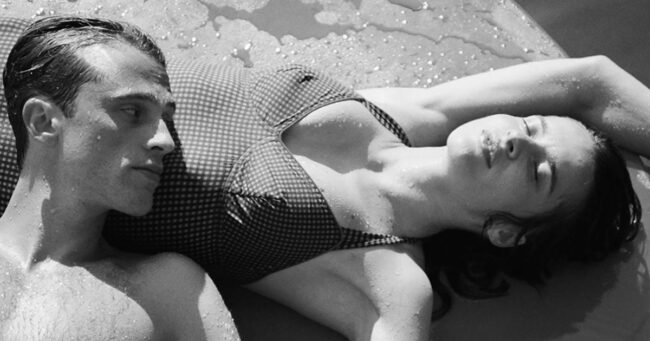
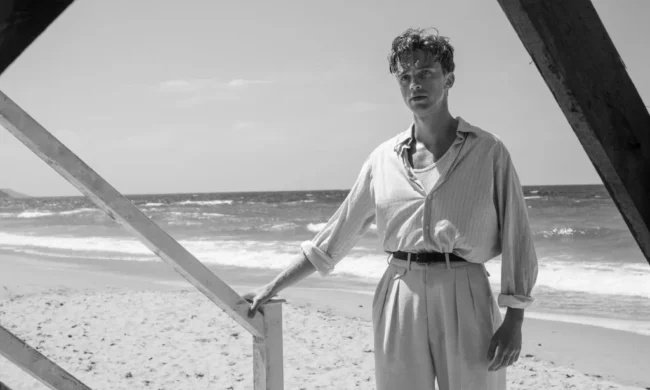
Ozon captures this tension with remarkable precision. Shot in crisp black-and-white, the film emphasizes texture and physical sensation: sunlight on skin, the rhythm of breath, the weight of heat pressing down on bodies. These tactile details root us in Meursault’s immediate experience even as his inner life remains opaque. Voisin’s performance is key here: controlled, watchful, and withholding, he becomes a figure defined as much by what he doesn’t express as by what he does.

François Ozon’s Cool, Unsettling 'The Stranger'

At the same time, Ozon subtly expands the frame of Camus’ story. Where the novel treats its colonial setting as a given, the film foregrounds it, allowing the social and political tensions of French Algeria to register more clearly. The people who exist at the margins of Meursault’s awareness take on a greater presence, not through overt revision but through subtle shifts in emphasis. The result is a quiet but meaningful rebalancing, one that reframes Meursault’s indifference as something shaped not only by temperament but by environment.

As perhaps the quintessential work of existentialist fiction, The Stranger endures not because it offers answers, but because it resists them. Ozon’s adaptation honors that resistance, even as it invites us to look more closely at the world surrounding it, and at what it means to move through that world without fully engaging with it.

“The Stranger, it turns out, is a story for our times, which makes this lovely new version doubly welcome.” – Bilge Ebiri, Vulture

“Ozon’s The Stranger keeps the spirit of its source material alive as a timeless warning in a modern world of stark polarization, ongoing colonialism, and plenty of Meursaults ignoring the suffering of others.” – Monica Castillo, The AV Club

Leave a Comment Filed Under: Featured Films, Films, Glendale, Greg Laemmle, Inside the Arthouse, Royal, Town Center 5 Tagged With: Albert Camus, François Ozon, French, Greg Laemmle, Inside the Arthouse, International Cinema, literary adaptation, Raphael Sbarge, The Stranger

  • 1
  • 2
  • 3
  • …
  • 281
  • Next Page »

Search

Instagram

☘️ WEAR GREEN ☘️ $AVE GREEN ☘️ $2 OFF your concess ☘️ WEAR GREEN ☘️ $AVE GREEN ☘️ $2 OFF your concessions order!

⭐ St. Patrick's Day! Tuesday March 17th Only!

-Movie ticket purchase not required
-Like and show this post!
🎟️ laemmle.com/discounts
🚀 PROJECT HAIL MARY, AN EPIC PRIZE PACK GIVEAWAY! 🚀 PROJECT HAIL MARY, AN EPIC PRIZE PACK GIVEAWAY!
👉 ENTER in BIO!

#ProjectHailMary — starring Academy Award® nominee Ryan Gosling and directed by Academy Award®-winning filmmakers Phil Lord & Christopher Miller. Based on Andy Weir's New York Times best-selling novel.

🎟️ GET TICKETS in BIO!
For the 21st consecutive year, Laemmle will be scr For the 21st consecutive year, Laemmle will be screening the Oscar-Nominated Short Films, opening on Feb. 20th. Showcasing the best short films from around the world, the 2026 Oscar®-Nominated Shorts includes three feature-length programs, one for each Academy Award® Short Film category: Animated, Documentary and Live Action.

ANIMATED SHORTS: (Estimated Running Time: 83 mins)
The Three Sisters
Forevergreen
The Girl Who Cried Pearls
Butterfly
Retirement Plan
 
LIVE ACTION SHORTS (Estimated Running Time: 119 minutes)
The Singers
A Friend Of Dorothy
Butcher’s Stain
Two People Exchanging Saliva
Jane Austin’s Period Drama

DOCUMENTARY SHORTS (Estimated Running Time: 158 minutes)
Perfectly A Strangeness
The Devil Is Busy
Armed Only With A Camera: The Life And Death Of Brent Renaud
All The  Empty Rooms
Children No More: “Were And Are Gone”

Please note that some films may not be appropriate for audiences under the age of 14 due to gun violence, shootings, language and animated nudity.
❤️ Laemmle be your Valentine ❤️ and enjoy a FREE S ❤️ Laemmle be your Valentine ❤️ and enjoy a FREE Sweet Treat 🍭 on Valentine's Day! Like this post and show at the concessions stand for One Free Candy w/purchase of any combo! (2/14 only)
For Tickets and Locations 🎟️ laemmle.com
Follow on Instagram


Laemmle Theatres

Laemmle Theatres
Tickets: http://laemmle.com/film/artfully-united | Subscribe: http://bit.ly/3b8JTym | ARTFULLY UNITED is a celebration of the power of positivity and a reminder that hope can sometimes grow in the most unlikely of places. As artist Mike Norice creates a series of inspirational murals in under-served neighborhoods in and around Los Angeles, the Artfully United Tour transforms from a simple idea on a wall to a community of artists and activists coming together to heal and uplift a city.

Tickets: http://laemmle.com/film/artfully-united

RELEASE DATE: 10/17/2025
Director: Dave Benner
Cast: Mike Norice

-----
ABOUT LAEMMLE: Since 1938, Laemmle [Theatres] has been showing the finest independent, arthouse, and international films.

Subscribe to Laemmle's E-NEWSLETTER: http://bit.ly/3y1YSTM
Visit Laemmle.com: http://laemmle.com
Like LAEMMLE on FACEBOOK: http://bit.ly/3Qspq7Z
Follow LAEMMLE on TWITTER: http://bit.ly/3O6adYv
Follow LAEMMLE on INSTAGRAM: http://bit.ly/3y2j1cp
Tickets: http://laemmle.com/film/brides | Subscribe: http://bit.ly/3b8JTym | Nadia Fall's compelling debut feature offers a powerful and empathetic look into the lives of two alienated teenage girls, Doe and Muna, who leave the U.K. for Syria in search of purpose and belonging. By humanizing its protagonists and exploring the complex interplay of vulnerability, societal pressures, and digital manipulation, BRIDES challenges simplistic explanations of radicalization.

Tickets: http://laemmle.com/film/brides

RELEASE DATE: 9/24/2025
Director: Nadia Fall

-----
ABOUT LAEMMLE: Since 1938, Laemmle [Theatres] has been showing the finest independent, arthouse, and international films.

Subscribe to Laemmle's E-NEWSLETTER: http://bit.ly/3y1YSTM
Visit Laemmle.com: http://laemmle.com
Like LAEMMLE on FACEBOOK: http://bit.ly/3Qspq7Z
Follow LAEMMLE on TWITTER: http://bit.ly/3O6adYv
Follow LAEMMLE on INSTAGRAM: http://bit.ly/3y2j1cp
Tickets: http://laemmle.com/film/writing-hawa | Subscribe: http://bit.ly/3b8JTym | Afghan documentary maker Najiba Noori offers not only a loving and intimate portrait of her mother Hawa, but also shows in detail how the arduous improvement of the position of women is undone by geopolitical violence. The film follows the fortunes of Noori’s family, who belong to the Hazaras, an ethnic group that has suffered greatly from discrimination and persecution.

Tickets: http://laemmle.com/film/writing-hawa

RELEASE DATE: 10/8/2025

-----
ABOUT LAEMMLE: Since 1938, Laemmle [Theatres] has been showing the finest independent, arthouse, and international films.

Subscribe to Laemmle's E-NEWSLETTER: http://bit.ly/3y1YSTM
Visit Laemmle.com: http://laemmle.com
Like LAEMMLE on FACEBOOK: http://bit.ly/3Qspq7Z
Follow LAEMMLE on TWITTER: http://bit.ly/3O6adYv
Follow LAEMMLE on INSTAGRAM: http://bit.ly/3y2j1cp
Subscribe

Recent Posts

  • Modern Love, Unfiltered: The Bold Charm of ‘Two Women’
  • ‘Our Land’ and the Weight of History
  • All the Right Notes: ‘Two Pianos’ and the Music of Complicated Love

Archive

Featured Posts

An “embrace of what makes us unknowable yet worthy of forgiveness,” A LITTLE PRAYER opens Friday at the Claremont, Newhall, Royal and Town Center.

Leaving Laemmle: A Goodbye from Jordan