The Official Blog of Laemmle Theatres.

Laemmle Theatres

Film Reviews & Previews

  • All
  • Theater Buzz
    • Claremont 5
    • Glendale
    • Newhall
    • NoHo 7
    • Royal
    • Santa Monica
    • Town Center 5
  • Q&A’s
  • Locations & Showtimes
    • Claremont
    • Glendale
    • NewHall
    • North Hollywood
    • Royal (West LA)
    • Santa Monica
    • Town Center (Encino)
  • Film Series
    • Anniversary Classics
    • Culture Vulture
    • Worldwide Wednesdays
  • Facebook
  • Instagram
  • TikTok
  • YouTube

You are here: Home / Archives for International Cinema

François Ozon’s Cool, Unsettling ‘The Stranger’

April 7, 2026 by Lamb Laemmle Leave a Comment

What does it mean to bring The Stranger—a novel defined by absence, detachment, and interiority—into a medium built on appearances? In his new adaptation of Albert Camus’s 1942 classic, François Ozon approaches that challenge not by radically reimagining the text, but by making its silences visible. The result is a film that feels at once faithful and interpretive, attuned to both the enduring power of Camus’s text and the historical context it left largely unspoken.

François Ozon’s Cool, Unsettling 'The Stranger'

Tune into Inside the Arthouse to hear Ozon discuss his latest film with co-hosts Greg Laemmle and Raphael Sbarge, or catch it in theaters beginning April 10th at the Laemmle Royal, Glendale, and Town Center theaters.

Set in 1930s Algiers under French colonial rule, the film follows Meursault (Benjamin Voisin), a clerk whose emotional detachment shapes every aspect of his life. He receives news of his mother’s death with little visible reaction, carrying out the rituals of mourning with a kind of mechanical precision. In Ozon’s retelling, it’s as if Meursault has only just arrived in the world at that moment: unformed, unmoored, and curiously untouched by the social expectations that surround him.

That sense of dislocation extends into his relationships. He begins an affair with Marie (Rebecca Marder), responds to her questions with indifference, and drifts into the orbit of his volatile neighbor Raymond (Pierre Lottin). Meursault rarely initiates; he responds. Yet this passivity proves deceptive as he repeatedly declines to perform basic gestures that would mark him as a passable member of society while simultaneously slipping into patterns of behavior that align him with its ugliest assumptions.

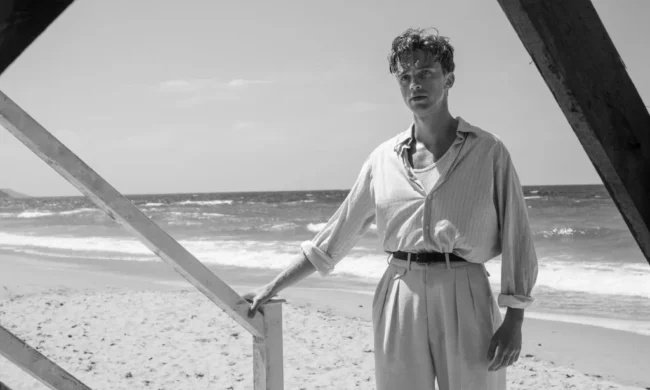
Ozon captures this tension with remarkable precision. Shot in crisp black-and-white, the film emphasizes texture and physical sensation: sunlight on skin, the rhythm of breath, the weight of heat pressing down on bodies. These tactile details root us in Meursault’s immediate experience even as his inner life remains opaque. Voisin’s performance is key here: controlled, watchful, and withholding, he becomes a figure defined as much by what he doesn’t express as by what he does.
François Ozon’s Cool, Unsettling 'The Stranger'

At the same time, Ozon subtly expands the frame of Camus’ story. Where the novel treats its colonial setting as a given, the film foregrounds it, allowing the social and political tensions of French Algeria to register more clearly. The people who exist at the margins of Meursault’s awareness take on a greater presence, not through overt revision but through subtle shifts in emphasis. The result is a quiet but meaningful rebalancing, one that reframes Meursault’s indifference as something shaped not only by temperament but by environment.

As perhaps the quintessential work of existentialist fiction, The Stranger endures not because it offers answers, but because it resists them. Ozon’s adaptation honors that resistance, even as it invites us to look more closely at the world surrounding it, and at what it means to move through that world without fully engaging with it.

“The Stranger, it turns out, is a story for our times, which makes this lovely new version doubly welcome.” – Bilge Ebiri, Vulture

“Ozon’s The Stranger keeps the spirit of its source material alive as a timeless warning in a modern world of stark polarization, ongoing colonialism, and plenty of Meursaults ignoring the suffering of others.” – Monica Castillo, The AV Club

Leave a Comment Filed Under: Featured Films, Films, Glendale, Greg Laemmle, Inside the Arthouse, Royal, Town Center 5 Tagged With: Albert Camus, François Ozon, French, Greg Laemmle, Inside the Arthouse, International Cinema, literary adaptation, Raphael Sbarge, The Stranger

Law as Labyrinth: Loznitsa’s ‘Two Prosecutors’

March 25, 2026 by Lamb Laemmle Leave a Comment

Sergei Loznitsa’s Two Prosecutors is less a historical drama than a slow descent into a meticulously ordered nightmare. Set in 1937 at the height of Stalin’s Great Purge, the film follows a young, newly promoted prosecutor, Kornyev (Aleksandr Kuznetsov), whose belief in the integrity of the Soviet legal system has not yet been eroded by experience. So when a blood-written letter alleging systemic torture and fabricated charges from a political prisoner crosses his desk, Kornyev does something both admirable and, in this world, dangerously naïve: he takes it seriously.

two prosecutors

Catch filmmaker Sergei Loznitsa for a series of live Q&As regarding his latest work following the 7 p.m. showing at the Laemmle Glendale on March 24th or the Laemmle Royal on March 26-27th.

Kornyev’s journey begins in Bryansk, where Loznitsa immediately establishes the film’s governing logic: obstruction not through force, but through delay. Doors remain closed, officials are perpetually “unavailable,” and requests are met with polite deflection. Kornyev merely waits, wielding his patience as a bureaucratic weapon. When he finally gains access to the prisoner, Stepnyak (Aleksandr Filippenko), the encounter is shocking not only for the man’s physical deterioration but for the clarity of his accusations. A former legal mind himself, Stepnyak describes a system that has turned inward, devouring its own architects in order to sustain the illusion of order. Convinced this must be an isolated case of local corruption rather than a structural reality, Kornyev travels to Moscow to bring the case to higher authorities, placing his faith in the idea that somewhere, at the top, justice still exists.

Law as Labyrinth: Loznitsa’s 'Two Prosecutors'

Loznitsa, whose background in documentary filmmaking informs his rigorously controlled style, stages much of Two Prosecutors in long, static takes that deny the audience conventional emotional cues. The camera rarely moves; instead, dread accumulates within the frame. Offices, corridors, and waiting rooms become indistinguishable from prison cells, suggesting that confinement is not a matter of walls but of systems. Even moments of apparent absurdity—a talkative stranger on a train, an encounter with a man too frightened to move—carry a disquieting sense of design, as though every interaction is part of an invisible web closing around Kornyev.

Though rooted in Stalinist history and adapted from a suppressed work by dissident writer and gulag survivor Georgy Demidov, Two Prosecutors resonates far beyond its period setting. Loznitsa is not simply reconstructing the past, but mapping the anatomy of authoritarian logic, where procedure replaces morality and complicity is cultivated through cynicism and inertia.

By the time Kornyev begins to understand the true nature of the system he has appealed to, the film has already made its devastating point. This is not a story about whether justice will prevail, but about how long one can believe in it once the evidence proves otherwise.

“A very disturbing parable of the insidious micro-processes of tyranny.” – Peter Bradshaw, The Guardian

“[A] compelling, meticulous, mordantly relevant historical drama.” – Jessica Kiang, Variety

Leave a Comment Filed Under: Filmmaker in Person, Glendale, Q&A's, Royal Tagged With: Aleksandr Kuznetsov, drama, historical, International Cinema, Russian, Sergei Loznitsa, Two Prosecutors

Running on Empty: Compassion and Crisis in ‘Late Shift’

March 10, 2026 by Lamb Laemmle Leave a Comment

When Late Shift premiered in 2025, it quickly established itself as a gripping portrait of life inside an overburdened healthcare system. Now returning to theaters for an expanded run, Petra Volpe’s propulsive hospital drama offers audiences another chance to experience one of the year’s most quietly intense character studies.

Running on Empty: Compassion and Crisis in 'Late Shift'

Catch Late Shift beginning March 20th at the Laemmle Royal, Glendale, and Town Center theaters.

At the center of the film is Leonie Benesch, an actor who has developed a reputation for portraying capable professionals under extreme duress. After her acclaimed performance in The Teachers’ Lounge—which earned an Oscar nomination for Best International Feature—and memorable roles in September 5 and The Crown, Benesch once again plays a woman trying to maintain her composure in an environment that threatens to overwhelm her.

In Late Shift, she is Floria, a single mother and dedicated nurse beginning a long night in the surgical ward of a Zurich hospital. The film unfolds almost entirely over the course of one exhausting shift. From the moment Floria pulls on her blue scrubs and steps onto the floor, the pace is relentless. The ward is understaffed, one colleague has called in sick, and the list of patients requiring attention seems endless.

Volpe structures the film as a breathless procession of urgent tasks and interruptions. Floria rushes through corridors, checks charts, administers medication, and tries to keep dozens of patients calm while juggling the demands of doctors, relatives, and a nervous trainee nurse.

  1. Running on Empty: Compassion and Crisis in 'Late Shift'

The film’s tension comes not from a single dramatic crisis but from the constant accumulation of small ones: An elderly man awaits test results from an overbooked doctor; a patient’s medication allergy threatens to slip through the cracks in the rush of rounds; a terminally ill woman’s worried sons demand updates that Floria scarcely has time to give. Every encounter matters, and every minute lost with one patient means someone else must wait.

Volpe captures this controlled chaos with brisk, fluid filmmaking that keeps the camera close to Floria as she moves through the hospital’s sterile corridors. The effect is immersive: viewers experience the shift as she does, racing from one urgent call to the next with barely a moment to breathe, faithfully mirroring the rhythms of hospital life, where emotional highs and lows arrive in rapid succession.

Amid this constant motion, Benesch gives a performance of remarkable control. Floria is compassionate and efficient, but the strain is always visible just beneath the surface. In small gestures—a weary pause in the hallway, a flicker of frustration when another demand arrives—Benesch reveals the human cost of a job that requires endless patience and emotional endurance.

Returning to theaters for a second go, Late Shift remains a tense, empathetic reminder of the unseen labor that keeps hospitals running, and of the quiet heroism that’s required to endure it.

“Benesch could be cornering the market in tough, competent, hardworking young women doing their best in a stressful situation.” – Peter Bradshaw, The Guardian

“Perhaps the slickest example yet of [Volpe’s] mainstream but character-oriented storytelling sensibility.” – Guy Lodge, Variety

Leave a Comment Filed Under: Featured Films, Films, Glendale, Royal, Town Center 5 Tagged With: International Cinema, Late Shift, Leonie Benesch, Petra Volpe

A Summer of Echoes: ‘Miroirs No. 3’ and the Art of Starting Over

March 10, 2026 by Lamb Laemmle Leave a Comment

Christian Petzold has long been one of Europe’s most distinctive filmmakers, crafting coolly precise dramas wherein ordinary settings conceal deep emotional fault lines. In his latest film, Miroirs No. 3, a chance encounter on a quiet country road sets off a moving tale about grief, identity, and the strange ways people try to begin again.

A Summer of Echoes: 'Miroirs No. 3' and the Art of Starting Over

Catch Miroirs No. 3 in theaters beginning March 20th at the Laemmle Royal, or from March 27th at the Glendale or Town Center 5.

The film opens with Laura (Paula Beer), a piano student in Berlin who seems adrift even before tragedy strikes. After reluctantly accompanying her boyfriend Jakob on a weekend trip out of the city, she asks to turn back almost as soon as they set out. What follows is sudden and violent: a car crash that leaves Jakob dead and Laura, miraculously, alive. Shaken and disoriented, she is taken in by Betty (Barbara Auer), a middle-aged woman who witnessed the accident and lives nearby in a modest rural home.

Rather than heading to a hospital, however, Laura asks if she can stay with Betty while she convalesces. The arrangement is unexpected but quietly welcomed. In the days that follow, Laura drifts into Betty’s daily routines: helping paint a fence, working in the garden, preparing meals in the kitchen. Freed from the pressures of her former life, she appears almost relieved to inhabit this temporary refuge.

Yet Petzold’s films rarely settle for simple emotional recovery, as subtle signs suggest that Betty’s generosity is tied to deeper wounds of her own. Her husband Richard (Matthias Brandt) and their son Max (Enno Trebs), who run a nearby auto repair shop, seem wary of Laura’s presence. Their unease hints at unresolved family tensions and a past loss that still reverberates through the household.

A Summer of Echoes: 'Miroirs No. 3' and the Art of Starting Over

Visually, Miroirs No. 3 carries the director’s familiar elegance. Shot in natural light by Petzold’s longtime cinematographer Hans Fromm, the Brandenburg countryside becomes a place both serene and uneasy, where summer warmth never quite dispels the lingering chill of grief.

At the center of it all is Paula Beer, continuing her remarkable collaboration with Petzold. Her performance balances opacity with vulnerability, making Laura both enigmatic and deeply human. As the story unfolds, it becomes clear that Miroirs No. 3 is less about solving a mystery than about watching people tentatively reshape themselves after suffering a loss.

Quiet, thoughtful, and emotionally resonant, the film offers another example of Petzold’s penchant for uncovering profundity within the smallest moments of everyday life.

“A compact, masterful film, with affecting performances.” – Dustin Chang, Screen Anarchy

“A quietly haunting domestic drama that remains cloistered in its pastoral setting.” – Brad Hanford, Slant Magazine

Leave a Comment Filed Under: Featured Films, Glendale, Royal, Town Center 5 Tagged With: Christian Petzold, International Cinema, Miroirs No. 3, Paula Beer

Fathers, Sons, and a Broken Election: Inside ‘My Father’s Shadow’

February 10, 2026 by Lamb Laemmle Leave a Comment

Akinola Davies Jr.’s My Father’s Shadow, the first-ever Nigerian film to be recognized among the Cannes Film Festival’s Official Selection, plays like a remembered daydream stretched across a political fault line. Set during Nigeria’s fraught 1993 presidential election crisis, the film filters national upheaval through the perspective of two young brothers who’ve been granted a rare day with their mostly absent father. The result is both a coming-of-age story and an act of cinematic reclamation: personal memory reframed as national history.

Fathers, Sons, and a Broken Election: Inside 'My Father’s Shadow'

Catch My Father’s Shadow in theaters beginning February 13th at the Laemmle Royal.

Told from the perspective of eight-year-old Akin and his older brother Remi (played by real-life siblings Godwin Chiemerie and Chibuike Marvelous Egbo), the film begins in a rural village where routine boredom is broken by the sudden return of the boys’ father, Folarin (Sope Dirisu). Charismatic, imposing, and emotionally opaque, he arrives without explanation and impulsively decides to take the boys with him to Lagos. Their mother is absent; the boys readily obey.

Folarin’s mission is simple: collect months of unpaid wages before the country’s political uncertainty curdles into chaos. But the errand swiftly becomes a wandering circuit. The boys encounter men who treat Folarin with peculiar deference, calling him “boss” and “leader.” They are told to show respect to strangers presented as quasi-uncles. Davies smartly keeps exposition thin; political crisis is not explained, but is overheard, glimpsed, felt.

What gives the film its emotional core is the gradual reshaping of the boys’ image of their father. Folarin begins as a near-mythic figure: commanding, sharply dressed, unquestionable. Over the course of the day, however, he becomes both more human and more contradictory. He is strict, evasive, possibly unfaithful, and frequently distracted, yet he is also attentive in bursts, showing them city landmarks, recounting his courtship of their mother, teaching Akin to swim, and bending rules to let them explore forbidden spaces. His philosophy of adulthood—that everything is sacrifice, and one must pray not to sacrifice the wrong thing—lands with tragic force in the context of both family and nation.

Fathers, Sons, and a Broken Election: Inside 'My Father’s Shadow'

The film’s governing question emerges when one of the boys repeats his mother’s strange dictum: that their father’s absence is proof of love, because he is away earning money for them, just as God, who also loves them, remains unseen. Is absence love? The film does not provide an easy answer, but lets the question echo against images of political upheaval, paternal limitation, and inherited memory.

By its end, My Father’s Shadow has outgrown its original container as a story about one family on one day into an ambitious exploration about how children assemble identity from partial knowledge, how nations fracture private lives, and how cinema can serve as an instrument of emotional archaeology. It turns political rupture into family myth—and family myth into something like scripture.

“British-Nigerian film-maker Akinola Davies Jr makes a strong directorial debut with this deft and intriguing tale of an absent father briefly reunited with his two young sons.” – Peter Bradshaw, The Guardian

“Akinola Davies Jr. announces himself as a major cinematic voice.” – Murtada Elfadl, Variety

“The historic crisis [of Nigeria’s annulled 1993 election] makes the personal tale reverberate with an inner immensity.” – Richard Brody, The New Yorker

Leave a Comment Filed Under: Awards, Featured Films, Films, Royal Tagged With: Akinola Davies Jr., Awards, Cannes, International Cinema, My Father's Shadow, Nigeria

Carmen Maura Shines in Maryam Touzani’s Tender ‘Calle Málaga’

February 3, 2026 by Lamb Laemmle Leave a Comment

For generations of moviegoers, Carmen Maura’s face is inseparable from the films of Pedro Almodóvar, beginning with their first collaboration forty-five years ago and continuing across seven defining features of modern Spanish cinema. In Calle Málaga, Maura reminds us why she remains one of the screen’s most expressive and emotionally generous performers, delivering a luminous late-career lead performance that is by turns funny, sensual, stubborn, and deeply moving.

Caren Maura in Calle Malaga

Catch Calle Malaga on the big screen beginning February 13th at the Laemmle Monica and Town Center theaters.

Director Maryam Touzani’s film centers on María Ángeles, an elderly Spanish widow living in Tangier, Morocco, where she has built a comfortable life of routine, friendship, and hard-earned independence. Her days are filled with small but sustaining pleasures: greeting market vendors by name, tending balcony flowers, listening to romantic boleros, and visiting the cemetery where her husband and friends are buried. When her daughter arrives from Madrid with urgent financial troubles and a plan to sell the apartment, María Ángeles is suddenly confronted with the loss not just of her home, but of her autonomy.

The premise may be simple, but its execution is rich in both detail and feeling. Touzani, working from a script co-written with her husband and fellow filmmaker Nabil Ayouch and inspired by her grandmother’s actual experiences, treats domestic space as emotional territory. Rooms, objects, and streets are not background but biography, containers of memory that cannot be easily boxed up and sold. The film understands how profoundly place and identity intertwine, especially later in one’s life.

Maura carries the film with masterful aplomb. The shifts in her inner life register instantly: pride wounded, resolve rekindled, mischief flashing back into her eyes. She never reduces María Ángeles to a stock “feisty elder” archetype, instead grounding her resistance in believable portrayals of dignity and desire. Even moments that do threaten to tip into sentimentality remain anchored by her naturalism and innate charm.

Carmen Maura Shines in Maryam Touzani’s Tender 'Calle Málaga'

The mother-daughter conflict is drawn with melancholy sharpness, capturing how love and resentment can calcify over time. Yet the film makes room for surprise and renewal. After a forced move into assisted living—and a quick, cleverly engineered escape—María Ángeles begins rebuilding her prior life on her own terms, launching a small neighborhood soccer-night and gradually forming an unexpected bond with a local antiques dealer. What follows includes one of the film’s most refreshing elements: a tender, late-life romantic and sexual awakening, portrayed with warmth and wit.

Above all, Calle Málaga stands as a worthy showcase for Carmen Maura, an icon revisiting familiar themes of womanhood, independence, and reinvention, while proving she remains as captivating now as at the zenith of her career.

“A sweet star showcase that belongs unequivocally to the incandescent Maura, whose earthy naturalness, sly humor and tenacious spirit feed a direct link back to her Almodóvarian glory days.” – David Rooney, The Hollywood Reporter

“A bright, light confection about resilience and joie de vivre into old(er) age.” – Boyd van Hoeij, Screen Daily

Leave a Comment Filed Under: Featured Films, Films, Monica Film Center, Santa Monica, Town Center 5 Tagged With: Calle Malaga, Carmen Maura, International Cinema, Maryam Touzani, Pedro Almodóvar

Search

Instagram

☘️ WEAR GREEN ☘️ $AVE GREEN ☘️ $2 OFF your concess ☘️ WEAR GREEN ☘️ $AVE GREEN ☘️ $2 OFF your concessions order!

⭐ St. Patrick's Day! Tuesday March 17th Only!

-Movie ticket purchase not required
-Like and show this post!
🎟️ laemmle.com/discounts
🚀 PROJECT HAIL MARY, AN EPIC PRIZE PACK GIVEAWAY! 🚀 PROJECT HAIL MARY, AN EPIC PRIZE PACK GIVEAWAY!
👉 ENTER in BIO!

#ProjectHailMary — starring Academy Award® nominee Ryan Gosling and directed by Academy Award®-winning filmmakers Phil Lord & Christopher Miller. Based on Andy Weir's New York Times best-selling novel.

🎟️ GET TICKETS in BIO!
For the 21st consecutive year, Laemmle will be scr For the 21st consecutive year, Laemmle will be screening the Oscar-Nominated Short Films, opening on Feb. 20th. Showcasing the best short films from around the world, the 2026 Oscar®-Nominated Shorts includes three feature-length programs, one for each Academy Award® Short Film category: Animated, Documentary and Live Action.

ANIMATED SHORTS: (Estimated Running Time: 83 mins)
The Three Sisters
Forevergreen
The Girl Who Cried Pearls
Butterfly
Retirement Plan
 
LIVE ACTION SHORTS (Estimated Running Time: 119 minutes)
The Singers
A Friend Of Dorothy
Butcher’s Stain
Two People Exchanging Saliva
Jane Austin’s Period Drama

DOCUMENTARY SHORTS (Estimated Running Time: 158 minutes)
Perfectly A Strangeness
The Devil Is Busy
Armed Only With A Camera: The Life And Death Of Brent Renaud
All The  Empty Rooms
Children No More: “Were And Are Gone”

Please note that some films may not be appropriate for audiences under the age of 14 due to gun violence, shootings, language and animated nudity.
❤️ Laemmle be your Valentine ❤️ and enjoy a FREE S ❤️ Laemmle be your Valentine ❤️ and enjoy a FREE Sweet Treat 🍭 on Valentine's Day! Like this post and show at the concessions stand for One Free Candy w/purchase of any combo! (2/14 only)
For Tickets and Locations 🎟️ laemmle.com
Follow on Instagram


Laemmle Theatres

Laemmle Theatres
Tickets: http://laemmle.com/film/artfully-united | Subscribe: http://bit.ly/3b8JTym | ARTFULLY UNITED is a celebration of the power of positivity and a reminder that hope can sometimes grow in the most unlikely of places. As artist Mike Norice creates a series of inspirational murals in under-served neighborhoods in and around Los Angeles, the Artfully United Tour transforms from a simple idea on a wall to a community of artists and activists coming together to heal and uplift a city.

Tickets: http://laemmle.com/film/artfully-united

RELEASE DATE: 10/17/2025
Director: Dave Benner
Cast: Mike Norice

-----
ABOUT LAEMMLE: Since 1938, Laemmle [Theatres] has been showing the finest independent, arthouse, and international films.

Subscribe to Laemmle's E-NEWSLETTER: http://bit.ly/3y1YSTM
Visit Laemmle.com: http://laemmle.com
Like LAEMMLE on FACEBOOK: http://bit.ly/3Qspq7Z
Follow LAEMMLE on TWITTER: http://bit.ly/3O6adYv
Follow LAEMMLE on INSTAGRAM: http://bit.ly/3y2j1cp
Tickets: http://laemmle.com/film/brides | Subscribe: http://bit.ly/3b8JTym | Nadia Fall's compelling debut feature offers a powerful and empathetic look into the lives of two alienated teenage girls, Doe and Muna, who leave the U.K. for Syria in search of purpose and belonging. By humanizing its protagonists and exploring the complex interplay of vulnerability, societal pressures, and digital manipulation, BRIDES challenges simplistic explanations of radicalization.

Tickets: http://laemmle.com/film/brides

RELEASE DATE: 9/24/2025
Director: Nadia Fall

-----
ABOUT LAEMMLE: Since 1938, Laemmle [Theatres] has been showing the finest independent, arthouse, and international films.

Subscribe to Laemmle's E-NEWSLETTER: http://bit.ly/3y1YSTM
Visit Laemmle.com: http://laemmle.com
Like LAEMMLE on FACEBOOK: http://bit.ly/3Qspq7Z
Follow LAEMMLE on TWITTER: http://bit.ly/3O6adYv
Follow LAEMMLE on INSTAGRAM: http://bit.ly/3y2j1cp
Tickets: http://laemmle.com/film/writing-hawa | Subscribe: http://bit.ly/3b8JTym | Afghan documentary maker Najiba Noori offers not only a loving and intimate portrait of her mother Hawa, but also shows in detail how the arduous improvement of the position of women is undone by geopolitical violence. The film follows the fortunes of Noori’s family, who belong to the Hazaras, an ethnic group that has suffered greatly from discrimination and persecution.

Tickets: http://laemmle.com/film/writing-hawa

RELEASE DATE: 10/8/2025

-----
ABOUT LAEMMLE: Since 1938, Laemmle [Theatres] has been showing the finest independent, arthouse, and international films.

Subscribe to Laemmle's E-NEWSLETTER: http://bit.ly/3y1YSTM
Visit Laemmle.com: http://laemmle.com
Like LAEMMLE on FACEBOOK: http://bit.ly/3Qspq7Z
Follow LAEMMLE on TWITTER: http://bit.ly/3O6adYv
Follow LAEMMLE on INSTAGRAM: http://bit.ly/3y2j1cp
Subscribe

Recent Posts

  • All the Right Notes: ‘Two Pianos’ and the Music of Complicated Love
  • A Life Unfiltered: ‘I Swear’ and the Story of John Davidson
  • Laemmle Theatres Reacquires the NoHo 7, Securing the Future of Independent Film in North Hollywood

Archive

Featured Posts

An “embrace of what makes us unknowable yet worthy of forgiveness,” A LITTLE PRAYER opens Friday at the Claremont, Newhall, Royal and Town Center.

Leaving Laemmle: A Goodbye from Jordan