
What does it mean to bring The Stranger—a novel defined by absence, detachment, and interiority—into a medium built on appearances? In his new adaptation of Albert Camus’s 1942 classic, François Ozon approaches that challenge not by radically reimagining the text, but by making its silences visible. The result is a film that feels at once faithful and interpretive, attuned to both the enduring power of Camus’s text and the historical context it left largely unspoken.

Tune into Inside the Arthouse to hear Ozon discuss his latest film with co-hosts Greg Laemmle and Raphael Sbarge, or catch it in theaters beginning April 10th at the Laemmle Royal, Glendale, and Town Center theaters.
Set in 1930s Algiers under French colonial rule, the film follows Meursault (Benjamin Voisin), a clerk whose emotional detachment shapes every aspect of his life. He receives news of his mother’s death with little visible reaction, carrying out the rituals of mourning with a kind of mechanical precision. In Ozon’s retelling, it’s as if Meursault has only just arrived in the world at that moment: unformed, unmoored, and curiously untouched by the social expectations that surround him.
That sense of dislocation extends into his relationships. He begins an affair with Marie (Rebecca Marder), responds to her questions with indifference, and drifts into the orbit of his volatile neighbor Raymond (Pierre Lottin). Meursault rarely initiates; he responds. Yet this passivity proves deceptive as he repeatedly declines to perform basic gestures that would mark him as a passable member of society while simultaneously slipping into patterns of behavior that align him with its ugliest assumptions.
Ozon captures this tension with remarkable precision. Shot in crisp black-and-white, the film emphasizes texture and physical sensation: sunlight on skin, the rhythm of breath, the weight of heat pressing down on bodies. These tactile details root us in Meursault’s immediate experience even as his inner life remains opaque. Voisin’s performance is key here: controlled, watchful, and withholding, he becomes a figure defined as much by what he doesn’t express as by what he does.
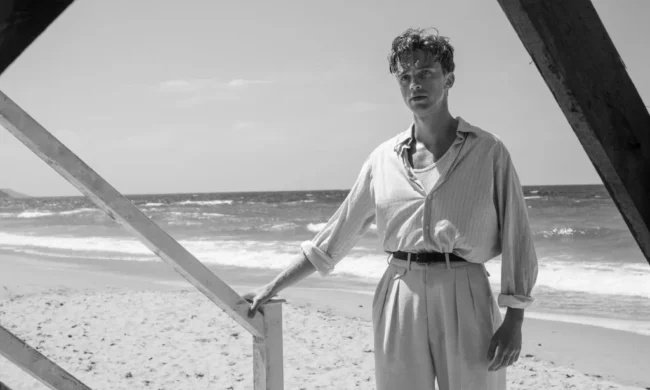
At the same time, Ozon subtly expands the frame of Camus’ story. Where the novel treats its colonial setting as a given, the film foregrounds it, allowing the social and political tensions of French Algeria to register more clearly. The people who exist at the margins of Meursault’s awareness take on a greater presence, not through overt revision but through subtle shifts in emphasis. The result is a quiet but meaningful rebalancing, one that reframes Meursault’s indifference as something shaped not only by temperament but by environment.
As perhaps the quintessential work of existentialist fiction, The Stranger endures not because it offers answers, but because it resists them. Ozon’s adaptation honors that resistance, even as it invites us to look more closely at the world surrounding it, and at what it means to move through that world without fully engaging with it.
“The Stranger, it turns out, is a story for our times, which makes this lovely new version doubly welcome.” – Bilge Ebiri, Vulture
“Ozon’s The Stranger keeps the spirit of its source material alive as a timeless warning in a modern world of stark polarization, ongoing colonialism, and plenty of Meursaults ignoring the suffering of others.” – Monica Castillo, The AV Club