
There’s a certain kind of cinematic romance that doesn’t just tug at the heartstrings: It yanks them, bends them, and occasionally snaps them altogether. Two Pianos, a lush and emotionally charged drama from Arnaud Desplechin, belongs squarely in that tradition, treating love, memory, and music with the same heightened intensity as a symphony reaching its crescendo.
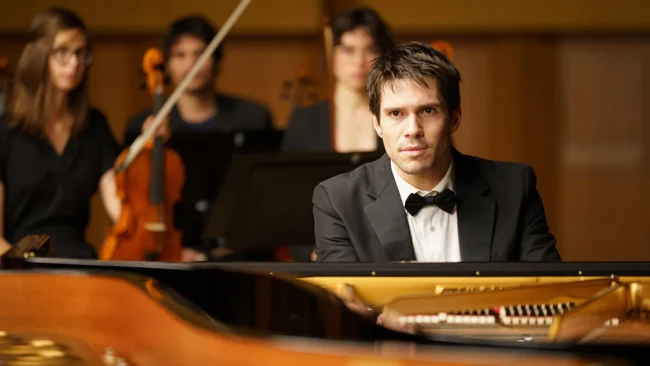
Catch Two Pianos in theaters beginning May 1st at the Laemmle Royal.
At the film’s center is Mathias, a gifted pianist whose return to his hometown of Lyon sets multiple strands of his life into motion at once. Played with sensitivity and restraint by François Civil, Mathias is a man caught between multiple versions of himself: the rising talent he once was, the underachieving teacher he has become, and the artist he might still be. His reunion with his formidable former mentor Elena—brought to life with imperious precision by Charlotte Rampling—pulls him back toward the stage, even as his personal life threatens to spiral in less controlled directions.
That personal life arrives with a jolt in the form of Claude, an old flame whose sudden reappearance sends the film into a kind of emotional overdrive. Nadia Tereszkiewicz plays her as mercurial and magnetic, someone who can shift from vulnerability to volatility in a heartbeat. What follows between her and Mathias is less a rekindling than a collision, two people circling unresolved feelings with a mixture of longing, regret, and lovestruck impulsivity.
Desplechin leans fully into this heightened register, crafting a story that moves with the unpredictability of memory itself. Chance encounters carry the weight of destiny; small gestures erupt into grand declarations. There are even fleeting touches of the uncanny, as Mathias becomes fixated on a young boy who seems to mirror his own past, adding another layer to the film’s fascination with doubling.
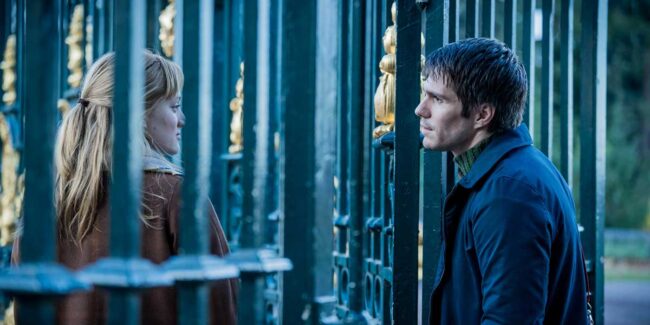
Yet for all its dramatic flourishes, Two Pianos remains grounded by its deep connection to music. The performances, both literal and emotional, are inseparable from the rhythms of the score, which pulses through the film with a restless energy. Classical pieces intertwine with an evocative original composition, creating a soundscape that cleverly mirrors the turbulence of the characters’ inner lives.
Visually, the film is just as expressive. Cinematographer Paul Guilhaume captures Lyon in rich, shifting tones, moving from shadowy interiors to crisp autumnal light, as if the city itself were responding to the characters’ emotional journeys. The effect is immersive without being overstated, allowing the story’s intensity to breathe and stretch its versatile narrative limbs.
If Two Pianos feels like it’s playing multiple melodies at once, that’s part of its design. It’s a film about divided selves and second chances, about the pull of the past and the risk of moving forward. And like any memorable piece of music, it lingers—not because it resolves every note, but because it dares to play them at full volume.
“Desplechin draws something liminal from a specific sense of place.” – Sheri Linden, The Hollywood Reporter
“[An] earnestly inflamed tale of art, grief, betrayal and all-consuming amour.” – Guy Lodge, Variety