
There’s a mischievous spark at the heart of Two Women, a film that takes a familiar setup—restless relationships, suburban routines—and flips it into something unexpectedly playful, warm, and quietly subversive. Directed with a light but assured touch by Chloé Robichaud, this Montreal-set comedy finds humor and honesty in the messiness of modern love.
Catch Two Women in theaters beginning May 1st at the Laemmle Monica and Town Center, followed by a special screening and Q&A hosted by Not Your Daddy’s Films following the 7:10 p.m. show on May 2nd at the Monica.
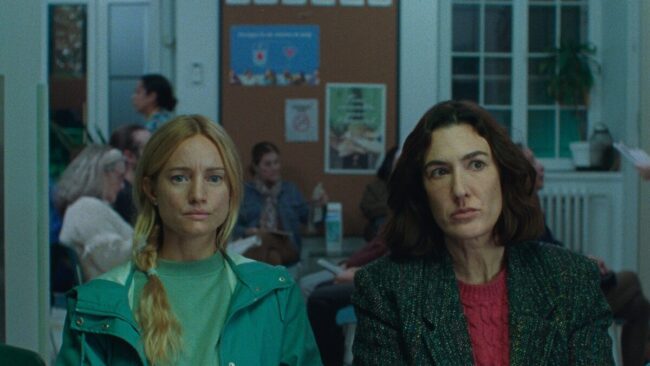
The story centers on two neighbors, Violette and Florence, who form an unspoken bond over their shared dissatisfaction at home. Violette, adjusting to new motherhood, finds herself adrift in a marriage that has lost all sense of intimacy, while Florence, navigating her own partner’s lack of libido, feels similarly disconnected. Their apartments may only be a balcony apart, but emotionally, they’ve both been stranded for some time.
What follows isn’t subtle: both women begin having affairs, embarking on a string of clandestine hookups that quickly spiral into something both comedic and unexpectedly revealing. Yet what might sound like a setup for moralizing instead plays out with a surprising lightness, for rather than framing this infidelity as purely destructive, Two Women treats it as a catalyst—messy, impulsive, and often funny—for the characters to confront what’s missing in their lives and to begin to discover what they actually want.
At the center of it all are two standout performances. Karine Gonthier-Hyndman brings a subtle emotional evolution to Florence, charting her journey from quiet detachment to a more awakened, self-assured presence. Opposite her, Laurence Leboeuf gives Violette a lively, layered warmth, balancing the character’s natural humor with an undercurrent of vulnerability. Together, they create a dynamic that feels genuinely lived-in, less like a traditional movie friendship and more like something instinctive and real.
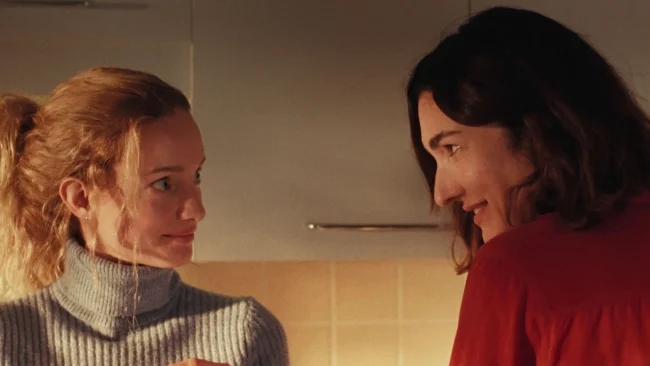
Robichaud’s direction keeps the tone buoyant even as the film brushes up against larger questions about relationships, expectations, and autonomy. There’s a sense that Two Women is less interested in offering definitive answers than in simply letting its characters explore the questions themselves. That openness extends to the film’s humor, which leans into awkwardness and absurdity without ever losing sight of its characters’ humanity.
Ultimately, Two Women is a film about connection: between friends, between partners, and (perhaps most importantly) with oneself. It’s playful without being trivial, thoughtful without being heavy, and anchored by performances that make every twist feel earned. In a landscape where stories about relationships often follow well-worn paths, this one finds its own rhythm—and invites audiences to enjoy the ride.
“[The film’s] reflections on modern relationships are engagingly comical, cynical and ultimately tender. ” – Allan Hunter, Screen Daily
“[Two Women is] unafraid of sex and female pleasure in a way that feels so rare in modern films.” – Jesse Saunders, Movie Jawn