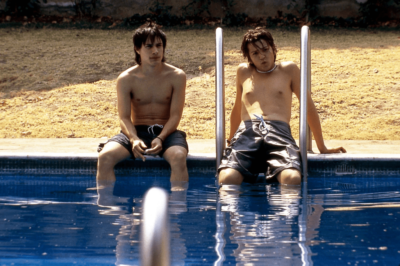
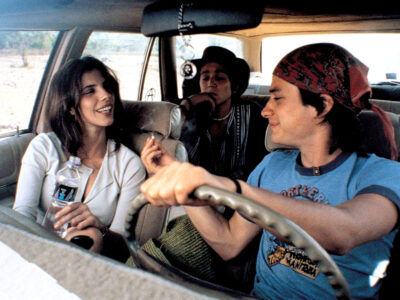
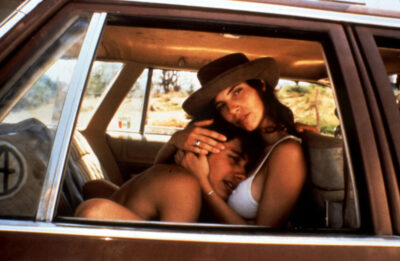
It’s the 20th anniversary of Alfonso Cuarón’s impossibly sexy, funny Y TU MAMÁ TAMBIÉN, which we’ll screen on December 8.


It’s the 20th anniversary of Alfonso Cuarón’s impossibly sexy, funny Y TU MAMÁ TAMBIÉN, which we’ll screen on December 8.


ABOUT ENDLESSNESS is a reflection on human life in all its beauty and cruelty, its splendor and banality. We wander, dreamlike, gently guided by our Scheherazade-esque narrator. Inconsequential moments take on the same significance as historical events: a couple floats over a war-torn Cologne; on the way to a birthday party, a father stops to tie his daughter’s shoelaces in the pouring rain; teenage girls dance outside a cafe; a defeated army marches to a prisoner-of-war camp.

Simultaneously an ode and a lament, ABOUT ENDLESSNESS presents a kaleidoscope of all that is eternally human, an infinite story of the vulnerability of existence.
“Give Roy Andersson 76 minutes, and he’ll give you the universe.” ~ David Ehrlich, IndieWire

An official selection of the Venice Film Festival (where Andersson won the Silver Lion for Best Director), the Toronto International Film Festival, and the Palm Springs International Film Festival.
ROADRUNNER is the latest from Academy Award®-winning filmmaker Morgan Neville (20 Feet from Stardom, Won’t You Be My Neighbor?). It’s unflinching look at chef, writer, adventurer, and provocateur Anthony Bourdain and it reverberates with his presence because it’s culled from 10,000 hours of raw footage from his TV shows. It’s “raw” in that most of it is from outtakes, but also in the sense that Bourdain’s technique to help his interview subjects open up was to get very personal with them first.
From Eric Kohn’s recent interview with Neville in Indiewire:
Q: How much footage do you estimate you went through?
A: There was anything from 60 – 100 hours of footage per episode. There were 96 episodes of “Parts Unknown.” That’s just “Parts Unknown.” Then there was “No Reservations” and “Cook’s Tour.” Not all the raw footage exists for those episodes, but it does for certain seasons. Of course, we didn’t go through all the footage, that would’ve taken years and years. We probably went through 10,000 hours. We had six of us all looking at footage, sometimes double-timed, because there was so much to go through. I love archive docs, and this was a unique one because the camera was always there and running. It becomes its own weird, interesting verite thing. It has a behind-the-scenes quality that feels raw, which I wanted to carry over into the telling of it.
Q: How did you narrow down the process?
A: We were going through footage for at least a year. Anytime there was an episode that he talked about or a crew member mentioned, we’d go through those episodes. There were definitely a number of episodes that were easy wins. A lot of the domestic ones. Or whenever Tony was on a beach. You can see that he’s in a different gear in those episodes. It’s pretty easy to tell early in a scene where Tony is phoning it in or actually wants to learn about a person. Those scenes floated to the top pretty quickly.

Q: Given how much of his shows were infused with his personality, what surprised you about the way he came across in this additional footage?
A: One of the biggest challenges early on was not to make the film feel like the show. Among the things that really surprised me was that he was fundamentally a shy person. Once you hear that, it makes sense — you can see that in him — but I don’t think it’s otherwise obvious. He overcame it in a big way, but there was always a part of him that was a little walled off.

When I was first talking to people who worked on the show, they would say, “Tony had this technique, and we didn’t know it was his technique.” When he was shooting a scene with someone he didn’t know, he would open up about himself in a really raw way. The crew would be sitting there wondering when he’d get to the point of speaking about the subject. Eventually he would, but by speaking about himself, he would get other people comfortable talking about themselves.

Of course, they cut all that stuff out of the show. But the raw footage has a lot of Tony revealing a lot about himself to people — knowing it was never intended for broadcast. It was part of who he was. I remember talking to David Simon about Tony and he said the first time he met Tony, the first thing he said was, “Oh, you’re from Baltimore. I tried to score heroin once there and couldn’t.” To which Simon replied, “Then you must have been a terrible junkie.”
Read Kohn’s full piece here.

This behind-the-scenes look at how an anonymous chef became a world-renowned cultural icon is enjoying universal acclaim:


Based on a true love story, the decades-spanning romance I Carry You with Me begins in Mexico between an aspiring chef and a teacher. Their lives restart in incredible ways as societal pressure propels the couple to embark on a treacherous journey to New York with dreams, hopes, and memories in tow. We’ll open this moving film this Friday at our Playhouse and Town Center theaters, with additional venues in the subsequent weeks.
Reviews have been glowing. “A gay story and a border story, told in the universal language of love, family, and dreams.” (Entertainment Weekly). “Ravishing and unshakable, Ewing’s authentic film feels like the crossbreed between a painful memory and a hopeful dream about a place, a relationship and a fight for acceptance that’s not political but entirely humanistic.” (Remezcla) “Dreams make up both the form and substance of I Carry You with Me, Heidi Ewing’s accomplished narrative feature debut.” (Washington Post)

The New York Times recently published a Nicolas Rapold piece headlined “When Truth Melds With Fiction: Making I Carry You with Me. Here is the beginning of the piece:
“Heidi Ewing knew her friends Iván García and Gerardo Zabaleta for seven years before learning the full story of their journey. Iván and Gerardo first fell in love in the 1990s in Mexico, where they had to keep their relationship a secret. They emigrated separately to the United States, with Iván crossing the border first on foot at great risk.
“In New York, the men eventually thrived as restaurateurs, and today run two Williamsburg establishments. But, Ewing learned, the couple remained undocumented, like millions of others.
“Ewing, an Academy Award-nominated filmmaker (“Jesus Camp”), recognized a captivating romance when she saw one. But how could she portray her friends’ in-between status, living in a world that kept forcing them to conceal basic facts of their existence?
“In I Carry You with Me , now in theaters, Ewing found her own in-between path by filming a hybrid fiction. Spanning childhood through adulthood, from Mexico City to New York, it’s the rare movie that both stars actors — Armando Espitia plays Iván and Christian Vázquez plays Gerardo — and the people being portrayed.

“But the project — Ewing’s first fiction feature — looked a little different at first.
““It was so trial-and-error, because when they first told me their story, my go-to was, ‘This is a beautiful documentary,’” Ewing said one morning at a Lower East Side eatery.
“Beginning around 2013, she filmed significant moments in Iván and Gerardo’s lives — birthdays, restaurant openings, Cinco de Mayo. She also shot interviews with them (carefully lit and partly inspired by “My Dinner with Andre”). While gathering these materials for several years, she continued to make movies with her longtime co-director, Rachel Grady: “Detropia,” “Norman Lear: Just Another Version of You” and “One of Us.”
“Heidi Ewing directed a film about two of her friends and their love story, both following them in real life and using actors to portray them in narrative moments.” Here are the first few paragraphs:
“But her documentary about her friends kept posing certain challenges. Hardly any archival photos or video of Iván and Gerardo existed, for example. And she usually steered clear of documentary productions that did not have a “current-day evolution of a story or narrative,” as she put it.
“There was also the question of doing justice to her friends’ romance.
““You want to see somebody fall in love. A documentary camera is never there — at the bar, the restaurant, the street corner, the subway, the bus, the glance between two people,” Ewing said.
“She decided to cast actors to dramatize Iván and Gerardo’s history together. The couple gave their full support.

Read the rest of the piece on the New York Times website.
In his acclaimed debut as a filmmaker, Ahmir “Questlove” Thompson presents a powerful and transporting documentary: part music film, part historical record, created around an epic event that celebrated Black history, culture and fashion. Over the course of six weeks in the summer of 1969, just one hundred miles south of Woodstock, The Harlem Cultural Festival was filmed in Mount Morris Park (now Marcus Garvey Park). The footage was never seen and largely forgotten–until now. SUMMER OF SOUL shines a light on the importance of history to our spiritual well-being and stands as a testament to the healing power of music during times of unrest, both past and present. The feature includes never-before-seen concert performances by Stevie Wonder, Nina Simone, Sly & the Family Stone, Gladys Knight & the Pips, Ray Baretto, Abbey Lincoln & Max Roach and more. SUMMER OF SOUL won both the Grand Jury Prize and the Audience Award for Feature Documentary at this year’s Sundance Film Festival. Laemmle Theatres opens in July 2 at the Claremont, Glendale, Monica Film Center, Newhall, NoHo and Playhouse theaters.
Reviews have been rapturous:
“A joyous piece of filmmaking, something that I could have watched for literal hours, and contains quite simply some of the best concert footage ever put on film.” ~ Brian Tallerico, RogerEbert.com
“SUMMER OF SOUL is as thoughtful as it is rousing, a welcome shot of adrenaline to kick off not just a film festival but a new year.” ~ Sheri Linden, Hollywood Reporter

“You can come for the music and stay for the politics, or vice versa; either way, it’s a vibrant document of an inspiring event that never loses sight of what that event meant for a community, a city and a culture.” ~ Steve Pond, TheWrap

“SUMMER OF SOUL stirringly captures the moment when a sea of people in Harlem heard a grand series of voices and said, Yes.” ~ Owen Gleiberman, Variety)

“Seething through the entire documentary, against the backdrop of a racially turbulent 1960s, is an insistence on a new kind of racial pride and unity across the diaspora, which infuses “Summer” with an honesty and realism.” ~ Tambay Obenson, indieWire

“The lack of awareness of this event is another tragic example of black history being ignored. Only this time the record survived, and now we all get to share in it.” ~ Jordan Hoffman, Guardian)

Now that Laemmle Theatres is fully reopened — all eight theaters at 50% capacity — now is a good time for a reminder that masks are still required in our lobbies and auditoriums by all managers, staff, and customers. The CDC issues recommendations but the state and county have jurisdiction and both the California and L.A. County health departments continue to require that masks be worn indoors regardless of vaccination status. The only exception for moviegoers: when seated in an auditorium while eating or drinking. We are doing our best to supervise with signage and polite verbal reminders when necessary, and fortunately most of our patrons are being very conscientious.
On an individual level, the vaccines are superbly effective and epidemiologists are saying that people who are fully vaccinated should feel really safe and confident being out in public.
On a community level, however, we still haven’t vaccinated a large enough percentage of the population. And that’s not just about the vaccine hesitant. There are also 12-16 year olds who only recently became eligible.
So for the sake of our community, and to really squelch the transmission of the virus, please stay masked up for the time being.
Hopefully, it will be just a few more weeks.
L.A. Times Culture Columnist & Critic Mary McNamara just published a terrific personal essay on returning to moviegoing headlined “Vaccinated and Back at the Movies, Together.” Here’s a highlight but the whole thing is worth reading:
“Then the lights went down and for two hours it was as if the pandemic did not exist, had never occurred. TOGETHER TOGETHER was sweet and smart and funny enough, but even if I had hated it, I was at the movies. A haven from heartbreak, anxiety and bad weather of all sorts, a place of necessary solitude, romantic anticipation, friendly bonding and familial celebration.
“After a year of crowded isolation, there were no interruptions from kids needing something; no ambient distraction courtesy of nearby leaf-blower or power tool; no hitting pause to check and see if the meatloaf was done yet. Having committed to it, the experience was literally out of my hands. I couldn’t use this time to also sort laundry or check my emails or do the dishes; couldn’t carry this screen from one room to another to see what the dogs were barking at this time or balance it on the counter while I did the dishes.
“I was at the movies and for two glorious hours all I could do was watch and listen and be.”
Moviegoing is unlike anything else and it’s worth preserving, especially moviegoing at locally owned and operated theaters. L.A. cinephiles, we humbly ask for your support.