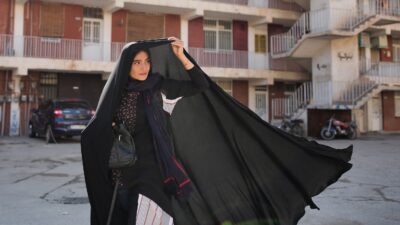
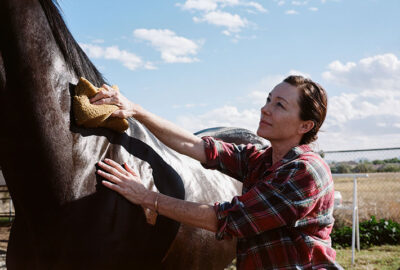
We open the beautiful new Italian film The Macaluso Sisters this Friday at the Newhall, Playhouse, Royal and Town Center, as well as August 20 at the Claremont. As of this writing, Emma Dante’s movie, about how a tragedy changes the lives of five sisters in Palermo, boasts a rare “100% Fresh” rating on Rotten Tomatoes, with praise such as:
“Haunting and powerful.” (New York Times);
“In just her second feature after the taut street-stand-off drama A Street In Palermo seven years ago, Dante sets a firm seal upon her cross-disciplinary emergence as a director of unusually vivid empathy.” (Variety);
“Dante’s film, beautifully done, is never more resonant than when reminding us of the lingering impact of childhood drama and the devastating nature of childhood trauma.” (Times [U.K.]).

Unfortunately, our usually excellent hometown daily erred and did not assign a film critic to publish a review. To make up for it, here’s the entirety of Beatrice Loayza’s full New York Times Critic’s Pick review:
“No mere sun-kissed coming-of-age film, The Macaluso Sisters opens on a blissful day filled with young love and beachside longing that is tragically upended by an accident that has everlasting reverberations.
“The Italian filmmaker Emma Dante, best known as a director of avant-garde theater and opera, adapted the film based on her acclaimed play of the same name. Here, she imagines the ripple effects of a sister’s death across generations with metaphysical grace and hints of fantasy, straying from the plot-reliant mold of most human dramas toward something more haunting and powerful.

“Five orphaned sisters — Katia, Lia, Pinuccia, Maria, and Antonella — live alone in a lively apartment in Palermo, Sicily, where they sustain themselves by loaning out pigeons for ceremonies and events. On their day off, they head to the beach, passing through a field peppered with enormous dinosaur figurines and initiating a pop music-scored dance party upon their arrival. These magical moments are grounded by the cinematographer Gherardo Gossi’s tactile photography, which accentuates the youthful vitality of the sisters’ bodies and the playful chaos of their movements.
“Following the death of a sister, Dante skips ahead to a future in which the group — now played by a different group of actresses — are middle-aged and broken, each in their own particular way. They remain in the same apartment, while ghostly manifestations of their missing sister create a stark contrast between their aging bodies and those of their brimming younger selves.

“A third act shows three sisters in old age and in mourning. Yet the apartment and its white cabinet — adorned with an etching of a beach — looks the same. By the end, Dante stages a transcendent confrontation with the impermanence of the body, destined to degrade, yet sustained by the memories and relationships that have come to define it.”
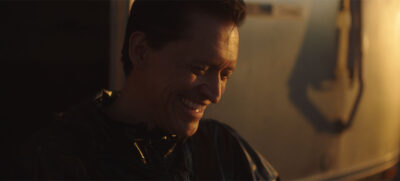
Legendary actor Udo Kier stars as retired hairdresser Pat Pitsenbarger, who escapes the confines of his small-town nursing home after learning of his former client’s dying wish for him to style her final hairdo. Pat embarks on an odyssey to confront the ghosts of his past — and collect the beauty supplies necessary for the job. Swan Song is a funny, bittersweet journey about rediscovering one’s sparkle, and looking gorgeous while doing so.

Writer-director Todd Stephens wrote the following about his new film:
“Back in 1984, I walked into my small-town gay bar for the first time — The Universal Fruit and Nut Company. There he was, glittering on the dancefloor. Wearing a teal feather boa, fedora and matching pantsuit, “Mister Pat” Pitsenbarger was busting old school moves straight out of Bob Fosse. I was seventeen, and Pat was a revelation.

“Years later, when I set out to write my autobiographical Edge of Seventeen, I immediately thought of Mister Pat. I went back home to hunt him down, only to discover Pat had just suffered an aneurism and was temporarily unable to speak. But his lover David told me stories…about how Pat was once the most fabulous hairdresser in Sandusky, Ohio…about his legendary drag performances…about how he used to shop at Kroger’s dressed as Carol Burnett – in 1967! This was a man who always had the courage to be himself, long before that was safe.

“The truth is, Mister Pat inspired me to write Edge of Seventeen. I wrote a significant “Pat” character as my protagonist’s mentor, but midway through the shoot, the part got cut. I always knew my muse would return someday in my writing, and when he finally did many years later, I looked for Pat again only to learn he just passed away. Sadly, Pat’s legendary hand-beaded rhinestone gowns are all lost to time. Only a shoebox remains – filled with some tarnished jewelry and a half-smoked pack of Mores.

“Swan Song is a love letter to the rapidly disappearing “gay culture” of America. As it has become more acceptable to be queer, what used to be a thriving community is rapidly melting back into society. Thanks to assimilation and technology, small-town gay bars like The Universal Fruit and Nut Company are becoming extinct. Swan Song is dedicated to all the forgotten flaming florists and hairdressers who built the gay community and blazed the trail for the rights many of us cling to today. But, above all, for me this film is about learning that it’s never too late to live again.”

Laemmle Theatres will open Swan Song on August 6 at the Playhouse, Royal and Town Center.
On Friday, July 30 we’ll open the Nigerian drama EYIMOFE (THIS IS MY DESIRE) at the Royal. A triumph at the 2020 Berlin International Film Festival, the revelatory debut feature from co-directors (and twin brothers) Arie and Chuko Esiri is a heartrending and hopeful portrait of everyday human endurance in Lagos, Nigeria. Shot on richly textured 16 mm film and infused with the spirit of neo-realism, Eyimofe traces the journeys of two distantly connected strangers—Mofe (Jude Akuwudike), an electrician dealing with the fallout of a family tragedy, and Rosa (Temi Ami-Williams), a hairdresser supporting her pregnant teenage sister—as they each pursue their dream of starting a new life in Europe while bumping up against the harsh economic realities of a world in which every interaction is a transaction. From these intimate stories emerges a vivid snapshot of life in contemporary Lagos, whose social fabric is captured in all its vibrancy and complexity. traces the journeys of two distantly connected strangers—Mofe (Jude Akuwudike), an electrician dealing with the fallout of a family tragedy, and Rosa (Temi Ami-Williams), a hairdresser supporting her pregnant teenage sister—as they each pursue their dream of starting a new life in Europe while bumping up against the harsh economic realities of a world in which every interaction is a transaction. From these intimate stories emerges a vivid snapshot of life in contemporary Lagos, whose social fabric is captured in all its vibrancy and complexity.
Writing at Film Threat, Hanna B. called EYIMOFE “a touching, beautiful, and complex tableau about how to overcome adversity and seek opportunities when you are at an impasse: a Nigerian story, an African story, a migrant story, a human story.”


It’s the 20th anniversary of Alfonso Cuarón’s impossibly sexy, funny Y TU MAMÁ TAMBIÉN, which we’ll screen on December 8.


ABOUT ENDLESSNESS is a reflection on human life in all its beauty and cruelty, its splendor and banality. We wander, dreamlike, gently guided by our Scheherazade-esque narrator. Inconsequential moments take on the same significance as historical events: a couple floats over a war-torn Cologne; on the way to a birthday party, a father stops to tie his daughter’s shoelaces in the pouring rain; teenage girls dance outside a cafe; a defeated army marches to a prisoner-of-war camp.

Simultaneously an ode and a lament, ABOUT ENDLESSNESS presents a kaleidoscope of all that is eternally human, an infinite story of the vulnerability of existence.
“Give Roy Andersson 76 minutes, and he’ll give you the universe.” ~ David Ehrlich, IndieWire

An official selection of the Venice Film Festival (where Andersson won the Silver Lion for Best Director), the Toronto International Film Festival, and the Palm Springs International Film Festival.
To celebrate the 2021 Olympics, Laemmle Theatres and the Anniversary Classics Series present one of the best-loved sports movies of all time: the 1981 Oscar-winning drama, ‘Chariots of Fire.’ The picture retrieved a largely forgotten chapter of Olympic lore, the British triumphs at the 1924 games in Paris. In a neat parallel to the story told on screen, the film’s victory at the Academy Awards ceremony has to be considered one of the most surprising but gratifying upsets in Oscar history. We’ll screen the film July 20 at the Newhall, Playhouse and Royal at 7 PM.

The year 1981 was one of the most competitive years in recent memory. The other films nominated for Best Picture were Warren Beatty’s ‘Reds’ (with a total of 12 nominations), ‘On Golden Pond’ (10 nominations), ‘Raiders of the Lost Ark’ (eight nominations), and Louis Malle’s ‘Atlantic City.’ ‘Chariots of Fire‘ came into the ceremony with a total of seven nominations, and unlike the other contenders, it had no major stars in the cast. Yet audience and industry love for the movie pushed it over the finish line. In addition to winning Best Picture, it also won Best Original Screenplay for Colin Welland, Best Costume Design, and Best Musical Score by Vangelis. The film also earned nominations for Hugh Hudson as Best Director, Ian Holm for Best Supporting Actor for his delightful portrayal of the track coach who guided the winning runners, and Best Film Editing.

The two leading roles in the film are portrayed by Ian Charleson as Eric Liddell and Ben Cross as Harold Abrahams. Both of them confronted daunting obstacles in their preparation for the 1924 Olympics. Liddell, the son of Scottish missionaries, came from a strict Christian upbringing, and he created complications for the British team when he refused to race on Sunday. Abrahams was Jewish and faced discrimination as a student at Cambridge and as an Olympic competitor. The excellent supporting cast includes Oscar winner John Gielgud and acclaimed director Lindsay Anderson as two stuffy, bigoted Cambridge dons, Alice Krige, Nigel Havers, Cheryl Campbell, and young American actors Dennis Christopher (‘Breaking Away’) and Brad Davis (‘Midnight Express’).

Producer David Puttnam (‘Midnight Express,’ ‘The Killing Fields,’ ‘Local Hero’) had conceived the film as a drama about faith and principle, in the tradition of such earlier award winners as ‘A Man for All Seasons.’ He assembled a first-rate team, including award-winning cinematographer David Watkin (‘Out of Africa,’ ‘Moonstruck,’ ‘Yentl’) and first-time feature director Hudson. Perhaps Puttnam’s boldest move was to hire Greek-born electronic composer Vangelis to provide an innovative musical score. Vangelis said that he was inspired by the fact that his father was a runner, and the score was intended as a kind of family tribute. His music has proved especially durable, serving as the theme for the 2012 Olympics held in London 30 years after the film’s release.

Reviews were largely celebratory. Kathleen Carroll of the New York Daily News praised “a movie that, with the help of Vangelis’s wonderfully stirring score, lifts the spirits to a new high.” Time magazine’s Richard Schickel added, “Like every element in this picture, the actors look right; they seem to emerge from the past, instead of being pasted on to it.” Roger Ebert declared, “’Chariots of Fire’ is one of the best films of recent years.” Later evaluations echoed the praise. Writing in 2012, Kate Muir of the UK Times said “From the opening scene of pale young men racing barefoot along the beach, full of hope and elation, backed by Vangelis’s now famous anthem, the film is utterly compelling.”
One of the first films to confront the horrors of the Holocaust remains one of the most powerful. Suffused with the visceral dread of a waking nightmare, Distant Journey draws from director and Holocaust survivor Alfréd Radok’s own experiences to tell the story of a Czechoslovak Jewish family—including a young doctor (Blanka Waleská) and her gentile husband (Otomar Krejča)—whose lives are torn apart by the terrors of the Nazi occupation, leading them inexorably to a grim fight for survival in the Theresienstadt concentration camp. Blending expressionistic cinematography with archival documentary footage (some drawn from Triumph of the Will) to potent effect, this harrowing vision of human atrocity was banned in its home country for more than forty years, only to reemerge as urgent and impactful as ever.

Tablet Magazine recently published J. Hoberman’s authoritative article about the film. Here are the opening paragraphs:
“Alfred Radok’s 1949 first feature, Distant Journey, was (and is) a landmark—a movie of its time that continues to speak to ours. Made in a no longer extant, once-communist state during the Cold War winter of 1948-1949, Radok’s remarkable debut is a masterpiece of Czech cinema. It was also one of the first and remains among the strongest, most original, and most influential movies to deal with the murder of European Jewry.

“Distant Journey had its New York premiere in August 1950, not three months into the Korean War, at the Stanley, a shabby theater off Times Square that then served as the home of Yiddish movies, Israeli documentaries, and Soviet imports. The film was given the Yiddish title Geto Terezin, for the “transit camp” Theresienstadt, known in Czech as Terezin, where it was largely set and partially filmed; it was so enthusiastically received that it was held for over a month.

“The New York Times critic Bosley Crowther called Distant Journey “the most brilliant, the most powerful and horrifying film on the Nazis’ persecution of the Jews,” that he had ever seen, albeit cautioning “the faint of heart” to see the movie “at their own risk.” The Yiddish daily Morgn Frayhayt reported the amazed public response of at least one spectator who claimed to recognize her fictionalized self on the screen—as well she might. The first fiction films to represent the Holocaust, produced in Eastern Europe soon after the war were typically made by and/or with actual survivors. All had aspects of psychodrama, docudrama, and documentary.

“Nothing if not personal, Distant Journey was written by Erik Kolár, an assimilated Czech Jewish lawyer who, married to a gentile, managed to stave off deportation to Terezin until 1945. Director Radok, the son of a Catholic mother and a Jewish father, grew up in a Bohemian village and spent much of the war in hiding before being sent to a forced labor camp for mischlings in Poland. Both his father and grandfather died in Terezin. Based on his experiences, Kolár took a conciliatory attitude toward his gentile countrymen; based on his experience, Radok did not. In its attitude and attention to detail, Distant Journey was the most Jewish film made in Czechoslovakia up until that time and perhaps ever.”
Read the full article on Tablet’s website.
Laemmle Theatres will open Distant Journey July 9 at the Royal and Town Center and on watch.laemmle.com.