For many viewers, it’s hard to recall a time when Willem Dafoe wasn’t beloved and famous. Yet in Kent Jones’ Late Fame, he’s able to embody the delight of a creative artist being recognized late in life, decades after giving up a poetry career for a practical job at the post office.
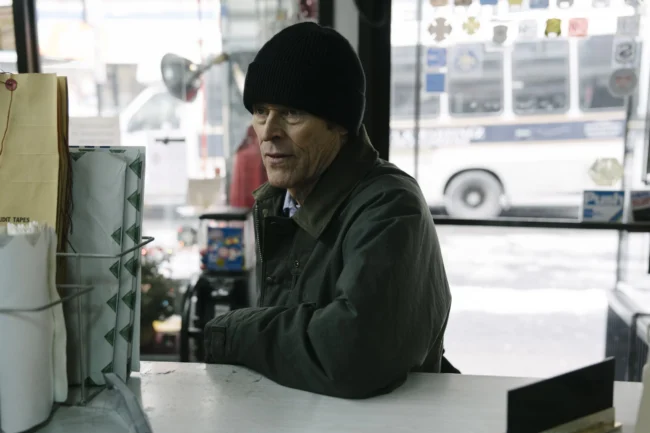
Late Fame opens Aug. 14th at Laemmle’s Royal, and then the 21st at the Glendale, NoHo and Town Center. Director Kent Jones and screenwriter Samy Burch will participate in a Q&A following the 7:30 PM shows on August 14th and 15th at the Royal. Jones will also be a guest on Inside the Arthouse with Greg Laemmle and Raphael Sbarge.
A former film critic, festival programmer and documentarian, the sixty-something Jones knows a bit about late blooming himself. Late Fame is only his second dramatic feature as director, following 2018’s Diane, which scored star Mary Kay Place a Best Actress award from the Los Angeles Film Critics Association and the National Society of Film Critics. His newest, like Stanley Kubrick’s Eyes Wide Shut, is based on a novella by turn-of-the-20th century Austrian author Arthur Schnitzler.
Jones’ approach, however, is very different – where Kubrick created artificial New York City blocks in London, and put Tom Cruise on a treadmill in front of a rear projection screen, Jones goes street-level in the real thing. There’s a liveliness and sense of space to it, from two-story coffee shops maximizing their vertical space to a surprisingly large single apartment that indicates hidden wealth on the part of its owner.
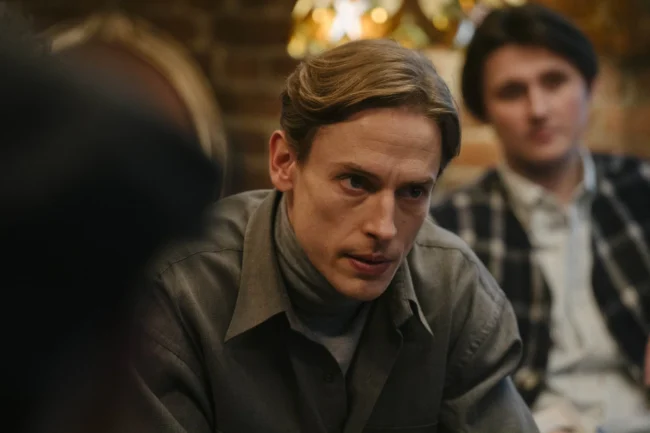
Dafoe’s Ed Saxberger has mostly accepted his blue-collar status, and is a bit bewildered when a young college student, Edmund Donovan’s dandy-ish Meyers, basically stalks him to his home to shower him with praise. Like Schnitzler himself, Meyers is part of a group of young, aspiring iconoclast writers who believe themselves well-positioned to shake things up. They use only surnames, speak formally, and theoretically eschew technology (to a point).
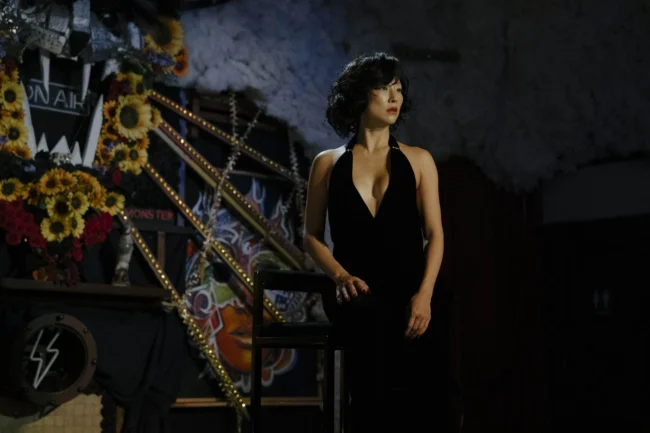
Gradually, Saxberger begins to enjoy the attention, particularly from showy, uninhibited would-be muse Gloria (Greta Lee). Finally flattered for his intellect, he starts to wonder if his working-class bar buddies are too unsophisticated. But even limited, newfound fame can be ultimately just as empty as the first time around – especially if you’re no longer the same person whose art earned it.
It would be easy to turn the scenario into caricature, with shallow rich kids misunderstanding an old man with real life experience. Jones, however, is more interested in fully developed characters and their nuances than in specific plot beats. These youngsters may be clueless but they genuinely want to be profound as well; Gloria’s performance art at one point is demonstrably so terrible that it stops the movie and the audience in its tracks, yet she can still deliver a meaningful poetry reading while completely high on something, and her life situation turns out to be way more complex than expected.
Ed’s post office career is designed to draw comparisons to author Charles Bukowksi, yet it also demonstrates their biggest point of contrast. Unlike Bukowski, Ed is several years sober, and enjoys his life with a steady government paycheck. He relishes the newfound attention for his work, and is bemused by the idea that he’s been “re-discovered,” but the reality is that a reasonably content, well-adjusted old man just isn’t in the same space as an angry, lovelorn young one breaking the rules of literature.
In real life, someone like Ed could take their cue from director Jones, maintaining an analytical lens throughout his careers that has proved endlessly adaptable, whether to film analysis, documentary, or fictional character study.
“…there’s a satisfying depth to it, and the movie abounds in exquisite grace notes.” – Sheri Linden, The Hollywood Reporter.
“The classic theatricality of its characters juxtaposed with the modern world gives ‘Late Fame’ the feeling of a eulogy for an artistic world that young idealists desperately want to revive.” – Jourdain Searles, RogerEbert.com.