The Official Blog of Laemmle Theatres.

Laemmle Theatres

Film Reviews & Previews

  • All
  • Theater Buzz
    • Claremont 5
    • Glendale
    • Newhall
    • NoHo 7
    • Royal
    • Santa Monica
    • Town Center 5
  • Q&A’s
  • Locations & Showtimes
    • Claremont
    • Glendale
    • NewHall
    • North Hollywood
    • Royal (West LA)
    • Santa Monica
    • Town Center (Encino)
  • Film Series
    • Anniversary Classics
    • Culture Vulture
    • Worldwide Wednesdays
  • Facebook
  • Instagram
  • TikTok
  • YouTube

You are here: Home / Theater Buzz

Padraic McKinley’s ‘The Weight’ Recalls Classic Westerns and Thrillers

September 16, 2026 by Lamb Laemmle Leave a Comment

Ethan Hawke and Russell Crowe are the big-name actors in Padraic McKinley’s The Weight, but the real star of the movie is the vast, untouched Bavarian forest location, standing in for Oregon circa 1933.

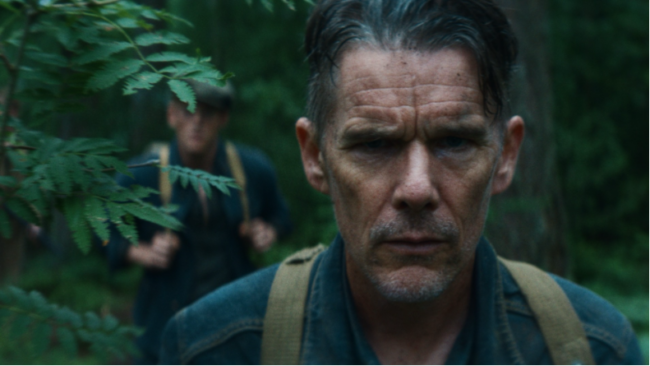
Ethan Hawke in The Weight

The Weight opens at Laemmle’s Newhall, Monica, Town Center 5, and NoHo 7 Sept. 18th. Be sure to catch McKinley on Inside the Arthouse with Greg Laemmle and Raphael Sbarge.

On the heels of his acclaimed turn in Blue Moon last year, Ethan Hawke sticks close to the same time period, this time as a World War I veteran in 1933 who’s fallen on hard times. He’s Murphy, a single father who can’t make the rent, but he knows a thing or two about illegal engine modifications. When a seeming case of mistaken identity gets him thrown into prison and on to a chain gang, he’s the kind of guy the wardens like: silent, strong, and all about the work. Getting out so that his young daughter doesn’t have to go into the foster system is the priority.

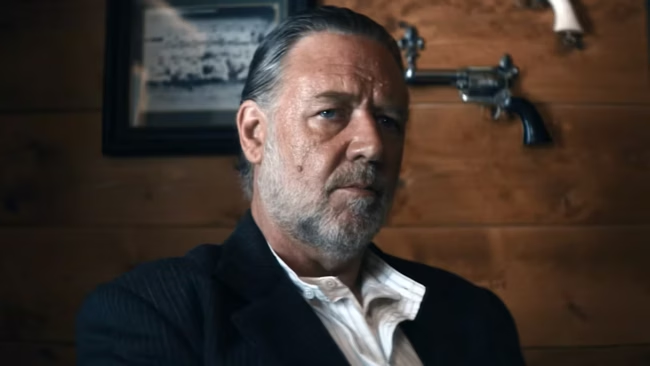
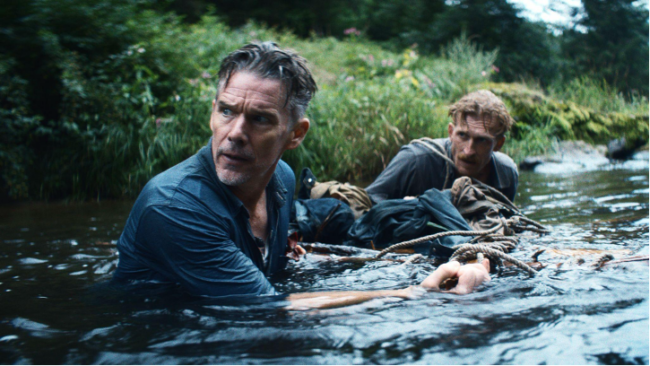
Along comes the metaphorical devil, to make a deal: Russell Crowe’s baseball-loving Warden Clancy needs some gold relocated from a mine before the FDR government comes along and confiscates it. If Murphy and the cohorts of his choosing – with supervision, of course – can spirit all that gold away on a five-day journey across Oregon, through unforgiving woods, they’ll get released immediately thereafter. The only problem, aside from it being highly illegal and the forest full of dangerous men, is that gold has a tendency to make men who’d otherwise cooperate think only about themselves.

Russell Crowe in The Weight

It’s a classic western setup in a more modern era: outlaws with gold braving the wilds on a perilous journey to freedom. But this wild, western state is no desert or high plain – rather, the endless woods feel like Blair Witch territory, waiting to cloud the mind and disorient or mislead casual travelers. Murphy’s war experience comes into play here, as he has a sense of danger that his colleagues do not, including an inclination of who is or isn’t bluffing.

Crowe peaces out of the middle of the movie – he’s there to set the stage and wrap things up with appropriate gravitas, menace, and token bits of quirkiness. (Clancy likes Dr. Pepper, shooting pigeons, and baseball.) McKinley served as consulting producer on the Crowe-directed Poker Face and executive produced and edited Showtime’s The Good Lord Bird with Hawke. Clearly he made a good impression, and they’re here paying back the favor in full. Co-screenwriter Shelby Gaines previously helped Hawke write the Flannery O’Connor biopic Wildcat, while coscribe Matthew Booi wrote the World War I drama Trench 11.

Ethan Hawke in The Weight

McKinley has been in the business for many years, predominantly as an editor. The Weight is his directorial debut, a genre blend that combines many of his favorite types of film, from chain-gang adventures like Fled to Depression-era drama like The Grapes of Wrath, and anti-heroic spaghetti westerns in The Good, The Bad, and The Ugly‘s vein. In Hawke, he has a cinephile star to match – going full-on Clint Eastwood, Murphy is the kind of guy to scowl slightly, speak softly, and pack a mean punch. Plus the things he does with a wedding ring include one of the finest bits of planting and payoff in any recent drama.

Actors were physically weighed down to feel like they were transporting gold bars for real, which makes the title literal, but there’s also the burden of trying to be a good father from behind prison walls, the trauma of war, and the conscience of doing what you have to do to survive among money-hungry and desperate men. The weighting, one might say, is the hardest part. Watching it comes much more easily.


“A rugged period melodrama that draws liberally from esteemed predecessors like The Treasure of the Sierra Madre, Deliverance, and Sorcerer” – Don Kaye, Moviefone.

“The Weight is the kind of ragtag, band-against-the-odds adventure that used to fill cinemas back in the day.” – Stephen A. Russell, Time Out.

Leave a Comment Filed Under: Inside the Arthouse, Newhall, NoHo 7, Santa Monica, Town Center 5 Tagged With: action, drama, Ethan Hawke, Padraic McKinley, Russell Crowe, The Weight

Iconoclastic Author, Iconic Comedians Kick off a Rich Documentary Fall

September 16, 2026 by Lamb Laemmle Leave a Comment

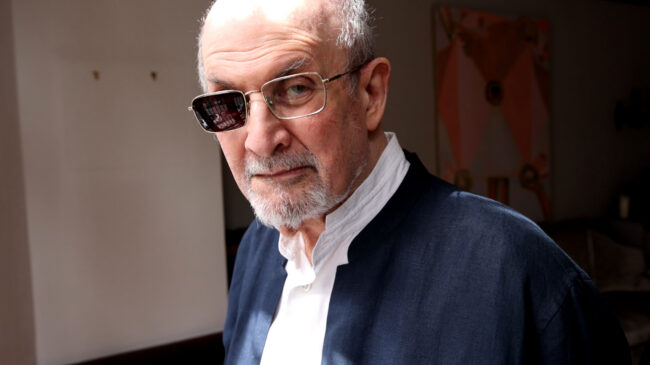
Aside from their lengthy titles, the documentaries You Had to be There:How the Toronto Godspell Ignited the Comedy Revolution, Spread Love & Overalls, and Created a Community That Changed the World (in a Canadian Kind of Way) and Knife: the Attempted Murder of Salman Rushdie both deal with key turning points in life, and how we process those memories.

Salman Rushdie

Knife opens at Laemmle’s Monica starting Sept. 25th . You Had to Be There opens at Laemmle’s Royal and Town Center 5 starting Sept. 25th.

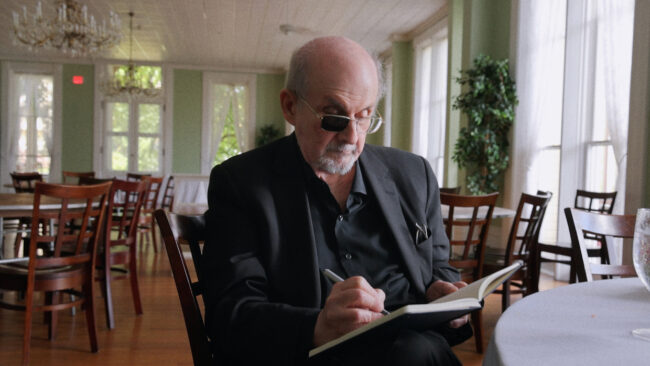
In 1989, Iran’s Supreme Ayatollah Khomeini proclaimed a fatwa on the head of writer Salman Rushdie, declaring he should die for writing a novel deemed blasphemous to Islam. Thirty-three years later, a young man who wasn’t even born at the time attempted to do the deed, repeatedly stabbing the author at a public event. Rushdie lived, and attempted to process the trauma of the incident as only an artist can, or would: through a book entitled Knife: Meditations After an Attempted Murder, and through video shot by his wife, the poet Rachel Eliza Griffiths, that has now been edited together into a film by acclaimed documentarian Alex Gibney. Rushdie is enough of a cause celebre that he can swing that level of filmmaker for an assist, but he is such for a reason – he can verbally process a situation like this more eloquently than most.

Given that Gibney is known, among other things, for the anti-Scientology documentary Going Clear, and a forthcoming expose of Elon Musk that has the tech mogul clearly nervous, it would have been easy to suspect that Knife could take on an anti-Islamist tone and theme. Yet unlike many War on Terror-era bloggers, Rushdie isn’t interested in being defined that way. He stands for free speech, and radical Islam suggests he should die for pushing the boundaries further than they can accept, and the movie doesn’t shy away from this, but it isn’t about that. It’s about the recovery and coping process, both physical and mental.

Salman Rushdie

Ironically, Rushdie’s controversial novel, The Satanic Verses, is fiction – at one point he says that if he had meant it to be critical of religion, it would have been more so. He intended to juxtapose the sacred and the profane, and illuminate truth through fiction. The documentary does some of the latter in itself, recreating some of Rushdie’s hallucinations and fantasy sequences, via animation and special effects. Next to so many other movies in the multiplex, it also illuminates fiction through truth in another way. We’ve seen so many action heroes in movies keep walking after sustaining stab wounds and gun shots; here, the harsh reality is that even a survivable knife attack leaves one man in recovery for a month before he can even walk out of bed.

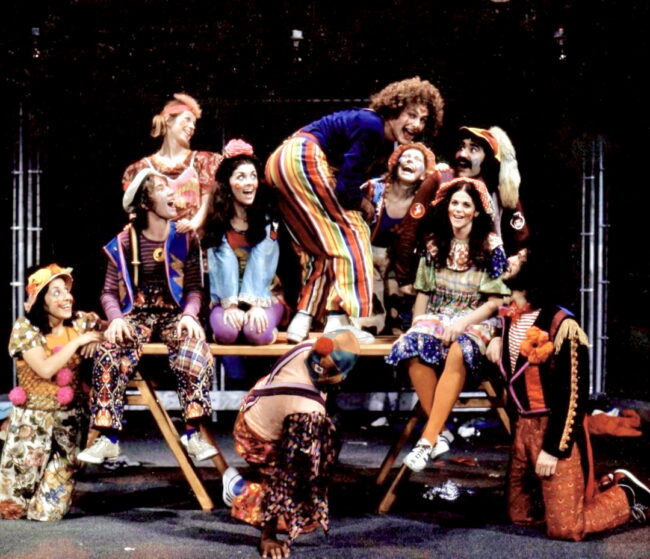
Gibney pointedly doesn’t let you see the footage of the actual attack until the end of the movie, so it can play more like a PTSD flashback than an opening jump-scare. You get to process the imagery only when Rushdie himself is ready to. That’s more of a visual than you get in You Had to Be There, whose title is pretty literal about the fact that virtually no footage survives of its subject: the 1972 Toronto production of Godspell.

Iconoclastic Author, Iconic Comedians Kick off a Rich Documentary Fall

What was so special about that production? Oh, only the fact that it featured a cast who would change comedy forever. A bunch of kids beginning their twenties with names like Martin Short, Gilda Radner, Paul Shaffer, and Eugene Levy. Lead actor Victor Garber would go on to star in the movie version afterward, to be replaced by Levy, who was replaced in his original role by Dave Thomas. Lorne Michaels and the producers of Second City were among those who saw the show…and saw money in its actors’ futures.

Short was a compulsive cassette recordist, so even though there’s very little video from the era, there’s a lot of audio, which director Nick Davis uses to create animated sequences in a deliberate seventies style. Davis is an improv group alumnus who mostly makes sports documentaries, so he knows how to make competitive performers of all types talk about their best moments. When what you have is animation and new interview segments, it helps that the subjects are all inherently funny people, though just in case, he adds a few younger folks like Lin-Manuel Miranda, James Austin Johnson, Heidi Gardner, and Mike Myers. And it’s not all smiles – there is one awful story of abuse in the midst of it, as well as the inevitable deaths to acknowledge that come with time.

Knife and You Had to Be There kick off a rich and varied awards season of documentaries coming to Laemmle Theatres in the upcoming weeks. Among others, The Trial of Alec Baldwin examines the actor-producer’s culpability in his infamous on-set shooting incident; The History of Concrete is a meta-doc about how you sell a movie about concrete; The Last Dive looks at the friendship between a biker and a giant manta ray; My Undesirable Friends Part II follows up on the acclaimed five-hour Russian documentary about exiled journalists; and The Gymnasts of Fisherman Colony has a title that probably says it all.

In truth as well as fiction, the storytelling possibilities are still nigh-endless.

“Through Rushdie’s path, we see a way to put our pain in its proper place, acknowledging that it does not have to be the sole way in which we’re defined by the world.” — Zachary Lee, The Wrap.

“The most incredible thing about You Had to Be There is that this film makes you feel like you were there, and these friends are your friends too.” — Kristy Puchko, Mashable.

Leave a Comment Filed Under: Royal, Santa Monica, Town Center 5 Tagged With: documentary, Gilda Radner, Knife, Martin Short, Salman Rushdie, You Had to Be There

Brydie O’Connor Preserves a Queer Icon’s Voice in ‘Barbara Forever’

September 9, 2026 by Lamb Laemmle Leave a Comment

The title Barbara Forever undoubtedly conjures up images in the mind, perhaps of a famous Barbara beloved by all. It’s not who you’re probably thinking, though: Barbara Hammer was beloved in certain circles, but lesser known to the world at large, a state of affairs this overdue tribute-documentary looks to correct.

Brydie O'Connor Preserves a Queer Icon's Voice in 'Barbara Forever'

Barbara Forever opens at Laemmle’s Royal Sept. 11th. Director Brydie O’Connor will participate in Q&As following the 7:30 p.m. shows at the Royal, moderated by Cameron Esposito on September 11 and Fenton Bailey on September 12.

There’s a scene in the film that’s been featured heavily in its trailer, in which Hammer, addressing a class of elementary school students, prepares them for the new kind of film she’s about to show them: an experimental film. She screens it – fortunately for all involved in that moment, it isn’t one of her many films full of female nudes – and the kids, while not necessarily knowing what to make of it, engage the material. One says he liked it; others simply try to describe what they’ve seen. But they all take away something, and none dismisses it out of hand.

Brydie O'Connor Preserves a Queer Icon's Voice in 'Barbara Forever'

That’s the way to approach Barbara Forever – wide-eyed and with childlike curiosity — which isn’t a conventional biographical documentary, but one made in the spirit of its subject, a pioneering lesbian avant-garde director. Not unlike Ross McElwee, she turned the camera on herself many years before social media had us all doing it. Unlike him, she was a queer woman who set out to make more abstract visual art about her sexuality, which was a combination of factors considered mutually exclusive in the ’60s when she began doing it.

Director Brydie O’Connor, expanding on her own short “Love, Barbara,” became fast friends with Hammer’s widow Florrie R. Burke after Hammer’s death. Given access to her archives, which had been donated to Yale, O’Connor put together Barbara Forever from bits of Hammer’s films, outtakes, new footage, old photographs, audio interviews, and more to create a subjective portrait of the director through her own images, textures, and editing rhythms. Hammer’s voice narrates; one gets little sense of O’Connor as a distinctive voice, but more a sort of vessel or medium for the spirit of her artist muse to communicate again.

Brydie O'Connor Preserves a Queer Icon's Voice in 'Barbara Forever'

As mentioned, there is a lot of nudity in Hammer’s body of work – normalizing lesbian sexuality was a huge motivating factor in her directing, including what many consider the first true lesbian lovemaking scene in her 1974 film Dyketactics. Later, as she documents her own cancer, Hammer literally goes beneath the skin, showing us her own x-rays in motion. It’s just another extension of her emotional nakedness, and after all, isn’t that often more challenging than the physical?

Hammer’s best-known film is arguably the 1992 documentary feature Nitrate Kisses, a history of LGBT repression since World War I. If you aren’t even familiar with that one, Barbara Forever offers an immersive entry point into her filmography highlights. In trying to sum up the reasons her life mattered, it necessarily covers a lot of ground, and does so creatively, but leaves many avenues open for newly converted fans to discover more on their own.

In some of Hammer’s final interviews, she made clear that she wanted to be remembered and respected for the work that she knew was important at the time. O’Connor gave her that respect due, and through her eyes, many more will now too.


“Like Hammer’s films, Barbara Forever is a polyphony of image and sound, sex and love, life and death; a radiant treat for the senses.” — Joseph Dimacchia, In Review Online.

“A beautifully assembled introduction to Hammer’s adventurous life and work.” — Zachary Barnes, Wall Street Journal.

Leave a Comment Filed Under: Filmmaker in Person, Royal Tagged With: Barbara Forever, Barbara Hammer, Brydie O'Connor, Cameron Esposito, documentary, experimental, Fenton Bailey, LGBTQ+

Alvaro Olmos Torrico’s ‘The Condor Daughter’ Contrasts Andean Tradition and Modernity

September 9, 2026 by Lamb Laemmle Leave a Comment

The Andes mountains stretch out as far as the eye – and the camera – can see in the land of the Quechua people. The view suggests infinite horizons and possibilities, yet the people live in small, thatched houses, sometimes with only one room. In Alvaro Olmos Torrico’s The Condor Daughter, these contrasts come to the fore.

Alvaro Olmos Torrico's 'The Condor Daughter' Contrasts Andean Tradition and Modernity

The Condor Daughter opens at Laemmle’s Royal and Glendale Sept. 18th. Director Alvaro Olmos Torrico will participate in Q&As following the 7:20 p.m. show on September 18 at the Glendale and after the 4:20 p.m. and  7:00 p.m. show on September 19 at the Royal.

The movie begins in the dark interior of one thatched house, warmly lit and cosily filmed through thin curtains. A woman is giving birth at home, with the aid of a traditional midwife – Ana, played by first-time actress María Magdalena Sanizo. Her daughter, Clara (also first-timer Marisol Vallejos Montaño) sings while she works, and indeed, seems to enjoy that part of the job most. In her village out of time, the radio is practically the only tie to modernity, and modern music in particular. Ana, at her age, says she now prefers silence.

The scene where the rebellious child leaves home is a trope of the coming of age film; here, Clara silently gets out of bad, packs her stuff, and makes it all the way to the door before her mother is revealed sitting up on the bed behind her, making intense eye contact. Nothing need be said, and nobody tries to stop anything – there’s an understanding that this is how it must go, and only later will Ana pursue her to the city.

Alvaro Olmos Torrico's 'The Condor Daughter' Contrasts Andean Tradition and Modernity

We are told by the neighbors that condors don’t attack – they only eat things that are already killed. In many ways, Ana’s village seems to be the dead meat she was nourished on. It’s scarcely known to exist, its retrograde politics include forcible and extreme haircuts for young women who dare talk to men outside their families, and the midwife role is soon to be phased out by the closest hospital, which wants to ensure safer childbirths by law. As residents leave, and crops die, some suspect a curse, and one that has come about all due to Clara leaving.

In the city, houses are jammed together, yet interiors and rooftops are far more spacious – there’s visual room here for people to grow even if nature cannot. The rooms are lighter, as even the dark ones at night are drenched in neon. Both urban and rural worlds are imbued with their own beauty, as director of photography Nicolas Wong (La Llorona) shoots the country like a painting, and the city like a photo book.

Torrico’s previous feature, Wiñay, told the opposite story: two city girls headed for the country in search of silence. Here, Clara and her best friend Flora seek the noise, and the ability to make a living in a party setting. Montaño, though new to acting, has some experience with this scene as part of an all-girl group. That she makes this aspect look the most naturally awkward attests to her quick study as an actor, and Torrico’s skill at directing her.

Alvaro Olmos Torrico's 'The Condor Daughter' Contrasts Andean Tradition and Modernity

The writer-director has points to make, but he sees the good in both close-knit rural tradition and open urban career frontiers, ultimately coming down on the side of personal choice. Become who you are because you want to, not because you were conditioned to. It’s a universal truism that undoubtedly helped this film to become Bolivia’s official entry for the Best International Feature Oscar.


“The Condor Daughter is, without a doubt, an experience that invites us to approach the Andean world with new eyes, not only to question its harmful patriarchy but also to revalue the contributions of its women” — Gustavo Herrera Taboada, Cinencuentro.

“The Condor Daughter is a story anyone can relate to, even if they’re not familiar with the setting or the language.” — Lissete Lanuza Sáenz, Fangirlish.

Leave a Comment Filed Under: Filmmaker in Person, Glendale, Royal Tagged With: Alvaro Olmos Torrico, Awards, Bolivia, Oscar submissions, The Condor Daughter

Orlando von Einsiedel’s ‘The Cycle of Love’ Takes Mettle to the Pedal

September 2, 2026 by Lamb Laemmle Leave a Comment

A prophecy of true love. A perilous journey most sane men would not attempt. These are classic fairy tale ingredients, but in 1977, for one young man in Delhi, they were very real. The Cycle of Love documents his incredible journey across continents to find the metaphorical princess.

Orlando von Einsiedel's 'The Cycle of Love' Takes Mettle to the Pedal

The Cycle of Love opens Sept. 4th at Laemmle’s Royal, and Sept. 11th at the Glendale and Town Center 5. Real-life subjects Lotta and P.K. Mahanandia will participate in Q&As following the 7:25 p.m. shows on Friday, Sept. 4th and Saturday, Sept. 5th, at the Royal

Director Orlando von Einsiedel has twice won Academy Awards for documentary shorts: in 2016 for “The White Helmets,” and in 2020, for “Learning to Skateboard in a Warzone (if you’re a girl).” Both films took the British director across the Muslim world, from Turkey to Syria and Afghanistan. The subject of The Cycle of Love goes on a similar journey, retraced by von Einsiedel’s cameras. P.K. Mahanandia, narrating in the present and played by Chirag Benedict Lobo in reenactments, was drawing portraits for money on the streets when he met Swedish tourist Lotta Von Schedvin (also herself in present-day segments, and Mina Dale in flashbacks), and knew it was destiny.

At least, he thought he knew. A prediction carved into a leaf, made by an astrologer in P.K.’s infancy, said his true love would live far away, be a Taurus, be musical, and own a jungle. Lotta hit all four, much to P.K.’s delight, with the asterisk that her family owned forest land rather than a literal jungle. He brought her to meet his parents; she promised to return in August. When she did not do so, he vowed to go to her…yet all he could afford was a half-price woman’s bicycle. Perhaps not since David Lynch’s The Straight Story, which documented Alvin Straight’s 1994 journey on a riding mower to see his ailing brother, has cinema tackled such a real-life, slow-motion, underdog odyssey for love.

P.K. in The Cycle of Love

It was the ’70s, so people still hitchhiked, traveled the world in vans, and were generally hospitable to wandering nomads, even in countries we now consider hostile like Iran and Afghanistan (Pakistan proved to be the exception, for Indians at least). Much of the road traveled is even called “the hippie trail.” So like any great mythic hero, P.K. met several interesting characters along the way, some of whom helped, while others hindered. At least one could almost have been a morality test from the gods, which he passed.

Von Einsiedel has made a unique choice not to strictly document the journey as it happened, but in spirit as he retraces it. Rather than specifically recasting the individuals encountered by P.K., he has actor Chirag Benedict Lobo interact in character with real people along the way, as the film crew follows the same path. It’s shot in a grainy style designed to evoke the ’70s, and presented as if it is, interspersed with what little available archival film exists, yet the presence of the lead actor tells us it’s new, while the testimonies of the real people he meets indicate that too little has changed over the years. In particular, P.K.’s heritage as part of the “Untouchable” Dalit caste in Indian society made him the victim of his own culture’s bigotry, viewing him as so spiritually dirty that even physical contact requires an immediate cleanse. When Lobo-as-P.K. speaks to other Dalits, it’s clear the prejudice remains.

Lotta in The Cycle of Love

The Cycle of Love also pointedly films the real P.K. and the real Lotta against completely different backdrops, leaving us in suspense for most of the movie as to whether or not the quest succeeded, or even if they’ve talked since then. Because it’s a documentary – albeit a mostly restaged one — viewers can find out the answer in advance if they really want to, but for better appreciation of the dramatic arc, the filmmakers strongly suggest that you refrain from that, and take the journey as it is meant to be experienced. In a year that cinema has rediscovered the classic literary Odyssey, come along for the ride on the one that really happened.


“Einsiedel’s method edges toward the revelatory, often recalling the cockeyed realities of Iranian director Abbas Kiarostami.” – Christian Craig, In Review Online.

“Delicate and heartwarming, Orlando von Einsiedel’s stirring documentary “The Cycle of Love” is the kind of film whose sweet subject transcends time and borders.” – Robert Daniels, RogerEbert.com.

Leave a Comment Filed Under: Actors in Person, Glendale, Q&A's, Royal, Town Center 5 Tagged With: documentary, Orlando von Einsiedel, The Cycle of Love

Andrius Blaževičius Bemusedly Wonders ‘How to Divorce During the War’

August 26, 2026 by Lamb Laemmle Leave a Comment

Breaking up is hard to do, and it’s only made harder when Vladimir Putin gets involved. In Andrius Blaževičius’ satirical drama How to Divorce During the War, a failed marriage is complicated by the Ukraine invasion beginning the day after a wife decides to call it quits.

HowtoDivorce_still_01

How to Divorce During the War opens Friday, Aug. 28th, at Laemmle’s Royal, Glendale, and Town Center 5. Catch director Andrius Blaževičius on the latest episode of Inside the Arthouse with Greg Laemmle and Raphael Sbarge.

How to Divorce During the War is Blaževičius’ third feature, and like the other two, stars Marius Repšys as a man named Vytas who finds his life going out of control. Returning from his second feature, Runner, is Žygimantė Elena Jakštaitė as girlfriend Marija, now his wife. You don’t need to have seen the prior films, and it isn’t clear that they’re in any way connected narratively – in fact, the less you know about this incarnation of Vytus and Marija, the better, as the film slowly unfolds all the important details about who they are and why they might be having problems.

Vytas and Marija live in Lithuania – this film is the country’s official Oscar submission – which is a NATO country, and thus traditionally protected against Russian attack. Yet with the current U.S. administration’s casual attitude towards the alliance, and Russia’s invasion of Ukraine, Lithuanians fear they’re next on the hit list if Ukraine falls. These anxieties move to the forefront once the war officially begins, but they don’t eliminate the practicalities of how to execute a divorce, especially with a child involved.

HowtoDivorce_still_04

Marije simply says she doesn’t love Vytus any more. No particular reason is given, at least at first. It seems to be an accumulation of little things: the fading of youth, the vicissitudes of entertainment industry careers, the responsibilities of parenthood, or a same-sex crush in a coworker. Vytus is an old-school filmmaker and screenwriter, which means in practical terms that he’s broke and serves as a house-husband; Marije works in new media, producing viral shorts for the web, and makes enough money doing that to pay all the family bills, though it also surrounds her with young and single people.

TV commentary on the war, about how neither side can come to a compromise, doubles and even triples in meaning, as it could easily be referring to the couple, or to a former Soviet society that becomes violently divided in its sympathies. In their own ways, Vytas and Marije demonstrate performative support for Ukraine, only to backslide the moment their bold stances start to actually cost them anything. It is, as always, the children who suffer most: daughter Dovile acts out at school, and tries to mirror her parents in the best ways, inadvertently holding a mirror up to their behavior that they may be too stubborn to gaze into.

HowtoDivorce_still_05

Blaževičius’ signature stylistic move is the slow camera push in towards a character or characters sitting in a car – it’s the one part of their environment they can control, or so they think. He also loves the dining room table as a source of drama: in one of the film’s standout scenes, Vytas subtly undermines Marije with the Ukrainian refugees she’s taken in, by speaking to them in Russian which she doesn’t understand, and pretending it’s all good.

The story begins and ends with the same, still cityscape, suggesting that life goes on regardless, and many of our gestures are futile. Yet so, the film suggests, is our selfishness – in the grand scheme of things, little of it matters, so why not consider the comfortable option? No easy answer is offered, but as everyone onscreen tries to figure it out, their foibles, however “foreign,” may start to look amusingly familiar. To cite but one more example, a scene where Vytus tries to remove his parents’ satellite TV so they won’t watch propaganda “news” channels should resonate just as strongly with American audiences.


“The results are sometimes dramatic but often dryly amusing, capturing the leads’ cushy lives and their often warped sense of altruism in a series of droll vignettes.” – Wilson Chapman, IndieWire.

“A drily witty, subtly searing comedy from writer-director Andrius Blaževičius, “How to Divorce During the War” is both empathetic and surgical as it examines both partners’ attempts to sublimate selfish angst into social activism.” – Guy Lodge, Variety.

Leave a Comment Filed Under: Awards, Glendale, Greg Laemmle, Inside the Arthouse, Royal, Town Center 5 Tagged With: Andrius Blaževičius', Awards, Greg Laemmle, How to Divorce During the War, Inside the Arthouse, Lithuania, Oscar submissions, Raphael Sbarge

Rafael Manuel’s ‘Filipiñana’ Captures National Class Struggle in a Golf Course

August 25, 2026 by Lamb Laemmle Leave a Comment

Writer-director Rafael Manuel has made a debut feature to immediately command attention with Filipiñana, a deadpan, day-in-the-life look at an elite golf course through the eyes of the teenage country girl who works there on the lowest rung of the service scale.

Filipiñana_Still_4

Filipiñana opens Friday, Sept. 4th at Laemmle’s Glendale and Monica Film Center. In person Q&As with writer-director Rafael Manuel after a special 7 p.m. show on Sept. 2nd at the Royal, a  7 p.m. show on Sept. 3rd at the NoHo, and after the 7 p.m. shows Sept. 4th and 8th  in Glendale!

As the title of the movie appears onscreen, Filipiñana delivers an edit that recalls the famous matchstick-to-desert cut in Lawrence of Arabia, but deliberately, ironically in reverse. The hot, crowded streets of Manila, where families line up for limited water rations, instantaneously transition to a view of sprinklers on a vast golf course. The water here is freely given away – to the plants rather than the people – while the fruit trees drop their mangoes that nobody is allowed to pick, to be eaten by ants on the ground. From a high angle, the rows of golf carts traveling in unison along the designated paths look like nothing more than the world’s most expensive model train set.

Earlier this summer, Gail Daughtry and the Celebrity Sex Pass riffed on The Wizard of Oz for comedic effect. Here, Manuel gives us a verdant Emerald City of sorts more akin to the original Baum novel, or perhaps Wicked, complete with all-female caddies in Glinda-pink uniforms. It’s an impressive kingdom – the movie’s golf resort was filmed using eight different courses to create the impression of one massive one. And it suggests opulence and luxury, yet it’s a fraud at heart, just like its very own “wizard,” Dr. Pelanca (Teroy Guzman). Like the nation of the Philippines itself, it’s built on colonization and exploitation, and its artificial space allows the richest clientele the luxury of not having to pay attention to anything else.

Filipiñana_Still_2

Seventeen year-old Isabel (Jorrybell Agoto) is new to the job, from the northern, rural region of Ilocos, which has a distinct culture and language (and was home to dictator Ferdinand Marcos). She’s a tee girl, whose job it is to ensure there is always a ball ready for players on the driving range to hit. Tee girls aren’t allowed on the actual course, but its vast size makes that an impossible rule to fully enforce. In the morning, as she cools off lying on the grass, a smaller girl walks into her field of vision, greets her, and then runs off. Later in the day, that girl will be reported missing, and almost nobody will care.

Cinematograoher Xenia Patricia shoots mostly long, static shots in 3:4 aspect ratio – not due to any expectation that Filipiñana will be screened in IMAX, but to emphasize vertical power dynamics, and the trees on the course which represent the labor. Water is thrown at them until they die, at which point they are easily replaceable. Employees are frequently filmed either lying down or from higher angles, while Dr. Pelanca and his friends are forcibly looked up to. Like Michael Haneke, Manuel wants to see how manipulable you are as an audience member. The takes are slow, but blink and you might miss a clue. The ultimate test of this is the end credits – be sure you sit through them rather than walking away too soon (as every character onscreen does), in order to get the real ending.

Like Jonathan Glazer’s Oscar-winning The Zone of Interest, Filipiñana says as much with what it doesn’t show as what it does, which is mostly luxury and comfort if you don’t look too closely. The caddies are old enough to speak truth, but only among ears that will hear it. Music is sparse, and mostly in the form of bands playing stereotypical “exotic” music they imagine the mostly Chinese guests will want to hear.

Filipiñana_Still_8

The feature is an expansion of Manuel’s thesis short film at the London Film School, and produced by Jia Zhangke (Still Life) who served as his mentor for two years. Filipiñana won the Special Jury Award for Creative Vision at this year’s Sundance Film Festival, rewarding everyone’s faith in the material. It should similarly reward viewers in theaters this fall.


“An incisive, slow-burning satire of capitalism and powerful men with far too much hubris — basically, a story for our times.” – Aisha Harris, NPR.

“Through heightened control of imagery and mood, attention to composition and texture and sound, Manuel turns this simple, languid setting into something far more sinister without ever betraying the beauty of what’s onscreen.” – Bilge Ebiri, Vulture.

Leave a Comment Filed Under: Films, Glendale, Santa Monica Tagged With: drama, Filipiñana, Filipino, Jorrybell Agoto, Rafael Manuel, satire

Emmanuel Courcol’s ‘The Marching Band’ Is Like a French Spin on ‘School of Rock’

August 19, 2026 by Lamb Laemmle Leave a Comment

Triumph and tragedy are inextricably intertwined in Emmanuel Courcol’s The Marching Band, from the moment superstar conductor Thibaut Desormeaux (Benjamin Lavernhe) gets a leukemia diagnoses that results in him finding a long-lost brother. As they mend fences and fight the illness, the two also prepare to compete together in a regional marching band contest.

Emmanuel Courcol's 'The Marching Band' Is Like a French Spin on 'School of Rock'

The Marching Band opens at Laemmle’s Town Center 5 and Royal Aug. 28th, and at the Glendale Sept. 4th.

You’ve likely heard of School of Rock – consider this movie “Factory of Classical.” Mishaps escalate early in the story for Thibaut, as he doesn’t just have cancer, but his sister can’t donate bone marrow to him, because she’s not his biological sister, and he never knew it. It’s a hell of a way to learn he’s adopted, just as it’s awkward for his long-lost brother Jimmy (Pierre Lotin) to suddenly learn about Thibaut when he suddenly shows up on the doorstep requesting a transfusion.

Jimmy works in a cafeteria, but plays in a marching band made up of local factory workers. He appears to have a genetic affinity for music, and Thibaut sees in him the potential to also become a conductor. When the band’s own conductor has to leave town over a job change, the two newfound brothers work together to get these decidedly ragtag, argumentative local musicians into shape for a regional competition.

Emmanuel Courcol's 'The Marching Band' Is Like a French Spin on 'School of Rock'

The selection they practice is “Bolero” by Maurice Ravel, which Thibaut calls the biggest classical hit of all time, possibly showing some patriotic bias as Ravel was French. Trust us, though, you’ve heard this piece, even if the name doesn’t ring a bell. It’s narratively related, too: “Bolero” was one of Ravel’s last compositions before e contracted a mystery illness that would ultimately kill him. It was also likely inspired by the rhythms of the factory in which Ravel’s father worked, and used to frequently take him as a child. (Thibaut claims this as a fact, but the actual facts are less clear.)

While the preparation and build up towards a big concert makes for a traditional underdog triumphant arc, Courcol is less interested in that aspect than he is the bonding between two very different siblings with similar gifts. Slender, well-dressed Thibaut had every advantage in life, worked hard on his music, and became a superstar in the classical world. Jimmy, who dons blue jeans and a tracksuit top, had to struggle to stay just above the poverty line, and could only find time for music as a hobby. The circumstances were out of their control, and it’s too late to radically change, especially with leukemia lurking, but if they can find forgiveness and the camaraderie they were never allowed as separated kids, maybe that’s as big a triumph as any competition victory.

Emmanuel Courcol's 'The Marching Band' Is Like a French Spin on 'School of Rock'

As a result, you don’t have to know anything about classical music to appreciate the story. Indeed, many of Jimmy’s bandmates don’t, but “Bolero” is a perfect entry-level tune for singers, musicians, and listeners, even as more knowledgeable audophiles will appreciate its thematic resonance as well.

Courcol’s first film as director was Ceasefire, a period drama about a World War I veteran who abandons his family for Africa, then returns and has to heal the wound he caused. His second, The Big Hit, was a comedy abut a prison theater troupe. With The Marching Band, he might just have hit the crowd-pleasing sweet spot, with both a performing troupe and healing familial bonds in play. The movie’s not above being a tear jerker at times, but a reason to cheer the characters onward is never far behind.


“This film may not surprise, but it’s a sincere and uplifting tale that is in tune with the spirit of underdog crowd-pleasers Brassed Off and The Full Monty.” – Dulcie Pearce, The Sun UK

“A huge hit in its native France, this uplifting, moving and subtly funny affair has been making friends right around the world.” – Leigh Paatsch, Daily Telegraph (Australia)

Leave a Comment Filed Under: Glendale, Royal, Town Center 5 Tagged With: classical music, drama, Emmanuel Courcol, inspirational, music, The Marching Band

  • 1
  • 2
  • 3
  • …
  • 263
  • Next Page »

Search

Instagram

Please follow the affected businesses on social me Please follow the affected businesses on social media. They will be posting how you can help as they figure out their next steps, and the best thing any of us can do right now is be ready when they ask. 

#OldTownNewhall #SantaClarita
Maddie's Secret is here, and so is the collector b Maddie's Secret is here, and so is the collector bundle.

😍 Ticket + Tee + Mini Poster, only at Laemmle NoHo. While supplies last.

"An extremely accomplished debut and one of the boldest American movies I have seen in years." Sam Bodrojan, IndieWire

A film by John Early.
#MaddiesSecret #JohnEarly #LaemmleNoHo #NoHo #MagnoliaPictures
🚀 STOP! THAT! TRAIN! AN EPIC PRIZE PACK GIVEAWAY! 🚀 STOP! THAT! TRAIN! AN EPIC PRIZE PACK GIVEAWAY!

👉 ENTER in BIO!
#StopThatTrain - A NYT Critic’s Pick! sees RuPaul and many of your favorite DRAG RACE stars in a high speed comedy aboard a locomotive headed for disaster.

⭐️ Starring @rupaulofficial, directed by @adamshankman, produced by @worldofwonder, distributed by @bleeckerstfilms, in association with @unapologeticprojects

🎟️ GET TICKETS: in BIO!
This is the way. 🍿 Exclusive Mandalorian & Grogu p This is the way. 🍿 Exclusive Mandalorian & Grogu popcorn tins and collectible figurines. Yours with a Mando Combo purchase! Very limited supply. 

@LaemmleNewhall & @LaemmleNoHo

🎟️Tickets: laem.ly/4aoKwRb
🖌️Sandwich board art by @mikaelparis_

#StarWars #TheMandalorian #Grogu
Follow on Instagram


Laemmle Theatres

Laemmle Theatres
Tickets: http://laemmle.com/film/artfully-united | Subscribe: http://bit.ly/3b8JTym | ARTFULLY UNITED is a celebration of the power of positivity and a reminder that hope can sometimes grow in the most unlikely of places. As artist Mike Norice creates a series of inspirational murals in under-served neighborhoods in and around Los Angeles, the Artfully United Tour transforms from a simple idea on a wall to a community of artists and activists coming together to heal and uplift a city.

Tickets: http://laemmle.com/film/artfully-united

RELEASE DATE: 10/17/2025
Director: Dave Benner
Cast: Mike Norice

-----
ABOUT LAEMMLE: Since 1938, Laemmle [Theatres] has been showing the finest independent, arthouse, and international films.

Subscribe to Laemmle's E-NEWSLETTER: http://bit.ly/3y1YSTM
Visit Laemmle.com: http://laemmle.com
Like LAEMMLE on FACEBOOK: http://bit.ly/3Qspq7Z
Follow LAEMMLE on TWITTER: http://bit.ly/3O6adYv
Follow LAEMMLE on INSTAGRAM: http://bit.ly/3y2j1cp
Tickets: http://laemmle.com/film/brides | Subscribe: http://bit.ly/3b8JTym | Nadia Fall's compelling debut feature offers a powerful and empathetic look into the lives of two alienated teenage girls, Doe and Muna, who leave the U.K. for Syria in search of purpose and belonging. By humanizing its protagonists and exploring the complex interplay of vulnerability, societal pressures, and digital manipulation, BRIDES challenges simplistic explanations of radicalization.

Tickets: http://laemmle.com/film/brides

RELEASE DATE: 9/24/2025
Director: Nadia Fall

-----
ABOUT LAEMMLE: Since 1938, Laemmle [Theatres] has been showing the finest independent, arthouse, and international films.

Subscribe to Laemmle's E-NEWSLETTER: http://bit.ly/3y1YSTM
Visit Laemmle.com: http://laemmle.com
Like LAEMMLE on FACEBOOK: http://bit.ly/3Qspq7Z
Follow LAEMMLE on TWITTER: http://bit.ly/3O6adYv
Follow LAEMMLE on INSTAGRAM: http://bit.ly/3y2j1cp
Tickets: http://laemmle.com/film/writing-hawa | Subscribe: http://bit.ly/3b8JTym | Afghan documentary maker Najiba Noori offers not only a loving and intimate portrait of her mother Hawa, but also shows in detail how the arduous improvement of the position of women is undone by geopolitical violence. The film follows the fortunes of Noori’s family, who belong to the Hazaras, an ethnic group that has suffered greatly from discrimination and persecution.

Tickets: http://laemmle.com/film/writing-hawa

RELEASE DATE: 10/8/2025

-----
ABOUT LAEMMLE: Since 1938, Laemmle [Theatres] has been showing the finest independent, arthouse, and international films.

Subscribe to Laemmle's E-NEWSLETTER: http://bit.ly/3y1YSTM
Visit Laemmle.com: http://laemmle.com
Like LAEMMLE on FACEBOOK: http://bit.ly/3Qspq7Z
Follow LAEMMLE on TWITTER: http://bit.ly/3O6adYv
Follow LAEMMLE on INSTAGRAM: http://bit.ly/3y2j1cp
Subscribe

Recent Posts

  • Padraic McKinley’s ‘The Weight’ Recalls Classic Westerns and Thrillers
  • Iconoclastic Author, Iconic Comedians Kick off a Rich Documentary Fall
  • Brydie O’Connor Preserves a Queer Icon’s Voice in ‘Barbara Forever’

Archive

Featured Posts

An “embrace of what makes us unknowable yet worthy of forgiveness,” A LITTLE PRAYER opens Friday at the Claremont, Newhall, Royal and Town Center.

Leaving Laemmle: A Goodbye from Jordan