
It’s daunting, even for cinephiles, to be told that one of the best movies of the year is a five-hour documentary that you absolutely must see. Such was the case with last year’s My Undesirable Friends: Part I — Last Air in Moscow, which won the New York and L.A. Film critics’ top documentary award. Now comes the sequel, My Undesirable Friends: Part II – Exile, which is arguably even better, and at nearly six hours, definitely longer…but worth it.
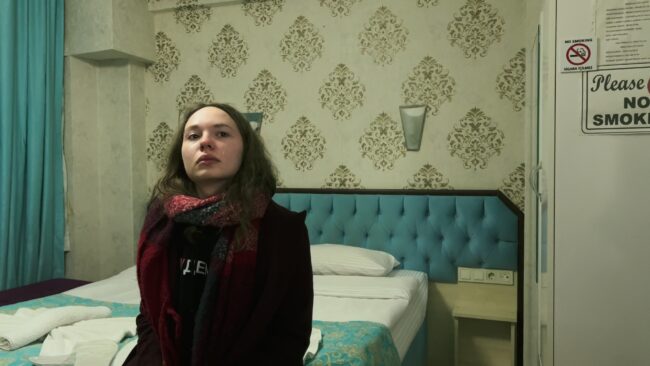
Laemmle Theatres will screen the film in two parts at the Royal, starting Oct. 16th. Chapters 1-3 total 192 minutes, and Chapters 4-5 are 164 minutes. For Chapters 1-3, filmmaker Julia Loktev will introduce the 1:30 p.m. and 6:00 p.m. shows on October 16, the 1:30 p.m. show on October 17, and the 6:00 p.m. show on October 18. Q&As with Loktev and subjects Valeria Ratnikova and Ksenia Mironova for Chapters 4-5 follow the 6:00 p.m. show on Oct. 17 and the 1:30 p.m. show on Oct. 18.
The tension in the original film was waiting to see when the main characters – Russian oppositional journalists who tell the truth about Vladimir Putin’s authoritarianism – would catch up to what we, watching from their future, already know: the situation is going to get worse, and Russia is going to initiate an unprovoked war against Ukraine. Due to the encroaching, increasingly fascistic state, most of the movie was filmed indoors, in the journalists’ homes, as they have to come to a decision whether it’s really, finally time to leave their home country, or risk imprisonment merely for existing there.
The sequel follows those who left, along with some new exiles, in various different countries. Some go straight to where the action is, in Ukraine, while others choose the relative safety of Turkey or Austria. Anna Nemzer, credited as codirector, uses her Jewish heritage to secure an Israeli passport, then worries that it compromises her ability to criticize the Israeli government. Because there is no imminent danger of arrest in these countries, there’s much more visual variety in the settings, as the exiles acclimate. And because they are also able to actually do some journalism again, there are more cutaways to the news footage. This may be a longer movie than the first, but it’s easier on the eyes, and attention span, in its pacing.
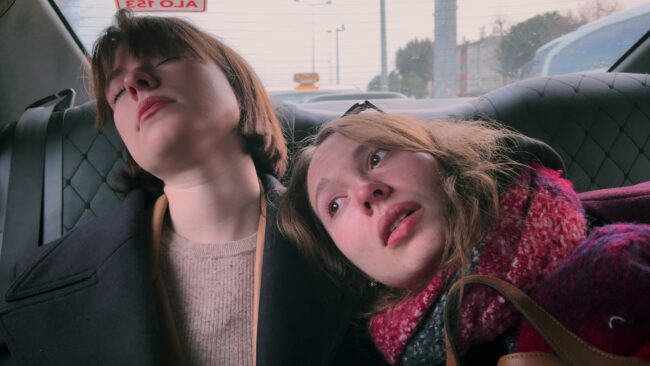
The tension here is less about what the subjects know and when they’ll know it, though stated predictions that the war will end quickly, and relief that dissident Navalny is still alive in prison, serve as ominous portents. Instead, Exile is more about coping with the difficulties of journalism in a world where both governments and commerce devalue it. It’s arguably the most extreme example, covering a war the totalitarian government wants everyone to think is mostly a peaceful police action, but it holds a mirror to smaller steps we might see on our own shores. As the older generation simply says, “Let’s not talk politics” when confronted with pictures of actual dead children, it feel like a reductio ad absurdum of conversations all of us have had with parents or elders. Denial persists even in the face of worse atrocities than we might hope to ever face.
Learning how to cope is a prevailing sentiment. “At least it’s not as bad as…” begins many sentences. Russian exiles find themselves stereotyped and scapegoated for the actions of their country, and refreshingly, they don’t get defensive. There’s no #NotAllRussians hashtag. Instead, in a model of how someone should behave in these circumstances, everyone here accepts a degree of collective blame. Yes, our country kinda sucks right now. Yes, maybe we could have done something to help, even if we don’t know what. Let us help you now, siding with you against our people’s atrocities.
Meryl Streep was so impressed by the first film that she signed on as executive producer for the second. Stick with it, and you’ll probably be impressed too. Don’t expect a threequel next year, however. Director Julia Loktev says she’s saving that for when Putin dies and everyone can (theoretically) return home.
“Loktev and co-editor Michael Taylor have, once again, crafted a conversational epic that imbues each twist and turn with enormous stakes.” – Siddhant Adlakha, Variety.
“Exile plays less like a journalistic procedural than Last Air in Moscow—which felt like an extension of the shoe-leather journalism practiced by the reporters—and more like a ruminative psychological drama.” – Marshall Shafer, Slant.