
Aside from their lengthy titles, the documentaries You Had to be There:How the Toronto Godspell Ignited the Comedy Revolution, Spread Love & Overalls, and Created a Community That Changed the World (in a Canadian Kind of Way) and Knife: the Attempted Murder of Salman Rushdie both deal with key turning points in life, and how we process those memories.
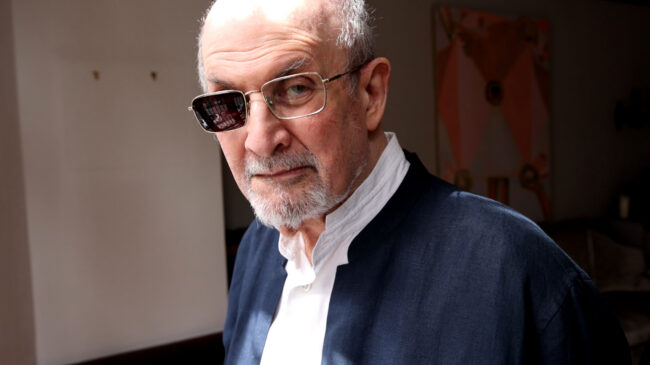
Knife opens at Laemmle’s Monica starting Sept. 25th . You Had to Be There opens at Laemmle’s Royal and Town Center 5 starting Sept. 25th.
In 1989, Iran’s Supreme Ayatollah Khomeini proclaimed a fatwa on the head of writer Salman Rushdie, declaring he should die for writing a novel deemed blasphemous to Islam. Thirty-three years later, a young man who wasn’t even born at the time attempted to do the deed, repeatedly stabbing the author at a public event. Rushdie lived, and attempted to process the trauma of the incident as only an artist can, or would: through a book entitled Knife: Meditations After an Attempted Murder, and through video shot by his wife, the poet Rachel Eliza Griffiths, that has now been edited together into a film by acclaimed documentarian Alex Gibney. Rushdie is enough of a cause celebre that he can swing that level of filmmaker for an assist, but he is such for a reason – he can verbally process a situation like this more eloquently than most.
Given that Gibney is known, among other things, for the anti-Scientology documentary Going Clear, and a forthcoming expose of Elon Musk that has the tech mogul clearly nervous, it would have been easy to suspect that Knife could take on an anti-Islamist tone and theme. Yet unlike many War on Terror-era bloggers, Rushdie isn’t interested in being defined that way. He stands for free speech, and radical Islam suggests he should die for pushing the boundaries further than they can accept, and the movie doesn’t shy away from this, but it isn’t about that. It’s about the recovery and coping process, both physical and mental.
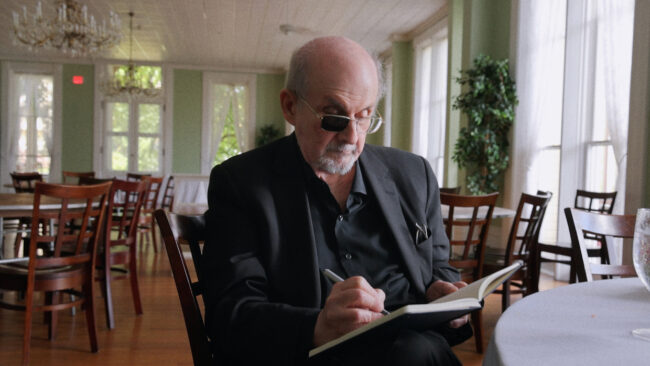
Ironically, Rushdie’s controversial novel, The Satanic Verses, is fiction – at one point he says that if he had meant it to be critical of religion, it would have been more so. He intended to juxtapose the sacred and the profane, and illuminate truth through fiction. The documentary does some of the latter in itself, recreating some of Rushdie’s hallucinations and fantasy sequences, via animation and special effects. Next to so many other movies in the multiplex, it also illuminates fiction through truth in another way. We’ve seen so many action heroes in movies keep walking after sustaining stab wounds and gun shots; here, the harsh reality is that even a survivable knife attack leaves one man in recovery for a month before he can even walk out of bed.
Gibney pointedly doesn’t let you see the footage of the actual attack until the end of the movie, so it can play more like a PTSD flashback than an opening jump-scare. You get to process the imagery only when Rushdie himself is ready to. That’s more of a visual than you get in You Had to Be There, whose title is pretty literal about the fact that virtually no footage survives of its subject: the 1972 Toronto production of Godspell.
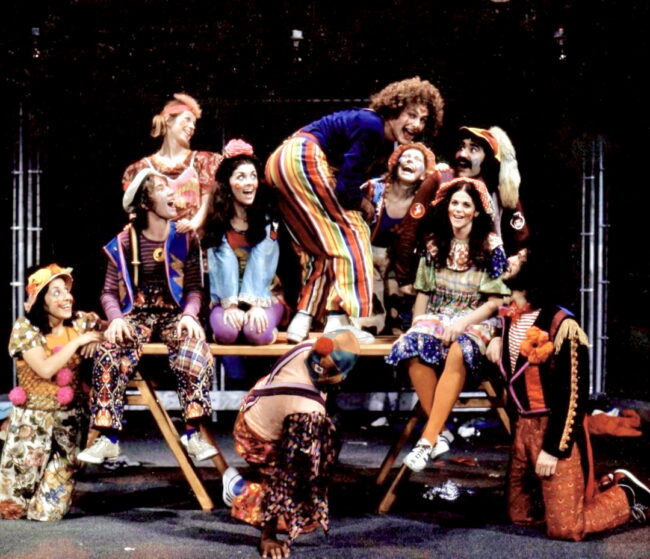
What was so special about that production? Oh, only the fact that it featured a cast who would change comedy forever. A bunch of kids beginning their twenties with names like Martin Short, Gilda Radner, Paul Shaffer, and Eugene Levy. Lead actor Victor Garber would go on to star in the movie version afterward, to be replaced by Levy, who was replaced in his original role by Dave Thomas. Lorne Michaels and the producers of Second City were among those who saw the show…and saw money in its actors’ futures.
Short was a compulsive cassette recordist, so even though there’s very little video from the era, there’s a lot of audio, which director Nick Davis uses to create animated sequences in a deliberate seventies style. Davis is an improv group alumnus who mostly makes sports documentaries, so he knows how to make competitive performers of all types talk about their best moments. When what you have is animation and new interview segments, it helps that the subjects are all inherently funny people, though just in case, he adds a few younger folks like Lin-Manuel Miranda, James Austin Johnson, Heidi Gardner, and Mike Myers. And it’s not all smiles – there is one awful story of abuse in the midst of it, as well as the inevitable deaths to acknowledge that come with time.
Knife and You Had to Be There kick off a rich and varied awards season of documentaries coming to Laemmle Theatres in the upcoming weeks. Among others, The Trial of Alec Baldwin examines the actor-producer’s culpability in his infamous on-set shooting incident; The History of Concrete is a meta-doc about how you sell a movie about concrete; The Last Dive looks at the friendship between a biker and a giant manta ray; My Undesirable Friends Part II follows up on the acclaimed five-hour Russian documentary about exiled journalists; and The Gymnasts of Fisherman Colony has a title that probably says it all.
In truth as well as fiction, the storytelling possibilities are still nigh-endless.
“Through Rushdie’s path, we see a way to put our pain in its proper place, acknowledging that it does not have to be the sole way in which we’re defined by the world.” — Zachary Lee, The Wrap.
“The most incredible thing about You Had to Be There is that this film makes you feel like you were there, and these friends are your friends too.” — Kristy Puchko, Mashable.