

Riveting Brazilian Film THE SECOND MOTHER Opens Next Week
An excitingly fresh take on some classic themes and ideas, THE SECOND MOTHER centers around Val, a hard-working live-in housekeeper in modern day Sao Paulo. Val is perfectly content to take care of every one of her wealthy employers’ needs, from cooking and cleaning to being a surrogate mother to their teenage son, who she has raised since he was a toddler. But when Val’s estranged daughter Jessica suddenly shows up the unspoken but intrinsic class barriers that exist within the home are thrown into disarray. Jessica is smart, confident, and ambitious, and refuses to accept the upstairs/downstairs dynamic, testing relationships and loyalties and forcing everyone to reconsider what family really means.
Variety film critic Geoff Berkshire called THE SECOND MOTHER “immensely endearing” and “a savvy, socially conscious crowdpleaser that occupies a rare middle ground between genteel and intellectual world cinema.” Hollywood Reporter writer Boyd van Hoeij declared “beautifully written and acted with precision, this film’s a winner.” We are extremely pleased to open THE SECOND MOTHER on August 28th at the Royal, September 4th at the Playhouse and Town Center, and September 11th at the Claremont.
ROSENWALD Filmmaker Aviva Kempner in the Forward: “To me, Julius Rosenwald is the best antidote to Donald Trump.”
Aviva Kempner’s Rosenwald, which we open at the Royal, Playhouse and Town Center on August 28th and the Claremont on September 5th, is the incredible story of Julius Rosenwald, who never finished high school but rose to become the president of Sears. Influenced by the writings of the educator Booker T. Washington, this Jewish philanthropist joined forces with African American communities during the Jim Crow South to build over 5,300 schools during the early part of the 20th century. The film sheds light on this silent partner of the pre-Civil Rights Movement. Rosenwald awarded fellowship grants to a who’s who of African American intellectuals and artists including: Marian Anderson, James Baldwin, the father and uncle of civil rights leader Julian Bond, Ralph Bunche, W. E. B. DuBois, Katherine Dunham, Ralph Ellison, Langston Hughes, Zora Neale Hurston, Gordon Parks, Jacob Lawrence and Augusta Savage along with Woody Guthrie. Inspired by the Jewish ideals of tzedakah (charity) and tikkunolam (repairing the world) and a deep concern over racial inequality in America, Julius Rosenwald used his wealth to become one of America’s most effective philanthropists. Because of his modesty, Rosenwald’s philanthropy and social activism are not well known today. He gave away $62 million in his lifetime.
In a Forward article titled “Is Julius Rosenwald Our Greatest Philanthropist,?” Ms. Kempner (The Life and Times of Hank Greenberg, Yoo-Hoo, Mrs. Goldberg) recently spoke about his latest film, saying “to me, Julius Rosenwald is the best antidote to Donald Trump. You see how pompous rich people can be, but Rosenwald is quite the contrary; he is one of the greatest examples for American Jews of tzedakah, tikkun olam , and repairing the world without fanfare — doing it just because he wants to make a difference.”
New York Times: “In WE COME AS FRIENDS, Hubert Sauper Takes Flight to Survey the Pain Below in Sudan.”
Academy Award® nominated director Hubert Sauper’s WE COME AS FRIENDS, which we are proud to open at the Royal, Playhouse and Town Center on Friday, August 21, is a modern odyssey, a dizzying, science fiction-like journey into the heart of Africa. At the moment when the Sudan, the continent’s biggest country, is being divided into two nations, an old “civilizing” pathology re-emerges – that of colonialism, the clash of empires, and new episodes of bloody (and holy) wars over land and resources. The director of DARWIN’S NIGHTMARE takes us on this voyage in his tiny, self-made, tin and canvas flying machine. He leads us into improbable locations and into people’s thoughts and dreams, in both stunning and heartbreaking ways. Chinese oil workers, U.N. peacekeepers, Sudanese warlords, and American evangelists ironically weave common ground in this documentary, a complex, profound and bitterly humorous cinematic endeavor.
On July 31, the New York Times published Nicolas Rapold’s fascinating piece about the film in their Sunday Arts & Leisure section. Here’s how it starts:
There’s no shortage of jaw-dropping moments in Hubert Sauper’s new film, “We Come as Friends,” an illustrated essay on contemporary colonialism. But the most haunting may be a lightning-streaked nighttime visit to a South Sudanese tribal leader. Mr. Sauper brandishes a copy of a contract to confirm a terrible truth, and the leader’s moistening eyes and dejected bearing say everything. The old man has signed away hundreds of thousands of acres of land to a Texas firm.
“This was history unfolding in its best and most sarcastic form in front of my camera. And then the storm came,” Mr. Sauper said in a Skype interview from Paris. “As a filmmaker, it’s too good to be true. And it’s terrifying.”
It’s one example of how Mr. Sauper, the Austrian-born director of “WeCome as Friends,” portrays complicated contemporary realities through vivid and industrious reportage. Ten years ago his Academy Award-nominated documentary, “Darwin’s Nightmare,” sifted through the wreckage of globalization by way of the fishing export industry in Lake Victoria, the impact on local Tanzanians, and a fast-and-loose subculture of Russian cargo-plane pilots.
Read the rest of the piece here.
https://www.youtube.com/watch?v=E0MgQLk2OCQ
BRIDGING THE DIVIDE: TOM BRADLEY AND THE POLITICS OF RACE Screenings Next Week with Q&A’s
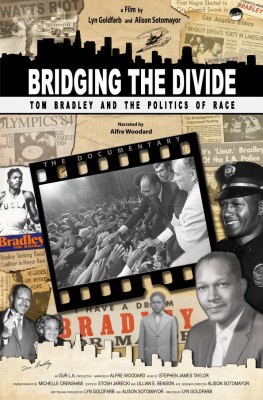 BRIDGING THE DIVIDE: TOM BRADLEY AND THE POLITICS OF RACE tells the story of Los Angeles Mayor Tom Bradley, the first African American mayor elected in a major American city with an overwhelmingly white majority. His extraordinary multi-racial coalition redefined Los Angeles, transformed the national dialogue on race and set the foundation for elections of minority candidates nationwide, including President Barack Obama.
We will be hosting two screenings of this documentary about this key figure in our city’s history, two of which featuring Q&A’s:
Q&A participants in Pasadena, August 11 at 7:30pm:
- Lyn Goldfarb, Producer, Director, Writer
- Alison Sotomayor, Producer, Research Director, Writer
- Robert Farrell, City Councilmember, 8th district from 1974-1991; Deputy to Councilmember Billy Mills (who represented South L.A.) during the Watts Riot.
- Lorraine Bradley, Tom Bradley’s eldest daughter
- Christopher Jimenez y West, Film Advisor, Assistant Professor, History, Pasadena City College
Q&A participants at the Town Center 5 in Encino, August 13 at 7:30pm:
- Lyn Goldfarb, Producer, Director, Writer
- Alison Sotomayor, Producer, Research Director, Writer
- Robert Farrell, City Councilmember, 8th district from 1974-1991; Deputy to Councilmember Billy Mills, who represented South L.A., during the Watts Riot.
- Lorraine Bradley, Tom Bradley’s eldest daughter
Special NICKY’S FAMILY Screenings in Honor of the Recently Passed Sir Nicholas Winton
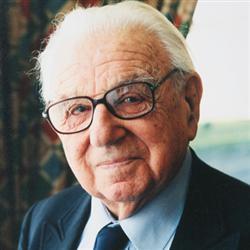
This month we were saddened to learn that Sir Nicholas Winton, a hero who for half a century said nothing of the fact that he rescued hundreds of mostly Jewish children from Czechoslovakia right before World War II, had died at the age of 106. We were proud to screen NICKY’S FAMILY, the documentary about his life, in 2013 and gladly do so again.
Please join Laemmle, Menemsha Films, and Tugg.com Sunday, August 2nd at the Playhouse, Town Center, Music Hall or Claremont 5 for what promises to be a very moving and special morning.
Use these links to reserve your FREE tickets* now:
10:30am on Sunday, August 2nd at the Playhouse
10:30am on Sunday, August 2nd at the Town Center
10:00am on Sunday, August 2nd at the Music Hall
10:30am on Sunday, August 2nd at the Claremont 5
* While supplies last
Courageous Defiance in the Face of Horror and Evil: Christian Petzold’s Masterful PHOENIX Opens July 31 at the Royal, August 7 at the Playhouse and Town Center
Next week (July 31 at the Royal, August 7 at the Playhouse and Town Center) we’ll begin screening one of the best movies of the year, the German film noir PHOENIX. It’s set in Berlin just after the second World War and follows Nelly (the great Nina Hoss), a German Jew and concentration camp survivor. Like her country, she is scarred, her face disfigured by a bullet. After undergoing reconstructive surgery, Nelly emerges with a new face, one similar but different enough that her former husband doesn’t recognize her. Rather than reveal herself, Nelly begins a dangerous game of duplicity and disguise as she tries to figure out if the man she loves may have been the one who betrayed her to the Nazis.
Film critics are hailing the movie. In the Village Voice, Stephanie Zacharek declared the film “rapturous…ardent, urgent and smoldering…so beautifully made that it comes close to perfect.”
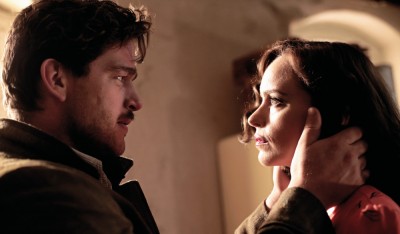
Director/co-writer Christian Petzold (Barbara, Yella) said this about his latest film: “The first day of shooting for PHOENIX: a birch forest, a man in Wehrmacht uniform, women in concentration camp garb. Our reference was a photograph supplied by the Shoah Foundation: a coarse-grain color picture of a woodland crossroads in impressionistic morning light. And, only at second glance, death: the corpse in the grass. Even during the shoot, we noticed that something wasn’t right. The light was good, we’d settled on the framing, it seemed like an accurate recreation of the image, but it didn’t work. The reconstruction of the horror, the cinematography in and around Auschwitz – as if we were saying, ‘Now it’s time. Now we’re going to condense the whole thing into a story and impose order on it.’ We threw away all the material from that first day of shooting.
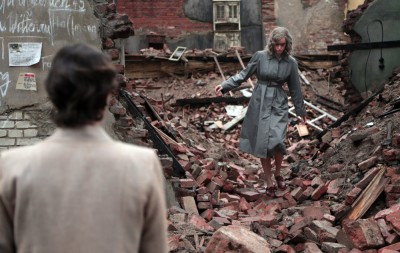
“Raul Hilsberg wrote that the terror meted out by the Nazis and the obedient public essentially made use of well-known techniques. What was novel were the extermination camps – the industrial extermination of people. For the old techniques, there was literature, stories, songs… None of that exists for the Holocaust.
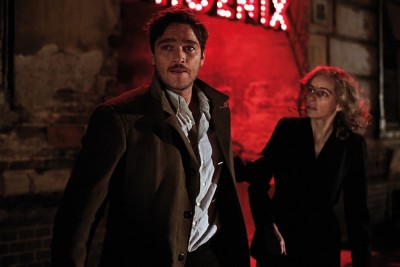 “One text had a major influence on our preparations: Ein Liebesversuch (‘An Experiment in Love’) by Alexander Kluge. The story is set in Auschwitz. The Nazis are looking through peepholes into a sealed room. They’re observing a couple who, according to their records, used to be passionately in love. The Nazi doctors are trying to revive this love: They want the couple to sleep with each other. The goal is to establish whether the woman has been successfully sterilized. They try everything: champagne, red light, spraying them with ice-cold water – thinking that the need for warmth might drive them together again. But nothing happens – the two of them don’t look at each other. In a strange way, the Nazi doctors’ failure is a victory for love: a love lost that can’t be re-kindled by these criminals. I think that was the most significant text for us. Is it possible to leap back over the deep, nihilistic chasm torn by the National Socialists and the Germans, and to reconstruct things: emotions, love, compassion, empathy – life?
“Nelly doesn’t accept stories, songs, poems claiming that love is no longer possible. She wants to turn back time. I’m interested in people who don’t accept something and, in doing so, are defiant and stubborn.”
Robert Redford on FALL TO RISE: “A heart-filling drama about the outstanding dedication of dancers to their art.” Culture Vulture screenings this Monday and Tuesday at all Laemmle venues.
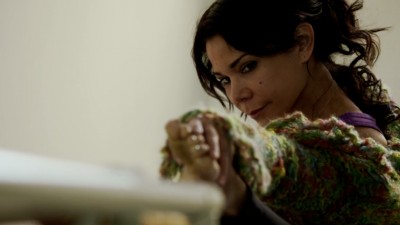 The engaging, richly textured drama FALL TO RISE follows a renowned principal dancer whose injury forces her out of her company and uncomfortably into the role of motherhood. She realizes that her identity depends on dance and struggles to return with the help of another former company dancer. With its star turns by Martha Graham Principal Dancer Katherine Crockett (featured in The Curious Case of Benjamin Button) and the acclaimed actress Daphne Rubin-Vega, this is a timeless tale with a distinctly New York flavor, revealing the conflict between art and life, between marriage and independence.
OFFICIAL SELECTION of 13 fests and counting including Dance Film Association and Film Society of Lincoln Center’s DANCE ON CAMERA
WINNER “Best Feature” On Location:Memphis International Music and Film Festival
WINNER Director Jayce Bartok “Bulleit Bourbon Frontier Filmmaker Award”
WINNER Ft. Lauderdale International Film Festival (FLiFF) Spirit of Independents Award
“FALL TO RISE is a heart filling drama about the outstanding dedication of dancers to their art. Director Jayce Bartok beautifully captured the emotional difficulties of dancers coming to terms with age and identity.” – Robert Redford
“Daphne Rubin-Vega gives a performance that’s raw, real, funny, passionate, and full of aching humanity.”
Michael Musto – OUT/ADVOCATE
“These universal themes and ideas are what makes the film successful on a base level, but the performances are what elevate it. Rubin-Vega’s Sheila is of particular note, as she shows an impressive range throughout.” 3 1/2 STARS – FILM THREAT
“Remarkable, convincing, very physical lead performances by Daphne Rubin-Vega and Martha Graham dancer Katherine Crockett.” John Beifuss – MEMPHIS COMMERCIAL APPEAL
- « Previous Page
- 1
- …
- 60
- 61
- 62
- 63
- 64
- …
- 75
- Next Page »