The Official Blog of Laemmle Theatres.

Laemmle Theatres

Film Reviews & Previews

  • All
  • Theater Buzz
    • Claremont 5
    • Glendale
    • Newhall
    • NoHo 7
    • Royal
    • Santa Monica
    • Town Center 5
  • Q&A’s
  • Locations & Showtimes
    • Claremont
    • Glendale
    • NewHall
    • North Hollywood
    • Royal (West LA)
    • Santa Monica
    • Town Center (Encino)
  • Film Series
    • Anniversary Classics
    • Culture Vulture
    • Worldwide Wednesdays
  • Facebook
  • Instagram
  • TikTok
  • YouTube

You are here: Home / Repertory Cinema

Claude Lelouch retrospective featuring cinephiles’ ultimate date-night movie, A MAN AND A WOMAN.

April 9, 2025 by Jordan Deglise Moore Leave a Comment

Next week we’ll begin a Claude Lelouch retrospective at the Royal with a week-long engagement of his 1966 double Oscar and Palme d’Or winner A Man and a Woman, newly restored by Rialto Pictures. April 26 through April 30 we’ll also screen his films Les Miserables, And Now My Love, Rendezvous, Cat and Mouse, La Bonne Année, and Bolero (Les Uns et les Autres).

“A tender, visually stirring film of rejuvenating love between a widow and a widower: Trintignant and Aimée share a candid romance while balancing the demands of career and parenthood. It’s a touching, realistic look at a burgeoning adult romance, with each participant encumbered by a past tragedy, causing them to proceed delicately. Also famous for Francis Lai’s gorgeous, swooning score…Quite possibly one of the sweetest love stories ever captured on screen.” – Wilson Chapman, IndieWire

“How to resist a pairing as photogenic as Aimée and Trintignant? I couldn’t take my eyes off either of them.” – Anthony Quinn, The Independent

“The final scene should go down in history as one of the most romantic ever put to film.” – Far Out Magazine (U.K.)

“Beautiful… breathtaking.” – The New York Times

“Probably the most efficacious make-out movie of the swinging ’60s.” – Pauline Kael

“Claude Lelouch’s A Man and a Woman is a film as simple and complicated as its title implies. Winner of the Palme d’Or at the 1966 Cannes Film Festival and the Academy Awards for Best Foreign Film and Best Original Screenplay, it chronicles the tentative, tender romance between a widow and a widower, irresistibly drawn to one another despite the heavy weight of past tragedies. Newly restored in 4K, the film features two of the most iconic and attractive stars of French cinema photographed in a beautiful mix of color and black-and-white—the kind of thing the big screen was made for, never mind that the story is much more intimate than epic.

“Every Sunday, script supervisor Anne (Anouk Aimée) travels north from Paris to Deauville to visit her young daughter, Francoise, at boarding school; racecar driver Jean-Louis (Jean-Louis Trintignant) does the same to visit his young son, Antoine. One wintery Sunday, Anne misses the last train back to Paris and gets a ride home with Jean-Louis, and sparks fly each time they lock eyes across the car. Both say they are married and still wear their rings, but they eventually reveal to each other that their respective partners have passed away—though, for Anne in particular, the memory of her stuntman husband, Pierre (Pierre Barouh), feels very much alive.

“Upon arriving in Paris, Jean-Louis asks Anne if she would like to drive up to Deauville together the next weekend. What follows is a delicate dance between the two as they grow closer while still keeping a small, safe distance—enough room for the ghosts of their partners to hover between them. It’s an undeniably adult yet no less swoon-worthy depiction of two people falling in love, in which seemingly small gestures like Jean-Louis gripping the back of Anne’s chair during lunch—wanting to be closer to her but resisting the urge to put his arm around her—say more about their growing connection than all the flowery dialogue in the world ever could.

“There is a lot that makes A Man and a Woman one of the most timeless romantic dramas ever committed to celluloid, but it would be a lie to say that the film’s two lovely stars don’t top the list. Not only are they almost unbelievably nice to look at, but they also have a natural chemistry that makes it impossible not to be invested in their characters’ love story. The film thrives on them and their emotions; every time they glance at each other and smile, as though they seemingly can’t believe their good luck in finding one another, you can feel that warmth in your own heart.

“Aimée’s performance as Anne, which earned her an Academy Award nomination for Best Actress, is deeply poignant; her struggle to reconcile her burgeoning love for Jean-Louis with her ongoing love for Pierre, and the feeling that she is somehow betraying him by falling for another, is complex and moving. Meanwhile, Trintignant makes Jean-Louis a figure of irresistible magnetism who nonetheless has insecurities about his new romance that the film brings to amusing, affecting life via voiceover. After all, how does one win the affection of a woman when your competition is dead and cannot do anything more to hurt his chances? Perhaps if Pierre had lived and their relationship had time to sour, instead of being cut short in such an idealized state, it would have been easier, Jean-Louis muses.

“A Man and a Woman also utilizes flashbacks that are effective in telling us how our protagonists’ partners died as well as in showing us how powerful their love was in life, and why it’s so difficult for them to resign such love to the past and move on. The film is strongest when it relies on images like these and the aforementioned small glances and gestures between Anne and Jean-Louis—a shared moment of laughter on a boat with their children, a spinning embrace on a deserted Deauville beach, a surprise moment of eye contact across a busy train platform—yet the script, co-written by Lelouch with Pierre Uytterhoeven, is nonetheless intelligent when it chooses to speak out loud.

“Lelouch, who also served as the film’s cinematographer and supervised this new restoration, shot A Man and a Woman partially in color and partially in black-and-white simply because of budget constraints, yet the result fits the film’s story so well you’d assume it was a more purposeful stylistic choice. (If a film shot on a shoestring budget is capable of looking this good, why does the industry bother spending millions of dollars on films that look a million times worse? Though, to be fair, they don’t have stars like Aimée and Trintignant to photograph.) And just when you thought the film couldn’t possibly be any more stylish in that quintessentially twentieth-century French cinema way, Francis Lai’s enchanting musical score arrives on the scene and uplifts everything.

“A Man and a Woman is quite possibly the cinephile’s ultimate date night movie and most definitely a romance that will win you over.” ~ Lee Jutton, Film Inquiry
 

Leave a Comment Filed Under: Cinematic Classics, Featured Films, Films, Press, Repertory Cinema, Royal, Theater Buzz

Lisa Cholodenko on her newly restored HIGH ART: “I wanted it to be deep and real and as dangerous as it should be.”

April 9, 2025 by Jordan Deglise Moore 1 Comment

Beautifully restored by the Academy Film Archive and UCLA Film & Television Archive in conjunction with the Sundance Institute, Lisa Cholodenko’s 1998 lesbian romantic drama High Art is now considered a queer classic, and it is ten times more potent on the big screen. The protagonist is Syd (Radha Mitchell), whose life changes after a chance meeting with her upstairs neighbor, Lucy Berliner (Ally Sheedy). Lucy, a once-celebrated photographer, lives an enthralling life with her drug-addicted German girlfriend, (Patricia Clarkson), that draws Syd in. Before she can catch her breath, Syd discovers dark truths of life on the edge, is forced to confront the price of her professional ambition. We are proud to open the film April 18 at the NoHo.

Cholodenko recently sat for an interview with Gay City News:

Q: The magazine in High Art is called “Frame,” and what I admire about your film is how you frame your characters and your scenes.

A: I was amused by “Frame” as the title for a magazine — the double entendre of the obvious connection to a photography and she is “framing” Lucy and is being “framed” by the artworld.

Q: But you immerse viewers in their world, which frames them. Your gaze frames the characters — shots of Syd in the bathtub, or Lucy behind her camera.

A: In my mind, what was interesting was that it was sexy, and the allure of coming into this world that was forbidden and kind of dangerous but sort of elite. At that time, that heroin chic moment was really glamorized in art and fashion photography. Selling things was commodified. I wanted it to feel you were walking in there and there was something sexy about it.

Q: There is a line in the film when Syd and Lucy are driving upstate — the light “lures you, then it’s gone.” Syd is lured by the bright light that is Lucy. Can you talk about creating the dynamic between these characters?

A: I always like the magic hour, that moment when it is really liminal and in-between. You are right there, and it’s going to go in an instant. I like that reference to the light, and as a filmmaker, that’s kind of obvious. I saw Lucy as someone who is intense and detached, and that is partly because of who she is and the power dynamic between them. She’s unattainable, and she talks about that in her career — that she slipped out and couldn’t go the distance. She went underground. Drug addicts and particularly heroin addicts are like that — intense and they slip out.

Q: Syd is empowered by her relationship with Lucy. Can you discuss that aspect of the film?

A: I see sexuality as fluid, so who one is attracted to can be affected by who you are connecting to intellectually or emotionally or by a power dynamic of what are you going to do for me, or what am I going to do for you? Or you are enamored by that human. It can be unexpected. I never saw Syd’s sexuality as definitive. I didn’t see it as a coming out story. Here is this charismatic, mysterious, talented, sexy, dangerous woman [Lucy] who is fixated on her and that was alluring to Syd. In terms of the contrast with her boyfriend, James, Gabriel Mann is sweet and has effete qualities, and Ally has swagger—I wouldn’t call her butch. But it was who is wearing the pants in a way.

Q: Your films feature themes of a stranger infiltrating a group and finding their identity through interactions and power struggles with others. Why does that cuckoo-in-the-nest theme resonate with you?

A: The disrupter story — isn’t that the fun comedy of manners? I think there is something about the allure of people you don’t know and what you can project onto them. As you get older you probably see more clearly who they are, but people can have a magic when you don’t know them, and they are projecting onto you what you want to see. There’s a dynamic — not necessarily the real deal — but it moves us towards something else we need to be responsive to.

Q: What can you say about the emphasis on and depiction of female pleasure in High Art in particular and your work in general? There were so few films that depicted female pleasure so I’m glad High Art did.

A: It was something I wrote. It was in my mind and own experiences. I wasn’t consciously comparing it to or thinking about where I placed in the chronology of lesbian films. I wanted it to be deep and real and as dangerous as it should be. There weren’t that many films depicting lesbian sex and relationships, and they seemed dated, and were about queerness and coming out. I am not telling that story, per se. I wanted to go into a world that I understand and that I am attracted to.

Q: High Art is a queer classic. What observations do you have about your film being so beloved?

A: It is interesting to watch it. I can see where the culture changed. There is so much cigarette smoking, which is unbelievable to me! We screened a few years ago at Sundance, and during the Q&A, younger women said it doesn’t feel dated to us, but it feels relevant to our lives now. I like that. Whatever it was in the design, acting, casting, or subject that it has a transcendent quality. I worked really hard. It holds up as a human story, and that is what I am most proud of. And if it is a gay classic, that is awesome!

Q: What reflections do you have about the film after all these years? Do you see flaws you want to fix, or marvel at how you got it made?

A: I was joyful to make the film. It was really hard. Were we going to be able to do it at the final hour because of the money? We pulled it together. There are very few scenes that look like we didn’t have enough time, or money, or lighting equipment. That’s not to pat myself on the back. It was restricted what we could do in a low-budget film. Looking at it now, I like how it is scrappy or flawed — that I used non-actors, or the ashtrays were overflowing. I was a student when I made that film. Tami [the cinematographer] could put the camera on her shoulder and we could run down into subway and steal a shot. It was a really different time.

Q: How do you think this film’s critical and commercial success helped your career as a filmmaker?

A: Obviously, you make a film, and it gets distribution and notice, then people notice you. When people asked would I do episodic TV, I raised my hand. I did episodes of “Homicide” and “Six Feet Under.” Meanwhile, Jeff, one of the producers on High Art paid me to keep writing. He produced “Laurel Canyon.” I read [other people’s] scripts, but nothing was compelling. I had it in my head to write my own thing. I was writing it for myself; what do I want to watch? If there is something I want to say, I’d rather do that and write my own script than try to make something fit that is coming my way.

1 Comment Filed Under: Featured Films, Filmmaker's Statement, Films, NoHo 7, Repertory Cinema, Theater Buzz

Alan Rudolph’s CHOOSE ME: Special Restoration Screening Tribute to Bob Laemmle with Keith Carradine, Lesley Ann Warren, and more April 3

March 19, 2025 by Jordan Deglise Moore 1 Comment

Alan Rudolph’s ‘Choose Me‘ Special 4K Restoration Screening Tribute to Bob Laemmle with costars Keith Carradine, Lesley Ann Warren, and producer David Blocker in person April 3.

Laemmle Theatres and the Anniversary Classics Series present a special 4K restoration screening of writer-director Alan Rudolph’s 1984 comedy-drama fable ‘Choose Me‘ as a tribute to the late Bob Laemmle, owner of Laemmle Theatres, who died in January. The film screens Thursday, April 3 at the historic Royal Theatre in West Los Angeles at 7:00 P.M. Costars Keith Carradine and Lesley Ann Warren will appear in person for a Q&A, joined by producer David Blocker. Bob Laemmle was a long-time supporter of Alan Rudolph and ‘Choose Me’ notably had a lengthy run of several months at the Royal in 1984 and 1985.

Alan Rudolph has been in the forefront of the American indie movement since his breakout arthouse hit ‘Welcome to L.A.’ in 1976. As a protégé of Robert Altman, he specializes in romanticism and fantasy with quirky characters. Set mostly in a nocturnal Los Angeles, ‘Choose Me‘ is essentially a lyrical roundelay among five characters: Nancy (Genevieve Bujold), a radio psychologist who goes by the nom de radio “Dr. Love” and dispenses advice to the lovelorn but is maladjusted herself; Eve (Lesley Ann Warren), a former sex worker who owns a bar in a seedy neighborhood; Mickey (Keith Carradine), a released mental patient who may still be quite mad; Pearl (Rae Dawn Chong), an alcoholic aspiring poet; and her wayward husband Zack (Patrick Bauchau). Working on a low-budget, Rudolph achieves high style collaborating with cinematographer Jan Kiesser and production designer Steven Legler and a soundtrack of soulful late-night jazz for the noirish atmospherics.

Critics embraced the film, with Vincent Canby in the New York Times noting how Rudolph features Los Angeles “as much of fairy-tale town as the Emerald City. It’s this quality that makes ‘Choose Me‘ an adult fable of expressive charm.” Janet Maslin, also in the Times, called the characters “garrulous, love-starved loners,” and praised the film “as free-flowing meditation on love, commitment, jealousy, radio call-in shows and just about anything that comes to mind.” Roger Ebert called it “an audaciously intriguing movie…about the endless surprise of human nature.” The Washington Post cited it as “a movie of manners leavened with sophisticated farce…locates the searching quality of contemporary sexual attitudes as well as any this year.” Pauline Kael noted the comedy-fantasy quality, calling it “crazy bananas,” and “in a magical, pseudo-sultry way — it seems to be set in a poet’s dream of a red-light district.”

Our guests have all enjoyed lengthy show business careers, and among their highlights are Academy Award recognition for both Keith Carradine (Best Song Oscar, “I’m Easy” from 1975’s Nashville) and Lesley Anne Warren (Best Supporting Actress nomination, 1982’s ‘Victor, Victoria’). Warren has had an extensive career on stage, screen, and television, including TV’s ‘Cinderella’ and ‘Desperate Housewives’; memorable movie performances in ‘Clue’ and ‘Life Stinks’; and she gave a Golden Globe-nominated performance (among multiple Globe nominations and one win through the years) in Alan Rudolph’s ‘Songwriter’ in 1984.

Carradine has enjoyed a more than five decades career since his debut in Robert Altman’s ‘McCabe & Mrs. Miller’ in 1971, appeared memorably on Broadway in ‘Will Roger’s Follies,’ and collaborated with Rudolph several times, including ‘Welcome to L.A.,’ ‘The Moderns,’ and ‘Mrs. Parker and the Vicious Circle.’ Notably, both Warren and Carradine are still active in entertainment with numerous projects.

David Blocker has produced several Rudolph films: ‘Choose Me,’ ‘Trouble in Mind,’ ‘The Moderns’ (those three with co-producer Carolyn Pfeiffer), ‘Made in Heaven,’ and ‘Equinox.’ His numerous works in television garnered an Emmy for the TV movie ‘Don King: Only in America’ (1997).


1 Comment Filed Under: Anniversary Classics, Featured Films, Featured Post, Filmmaker in Person, Films, Q&A's, Repertory Cinema, Royal, Theater Buzz

“It’s a fantasy, a comedy, a musical, and a tragedy all at once.” Godard’s A WOMAN IS A WOMAN Opens Friday at the Royal, March 28 in Glendale.

March 19, 2025 by Jordan Deglise Moore Leave a Comment

From Bilge Eberi’s recent New York Magazine piece about the new restoration of Jean-Luc Godard’s A Woman is A Woman:

“I don’t know whether it’s a comedy or a tragedy,” Jean-Luc Godard said about his film A Woman Is a Woman in 1961, not long before it opened. “At any rate, it’s a masterpiece.” The director, who at the time had released just one feature, was being characteristically cheeky. Later in that same interview, he admitted that the movie was an uneasy mix of influences. Shot in CinemaScope and color, it was meant to be a spectacle, “a set designer’s film,” that he had deliberately improvised and rushed. Though A Woman Is a Woman (now on the big screen again in a 4K restoration) is billed as a “neorealist musical,” in truth it is neither. It has music but almost never when anyone’s singing. The production stole shots on the street amid the unsuspecting working-class pedestrians of Strasbourg–Saint-Denis, but Godard often used these images for absurd scenarios. The visual scheme is deliberately dissonant, with the bold primary colors of the costumes and the set dressing clashing against drab, gray, real-life backgrounds.

This gorgeous film’s premise is a simple, humanist, and not particularly dramatic one, of the type that the Italian neorealists treasured, but it’s been given an absurd, comic-romantic spin. A young woman, Angela (played by Godard’s muse and future wife Anna Karina), wants to have a baby, but her distant boyfriend, Emile (Jean-Claude Brialy), doesn’t want to impregnate her because he has a bicycle race that weekend, so his best friend, Alfred (Jean-Paul Belmondo), who also pines for her, steps in.

The director had completed two features before A Woman Is a Woman. 1960’s lovers-on-the-run caper Breathless, still the most iconic of New Wave films, had been a phenomenon, while the political drama Le petit soldat (shot in 1960 but not released until 1963) was held back by controversy. Heavily anticipated, A Woman Is a Woman came at a kind of make-or-break moment for the Nouvelle Vague; its subsequent box-office failure, alongside the financial disappointment of Francois Truffaut’s Shoot the Piano Player (1960), would prompt some pundits to prematurely proclaim the movement’s demise.

In truth, things were just getting started. A Woman Is a Woman would establish Karina as a star. She won a Best Actress award at that year’s Berlin Film Festival. Watching her saunter, stare, smile, and sigh through this movie, it’s not hard to see how an entire generation of cinephiles fell in love — not just with her, but with the idea of her, and with the incipient world she represented. Her colorful costumes and playful delivery convey effervescence, and yet there’s a deep sadness within. Originally from Denmark, she stumbles with French dialogue and pronunciation, and we can sense the awkwardness; Godard even includes a couple of blown takes. He’s in love with her imperfections, and so are we. But what an incredibly tough position to be in as a performer.

The picture also furthered the invigorating experimentation that defined so much of the director’s monumental career. Breathless had started as a somewhat conventional project that Godard turned into an irreverent formal free-for-all; the noirish, plaintive Le petit soldat had enough genre elements to mistake it for something more traditional. But A Woman Is a Woman seems to have been conceived by someone who sought first and foremost to demystify the filmmaking apparatus.

It has the rhythms, gestures, and mood of a musical, often without the actual music. A song might start right before cutting out completely in the next shot. Direct sound clashes with expressionistic (and sometimes just plain nutty) audio choices. Loud, cartoonish sound effects punctuate each line in a lovers’ squabble. An ostensibly serious scene starts with the actors curtseying to the audience. Angela works at a strip club where women’s clothes come off not through dances but via jump cuts; their faces are expressionless and their bodies immobile, as if they’ve been reduced to deadpan pin-up poses. One night, Angela and Emile have an argument where they refuse to speak to each other, communicating entirely via book titles, each of which they pick out while lugging a giant floor lamp around for illumination. The most coordinated thing anyone does in the movie might be to gracefully and rhythmically brush the dirt off their feet before going to bed.

But beneath all this color and artifice and levity runs something deeper and more personal. It’s not just Karina’s performance that conveys a subdued, counterintuitive melancholy. Godard’s subsequent films with his muse (as well as a couple without her, such as his 1963 masterpiece Contempt) would be inspired by their tumultuous relationship, and here, too, amid all these stylistic flourishes, we sense a very real anxiety — about love, about family, about commitment, about the future, and about the fundamental inscrutability of relationships. Director and actress had already broken up and gotten back together before making A Woman Is a Woman; it wouldn’t be the last time. Not long after the shoot ended, Karina would discover she was pregnant, and they would hastily marry; she would miscarry a couple of months later. Their marriage continued in increasingly chaotic fashion. They made eight films together, including a couple after their final separation and a couple in the middle of it.

Though Godard always tended to be gnomic about such matters in interviews (honestly, he tended to be gnomic about pretty much everything), his work embodied the personal storm. His formal daring was inextricably linked to the emotional turbulence in his life: The frantic innovation of his films is a projection of a mind and a heart at unrest. In deconstructing cinema, the movies seek to deconstruct life itself. (For Godard, I doubt there was much of a difference between the two.)  A Woman Is a Woman, despite its surface frivolity, its confectionary experimentalism, is about a man and a woman who don’t understand one another, but who somehow love each other even more because of it. It’s a fantasy, a comedy, a musical, and a tragedy all at once.

Leave a Comment Filed Under: Featured Films, Films, Glendale, Repertory Cinema, Royal, Theater Buzz

SIDEWAYS 20th Anniversary Screening, Discussion and Book-Signing March 20, 2025 Laemmle Monica Film Center

February 26, 2025 by Jordan Deglise Moore Leave a Comment

Laemmle Theatres and the Anniversary Classics Series present a 20th anniversary screening of one of the most acclaimed movies of the 21st century: Alexander Payne’s Oscar-winning ‘Sideways.’ The March 20 screening at the Monica Film Center is held in conjunction with the publication of the new book, ‘Sideways Uncorked: The Perfect Pairing of Film and Wine,’ written by critic and journalist Kirk Honeycutt and his wife, Mira Advani Honeycutt. Mira comes to the project with 25 years of experience as a wine journalist. They will be joined by the Oscar-nominated producer of ‘Sideways,’ Michael London.

‘Sideways,’ based on a novel by Rex Pickett, was adapted for the screen by Payne and his frequent collaborator, Jim Taylor. It follows a weeklong journey through Santa Barbara wine country by two mismatched pals, a teacher and unsuccessful writer, played by Paul Giamatti, and a part-time actor played by Thomas Haden Church. Along the way they have encounters with two tantalizing women (Sandra Oh and Virginia Madsen). The sharp, often hilarious insights into character energize the film.

When the film opened in the fall of 2004, it earned universally rave reviews. Kirk Honeycutt wrote the very first review out of the Toronto Film Festival. He declared, “The slapstick is perfectly timed and executed. As with the best comedies of Billy Wilder and Blake Edwards, laughs derive from excruciating pain, both emotional and physical.” Roger Ebert praised the film as “the best human comedy of the year—comedy because it is funny, and human, because it is surprisingly moving.” Newsweek’s David Ansen wrote, “Payne has created four of the most lived-in, indelible characters in recent American movies.”

Both the New York Film Critics Circle and the Los Angeles Film Critics Association named ‘Sideways‘ as the best film of 2004. The screenplay was named the year’s best by those two groups, along with the National Board of Review, the National Society of Film Critics, and the Writers Guild of America. Payne and Taylor also won the Oscar for Best Adapted Screenplay, and the film earned Academy nominations for Best Picture, Best Director, and Best Supporting Acting nods for Church and Madsen.

The film had an influence beyond the world of cinema. In one key scene in the film, Giamatti declaims against merlot and declares pinot noir to be the far superior wine. Sales of pinot noir soared all over the country after the film’s release.

‘Sideways‘ ended up grossing more than $100 million, a huge score for a film that started its life as a small arthouse release.

Kirk and Mira Honeycutt will be selling and signing copies of their book before and after the screening on March 20. Alexander Payne had high praise for it: “The Honeycutts’ account of ‘Sideways‘ and its reverberations is so thorough that even I learned things I hadn’t known. A delightful, accurate chronicle with great wine tips.” Leonard Maltin called ‘Sideways Uncorked’ “an astute and entertaining book about the making of a great American film and its aftermath in the world of wine.”

Producer Michael London has many other distinguished credits, including ‘House of Sand and Fog,’ ‘The Family Stone,’ ‘The Visitor,’ ‘Milk,’ and ‘Trumbo.’

Leave a Comment Filed Under: Anniversary Classics, Featured Films, Filmmaker in Person, Films, Monica Film Center, Q&A's, Repertory Cinema, Santa Monica, Theater Buzz

PICNIC AT HANGING ROCK ~ 50th anniversary screenings of one of Australia’s premiere films.

February 19, 2025 by Jordan Deglise Moore 3 Comments

Before The Year of Living Dangerously, Witness, The Mosquito Coast, Dead Poets Society, The Truman Show, and Master and Commander: The Far Side of the World, Peter Weir’s estimable career took off with his eerie, languorous 1975 drama Picnic at Hanging Rock. A milestone for the Australian film industry, it has stood the test of time, and we are thrilled to open a week of screenings this Friday at the Royal. The keepers of world cinema at Janus Films have released a new 4K restoration of Weir’s 1998 director’s cut. Here’s film critic J. Hoberman in the New York Times:

“Once upon a time in Australia: Three schoolgirls and their teacher vanish in broad daylight while touring a prehistoric landscape. Peter Weir’s 1975 film Picnic at Hanging Rock epitomizes the idea of the quasi-supernatural ‘outback uncanny’ — the incongruity of a decorous settler civilization on what appears to be an alien planet.

“Based on the 1967 novel by Joan Lindsay that was inspired by a dream, Picnic at Hanging Rock is something of a national treasure, anointed the country’s greatest movie by the Australian Film Institute…On Valentine’s Day, 1900, the young ladies of Appleyard College, an exclusive finishing school well-stocked with Victorian knickknacks, flutter with anticipation at the prospect of a daylong excursion to Hanging Rock, a craggy volcanic formation in central Victoria dating to the Miocene epoch. Swans grace the pond, billets-doux circulate, the Romanian folk musician Gheorghe Zamfir’s pan flute fills the air.

“’What we see and what we seem are but a dream — a dream within a dream,’ the beautiful and beloved Miranda (Anne-Louise Lambert), muses, loosely citing a poem by Edgar Allan Poe. Once the party reaches the Rock, time stands still … literally. Disregarding the orders of the school’s dragon-like headmistress (Rachel Roberts), the young French teacher, Mademoiselle Dianne de Poitiers (Helen Morse), allows several of the girls to explore the forbidden geological formation, led by Miranda, whom Mademoiselle compares to a Botticelli angel. The afternoon passes, the girls do not return, even as the remaining classmates fall into a languorous erotic trance. The ensuing procedural scarcely demystifies the absence.

“Hanging Rock has echoes of L’Avventura and Psycho, two movies that create an existential void when a main character vanishes less than midway through. It is more genteel yet more erotically charged than either — ‘both spooky and sexy,’ Vincent Canby wrote in his 1979 New York Times review — and, like the Rock itself, has cast a resilient spell. The actress Chloë Sevigny has namechecked Hanging Rock as a favorite film. Sofia Coppola, whose movies are often set in hermetic worlds populated by privileged young women, seems to have been especially impressed.” (Click here to read the rest of Mr. Hoberman’s piece.)

3 Comments Filed Under: Cinematic Classics, Featured Films, Featured Post, Films, Repertory Cinema, Royal, Theater Buzz

SWEPT AWAY 50th anniversary screening February 13 at the Royal. Regular engagement starts February 21 in Glendale.

February 5, 2025 by Jordan Deglise Moore Leave a Comment

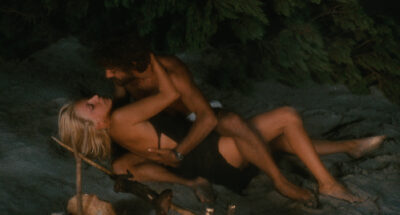
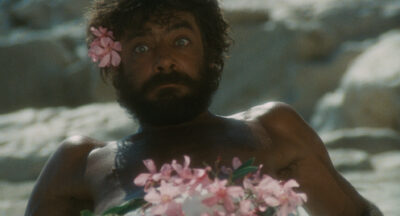
For those who don’t like Valentine’s Day, join us for an “anti-romantic” evening with Lina Wertmuller’s Swept Away. Laemmle Theatres and the Anniversary Classics Series present a 50th anniversary screening of the odd-couple arthouse sensation Swept Away. Lina Wertmüller’s provocative, fable-like two-hander brings together Mariangela Melato and Giancarlo Giannini for an oft-ugly battle of the sexes (and classes) cage match with the sparkling Mediterranean for a beautiful backdrop.

 SWEPT AWAY 50th anniversary screening February 13 at the Royal. Regular engagement starts February 21 in Glendale.

Not long after setting off on a yachting expedition, Milanese millionairess Raffaella (Melato) finds herself stranded on an obscure island with the boat’s deckhand (Giannini), a working-class Sicilian communist who promptly establishes dominion over the isle — and his once-prideful ex-employer. A contentious cinematic war of words, which has lost none of its power to inspire heated debate among its viewers.

We will also have a daily regular engagement February 21-27 at the Laemmle Glendale.

In 1976, Wertmüller became the first woman ever to earn an Oscar nomination as Best Director for her film Seven Beauties.
SWEPT AWAY 50th anniversary screening February 13 at the Royal. Regular engagement starts February 21 in Glendale.

“[With Swept Away,] Wertmüller delivered the first girl power picture, and it’s a stunning masterstroke of a movie.”  – Bill Gibron, DVD Talk

“Wertmüller didn’t just tap the tangled sexual politics of the ’70s— she lit a fuse under them.” – Owen Gleiberman, Variety

“As ferocious as it is funny.” – Judith Crist

“A powder keg of class and sexual politics.” – Scott Tobias, AV Club


Leave a Comment Filed Under: Anniversary Classics, Abroad, Featured Films, Featured Post, Films, Glendale, Repertory Cinema, Royal, Theater Buzz

35th Anniversary WILD AT HEART in memoriam screening for David Lynch February 19 at the NoHo.

January 29, 2025 by Jordan Deglise Moore Leave a Comment

The news of David Lynch‘s death hit like David Bowie’s. Here were two sui generis, irreplaceable artists so original their names became adjectives, and they were gone. There will never be another David Lynch movie, but we can watch Eraserhead, Blue Velvet, Mulholland Drive, Inland Empire, Lost Highway and the extravagantly violent and sexy romantic comedy Wild at Heart — February 19 at the NoHo — on the big screen as the auteur intended. The 1990 Palme d’Or winner stars Laura Dern and Nicolas Cage as Lula and Sailor, roadtripping lovers plagued by Lula’s crazed mother (Diane Ladd, Oscar nominated for this performance). Willem Dafoe’s frightening turn as the creepy Bobby Peru earned him a Spirit Award nomination for Best Supporting Actor.

Leave a Comment Filed Under: Films, Anniversary Classics, Featured Post, NoHo 7, Repertory Cinema, Theater Buzz, Tribute

  • « Previous Page
  • 1
  • 2
  • 3
  • 4
  • …
  • 27
  • Next Page »

Search

Instagram

This is the way. 🍿 Exclusive Mandalorian & Grogu p This is the way. 🍿 Exclusive Mandalorian & Grogu popcorn tins and collectible figurines. Yours with a Mando Combo purchase! Very limited supply. 

@LaemmleNewhall & @LaemmleNoHo

🎟️Tickets: laem.ly/4aoKwRb
🖌️Sandwich board art by @mikaelparis_

#StarWars #TheMandalorian #Grogu
☘️ WEAR GREEN ☘️ $AVE GREEN ☘️ $2 OFF your concess ☘️ WEAR GREEN ☘️ $AVE GREEN ☘️ $2 OFF your concessions order!

⭐ St. Patrick's Day! Tuesday March 17th Only!

-Movie ticket purchase not required
-Like and show this post!
🎟️ laemmle.com/discounts
🚀 PROJECT HAIL MARY, AN EPIC PRIZE PACK GIVEAWAY! 🚀 PROJECT HAIL MARY, AN EPIC PRIZE PACK GIVEAWAY!
👉 ENTER in BIO!

#ProjectHailMary — starring Academy Award® nominee Ryan Gosling and directed by Academy Award®-winning filmmakers Phil Lord & Christopher Miller. Based on Andy Weir's New York Times best-selling novel.

🎟️ GET TICKETS in BIO!
For the 21st consecutive year, Laemmle will be scr For the 21st consecutive year, Laemmle will be screening the Oscar-Nominated Short Films, opening on Feb. 20th. Showcasing the best short films from around the world, the 2026 Oscar®-Nominated Shorts includes three feature-length programs, one for each Academy Award® Short Film category: Animated, Documentary and Live Action.

ANIMATED SHORTS: (Estimated Running Time: 83 mins)
The Three Sisters
Forevergreen
The Girl Who Cried Pearls
Butterfly
Retirement Plan
 
LIVE ACTION SHORTS (Estimated Running Time: 119 minutes)
The Singers
A Friend Of Dorothy
Butcher’s Stain
Two People Exchanging Saliva
Jane Austin’s Period Drama

DOCUMENTARY SHORTS (Estimated Running Time: 158 minutes)
Perfectly A Strangeness
The Devil Is Busy
Armed Only With A Camera: The Life And Death Of Brent Renaud
All The  Empty Rooms
Children No More: “Were And Are Gone”

Please note that some films may not be appropriate for audiences under the age of 14 due to gun violence, shootings, language and animated nudity.
Follow on Instagram


Laemmle Theatres

Laemmle Theatres
Tickets: http://laemmle.com/film/viaggio-travels-pope-francis | Subscribe: http://bit.ly/3b8JTym | IN VIAGGIO: THE TRAVELS OF POPE FRANCIS is a decade-long chronicling of the head of the Catholic church, from Academy Award® nominated filmmaker Gianfranco Rosi (FIRE AT SEA, NOTTURNO). In the first nine years of his pontificate, Pope Francis made trips to 53 countries, focusing on his most important issues: poverty, migration, environment, solidarity, and war. Composed mostly of archival footage, the documentary grants rare access to the public life of the pontifical.<br /><br />Tickets: http://laemmle.com/film/viaggio-travels-pope-francis<br /><br />RELEASE DATE: 3/27/2023<br /><br />-----<br />ABOUT LAEMMLE: Since 1938, Laemmle [Theatres] has been showing the finest independent, arthouse, and international films.<br /><br />Subscribe to Laemmle's E-NEWSLETTER: http://bit.ly/3y1YSTM<br />Visit Laemmle.com: http://laemmle.com<br />Like LAEMMLE on FACEBOOK: http://bit.ly/3Qspq7Z<br />Follow LAEMMLE on TWITTER: http://bit.ly/3O6adYv<br />Follow LAEMMLE on INSTAGRAM: http://bit.ly/3y2j1cp
Tickets: http://laemmle.com/film/somewhere-queens | Subscribe: http://bit.ly/3b8JTym | Leo lives a simple life in Queens with his wife, their son "Sticks," and Leo’s close-knit network of Italian-American relatives and friends. Happy enough working at the family construction business, Leo lives each week for Sticks' high school basketball games, never missing a chance to cheer on his only child, a star athlete. When Sticks gets a life-changing opportunity to play college basketball, Leo jumps at the chance to provide a plan for his future. But when sudden heartbreak threatens to derail things, Leo goes to unexpected lengths to keep his son on this new path.<br /><br />Tickets: http://laemmle.com/film/somewhere-queens<br /><br />RELEASE DATE: 4/21/2023<br /><br />-----<br />ABOUT LAEMMLE: Since 1938, Laemmle [Theatres] has been showing the finest independent, arthouse, and international films.<br /><br />Subscribe to Laemmle's E-NEWSLETTER: http://bit.ly/3y1YSTM<br />Visit Laemmle.com: http://laemmle.com<br />Like LAEMMLE on FACEBOOK: http://bit.ly/3Qspq7Z<br />Follow LAEMMLE on TWITTER: http://bit.ly/3O6adYv<br />Follow LAEMMLE on INSTAGRAM: http://bit.ly/3y2j1cp
Tickets: http://laemmle.com/film/severing | Subscribe: http://bit.ly/3b8JTym | The Severing, from filmmaker Mark Pellington, is a visceral, powerful feature-length dance film. This cathartic movement piece was created in collaboration with the brilliant choreographer Nina McNeely (Gaspar Noe’s Climax), Dutch cinematographer Evelin Van Rei, and editor Sergio Pinheiro. Inspired by the Wim Wenders' Pina, Pellington was interested in expressing feelings and emotions through a ‘narrative of movement and text,’ told through the physical expression of dancers’ bodies and souls.<br /><br />Tickets: http://laemmle.com/film/severing<br /><br />RELEASE DATE: 4/17/2023<br />Director: Mark Pellington<br />Cast: Danny Axley, Allison Fletcher, Maija Knapp, Courtney Scarr, Ryan Spencer, Blake Miller<br /><br />-----<br />ABOUT LAEMMLE: Since 1938, Laemmle [Theatres] has been showing the finest independent, arthouse, and international films.<br /><br />Subscribe to Laemmle's E-NEWSLETTER: http://bit.ly/3y1YSTM<br />Visit Laemmle.com: http://laemmle.com<br />Like LAEMMLE on FACEBOOK: http://bit.ly/3Qspq7Z<br />Follow LAEMMLE on TWITTER: http://bit.ly/3O6adYv<br />Follow LAEMMLE on INSTAGRAM: http://bit.ly/3y2j1cp
Subscribe
This error message is only visible to WordPress admins

Cannot collect videos from this channel. Please make sure this is a valid channel ID.

Recent Posts

  • The Needle, the Noise, the Nineties: ‘Trainspotting’ Turns 30
  • The Last Great Maestro: Inside ‘Bernstein’s Wall’
  • Culture Vulture: All the World’s a Stage, and These Are Its Players

Archive

Featured Posts

An “embrace of what makes us unknowable yet worthy of forgiveness,” A LITTLE PRAYER opens Friday at the Claremont, Newhall, Royal and Town Center.

Leaving Laemmle: A Goodbye from Jordan