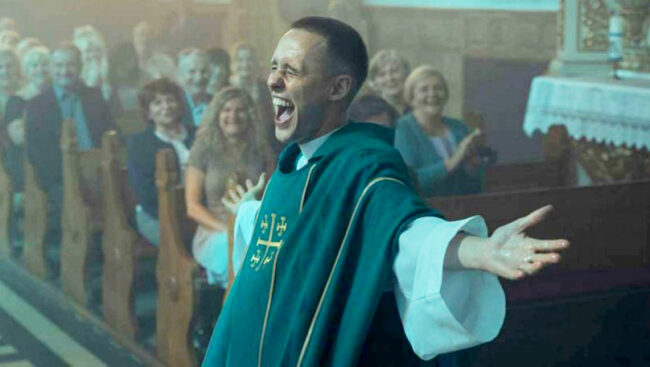
It was an unprecedented Oscars for foreign language cinema, with “Parasite” taking not only Best International Film but Best Director and Picture. Laemmle Oscar Contest participants who correctly guessed the Academy would break with tradition and choose a foreign film over an English-language film won our contest. First place garnered a Laemmle Premiere Card worth $150 and the two second place winners get Laemmle Premiere Cards worth $100. The winners’ prizes are on the way.
23 correct: 1st Place) Jared N. of Pasadena.
22 correct: (205 mins) 2nd Place tie) So Jin C. of L.A.
22 correct (205 mins) 2nd Place tie) Megan M. of Pasadena.
We had a sole first place winner this year with 23 out of 24 categories correctly selected! The first place winner only missed one category, Best Director, by incorrectly selecting Todd Phillips from “Joker” instead of eventual winner Bong Joon Ho from “Parasite.”
The two 2nd place winners missed two categories out of 24, both choosing “1917” to win Best Sound Editing instead of eventual winner “Ford v Ferrari.” One incorrectly chose “Parasite” for Best Editing instead of eventual winner “Ford vs. Ferrari,” and the other chose “Once Upon a Time in Hollywood” instead of eventual winner “Little Women” for Best Costume. They both chose the exact same and closest to actual run-time of 205 minutes on the tie-break question resulting in two 2nd place winners!
Best Picture winner “Parasite” was selected by only 18% of entries but nearly 90% for Best Foreign Film. “1917” received nearly 50% of the votes for Best Picture. No one picked “Once Upon a Time…in Hollywood” to win Best Picture. Sam Mendes had 50% of the Best Director votes for “1917,” no doubt because he won the DGA award. “American Factory” had 50% of the votes for Best Documentary. “Toy Story 4” had 50% of the vote for Best Animated Feature. Best Adapted Screenplay winner “Jojo Rabbit” and fellow nominee “LIttle Women” both received a good portion of the votes at 35% each. Joaquin Phoenix did not receive a unanimous vote for Best Actor but he did receive the second highest vote tally, after Parasite for Best Foreign Film, at 84%.
Congratulations to the winners and thanks to all for playing!

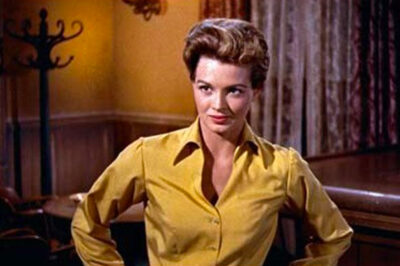 Laemmle Theatres and the Anniversary Classics Series present one of the best-loved westerns of all time, Howard Hawks’ 1959 action romp,
 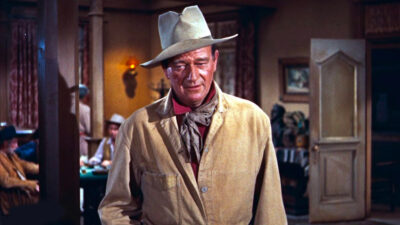 The story by B.H. McCampbell (Hawks’s eldest daughter Barbara) presents a fairly simple tale. Wayne plays a sheriff in a small Texas town who is holding a murderer (Claude Akins) in the town jail until the marshal can move him to a nearby penitentiary. But the killer’s brother, a wealthy rancher with a large gang of confederates, intends to break the prisoner out of jail. Wayne’s character is vastly outnumbered, but he turns to an unlikely posse—a drunken deputy (Martin), a helpless cripple (Brennan), and a young greenhorn (Nelson), along with a visiting lady gambler (Dickinson).
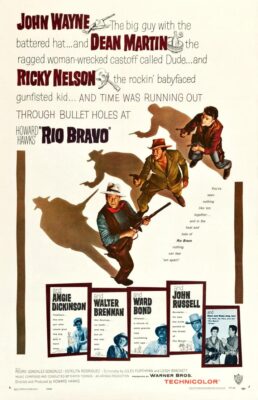 Brackett surely contributed to the vitality of Angie Dickinson’s character, Feathers, a tough, sassy woman who more than holds her own in confrontations with Wayne. The Los Angeles Times took special note of Dickinson, saying, “starmaker Howard Hawks has worked some of the same kind of magic as he did with Lauren Bacall in To Have and Have Not.” Indeed, some of the memorable repartee between Bogart and Bacall in that film was recycled effectively in Rio Bravo.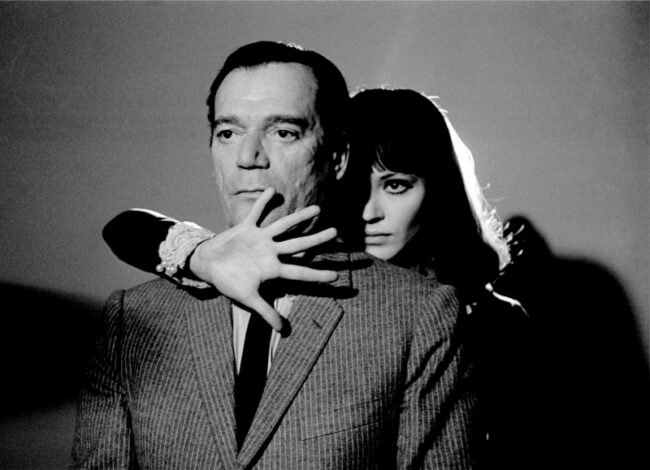
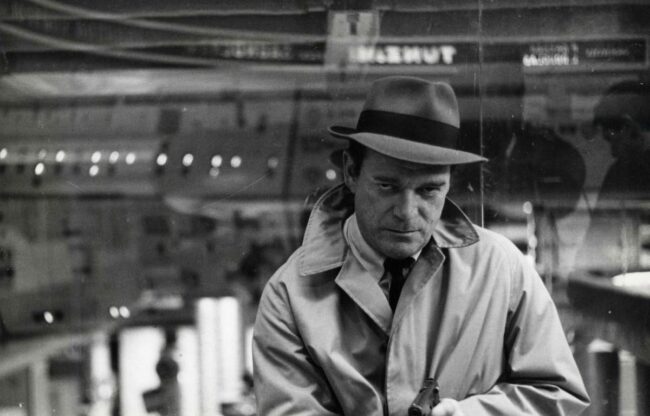
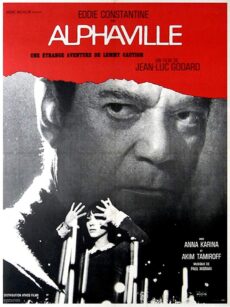 The film won the top prize, the Golden Bear, at the Berlin Film Festival. Reviews were mixed at the time, with some critics bewildered and others praising the film’s style and originality. Over the years it has been recognized as a prophetic work in its protest of the growing dehumanization of modern life. As the Boston Globe’s Ty Burr wrote, “Alphaville moves closer to relevance with every passing year.” The New Yorker’s Richard Brody called it “one of the great cinematic works of romanticism.” Time Out’s Keith Uhlich added, “Karina proves to be the beating heart of the movie.”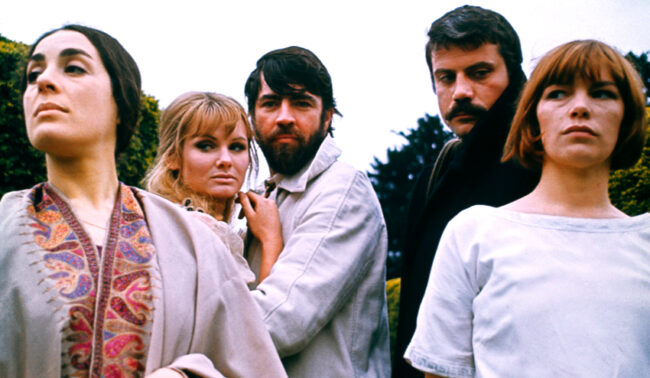
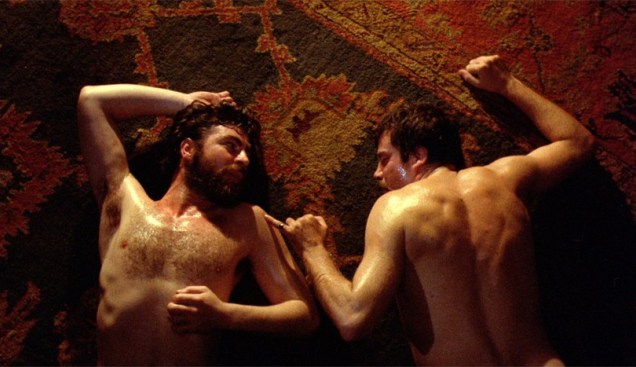
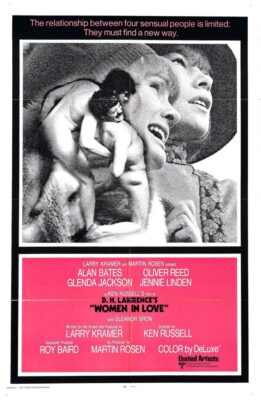 Director Ken Russell, best known for his “flamboyant and controversial style,” in such subsequent films as The Music Lovers, The Devils, The Who’s Tommy, Lisztomania, and Altered States, is notably more restrained in WOMEN IN LOVE. He did, however, connect with the sexual revolution and bohemian politics of the late 1960s, when the film was made, in notorious scenes such as the nude wrestling match between Reed and Bates, the first display of full-frontal male nudity in a mainstream movie. WOMEN IN LOVE represents his sole Oscar nod for directing.