
On Wednesday, Aug. 19th, at 7 p.m., Laemmle Theatres presents a 65th anniversary screening of Let’s Make Love, Marilyn Monroe’s penultimate film, spotlighting the astonishing dance work of choreographer Jack Cole.
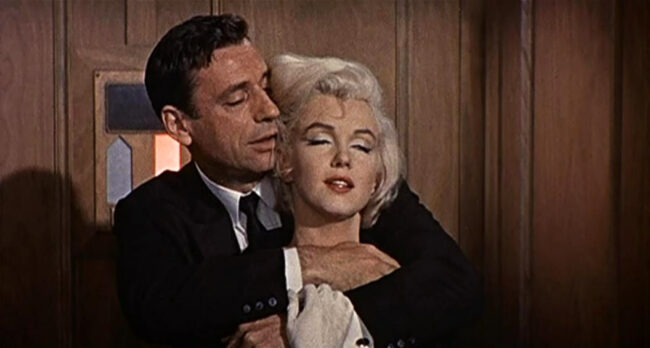
Catch Let’s Make Love at the Laemmle Royal, with Cole biographer Debra Levine in attendance to sign her book JAZZED: Jack Cole and Twentieth Century American Dance.
In 1959 Marilyn was entering her final chapter—with her favorite choreographer, Jack Cole, in tow. As Monroe’s decade, the 1950s, wound to a close, the indelible movie star was not in good shape. Repeated breakdowns and hospitalizations had taken their toll. When Let’s Make Love producer Jerry Wald reached out to Cole for what would be his sixth-and-final Monroe movie, Cole was evasive. Eventually, needing money, he acquiesced. Toward the end of a grueling seven-month shoot, with only Cole, Monroe, and scant crew on set, Let’s Make Love had the feel of a home movie. Cole got the star across the finish line. But, he said, “It was very difficult.” Seen in retrospect, the film’s centerpiece production number, to Cole Porter’s “My Heart Belongs to Daddy,” is a danse-macabre, a foreshadowing of tragic events to come.
This summary, contributed by Debra Levine, a friend of Laemmle’s Anniversary Classics Series, is adapted from her brand-new Jack Cole biography, JAZZED: Jack Cole and Twentieth Century American Dance, from University Press of Kentucky (release date August 11, 2026). Debra, who will be our interview guest on August 19, will share revelations from her deep research into the making of this movie through the prism of the close Monroe/Cole relationship, a trove of information that many traditional forays into Marilyn’s final films have overlooked. Debra will be selling and signing her acclaimed book after the screening.
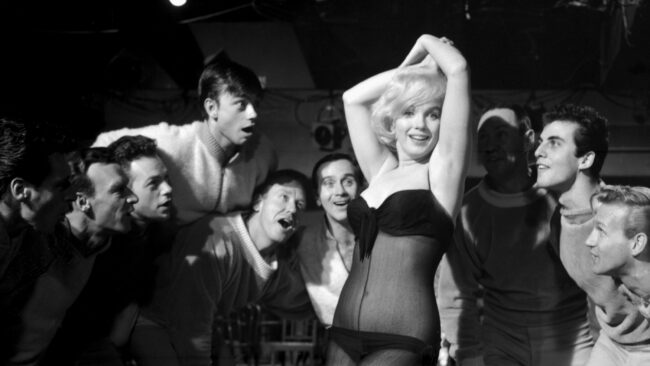
Let’s Make Love was Marilyn’s second last film, made in part to fulfill her contract to 20th Century Fox. Her co-star was iconic French actor Yves Montand, the star of such classic films as The Wages of Fear and the French version of The Crucible. Hollywood often wooed revered European actors, and Montand spent several years making American movies in the 1960s before returning to Europe to make Z, The Confession, Cesar and Rosalie, and Jean de Florette. He and Monroe had a brief affair during the shooting of Let’s Make Love, which he abruptly broke off, aggravating Marilyn’s insecurities.
The script by Norman Krasna and Hal Kanter, with uncredited assist by Arthur Miller, Monroe’s husband at the time, centers on a European billionaire who learns that he is going to be satirized in a new off-Broadway production and decides to investigate by trying to join the production with a false identity. Award-winning director George Cukor (Little Women, Born Yesterday, Adam’s Rib, A Star Is Born, My Fair Lady) was at the helm of the production. Cukor, cinematographer Daniel L. Fapp, art directors Gene Allen and Lyle Wheeler, and costume designer Dorothy Jeakins assured that Monroe was most alluringly photographed.
The supporting cast includes Tony Randall, Frankie Vaughan, and Wilfred Hyde-White, with cameos by Gene Kelly, Bing Crosby, and Milton Berle as experts trying to train the amateur Montand for his theater debut.
As critic Stanley Kauffmann observed, “The scene in which Milton Berle teaches [Montand] how to be a comic is first-rate knockabout fun.”