
What does it mean for a glacier to die? That haunting question lingers at the center of Time and Water, the lyrical new documentary from filmmaker Sara Dosa. Following her Oscar-nominated breakthrough Fire of Love, Dosa once again turns toward humanity’s relationship with the natural world, though this time through a quieter, more meditative lens. Drawing from the writings and personal archives of Icelandic author Andri Snær Magnason, the film becomes at once a climate documentary, a family memoir, and a message to the future.
Tune into Inside the Arthouse to hear documentarian Sara Dosa discuss her latest film with co-hosts Greg Laemmle and Raphael Sbarge, or come see it on the big screen beginning June 5th at the Laemmle Royal.
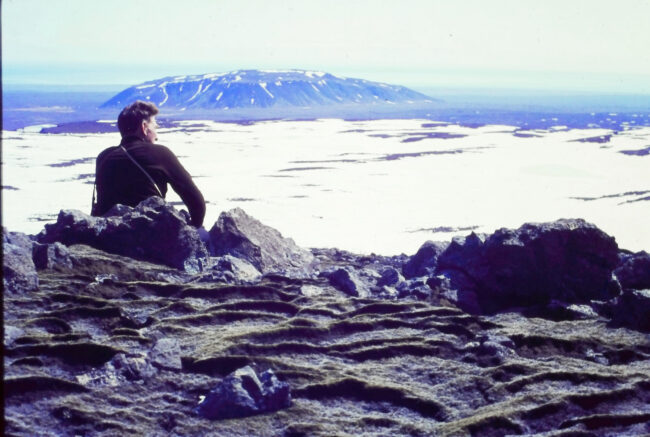
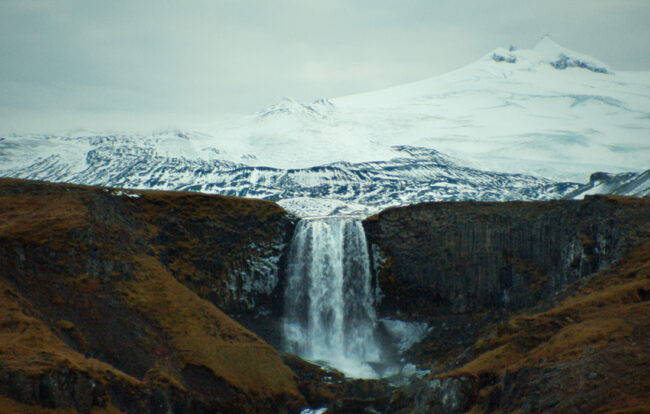
Structured as a kind of cinematic time capsule, Time and Water moves fluidly between personal memory and geological history. Magnason narrates much of the film himself, reflecting on both his family’s past and Iceland’s rapidly changing landscape. Central to the story are his grandparents, early explorers of Iceland’s vast glaciers whose photographs and home movies from the 1950s lend the film a remarkable tactile intimacy. Dosa blends these archival fragments with sweeping contemporary imagery of ice fields, volcanic terrain, waterfalls, and black sand coastlines, creating a film that feels suspended somewhere between documentary and dream.
Yet beneath its beauty lies an unmistakable sense of grief. The glaciers of Iceland, once thought to be eternal, are disappearing at an alarming pace. One glacier in particular, Okjökull, became the first in the country to be officially declared dead in 2019 after losing the movement that defines a living glacier. That event hangs over the film as both ecological warning and existential reckoning. If glaciers function as archives of the Earth, storing centuries of environmental history within their layers of ice, what happens when those archives vanish?
Rather than relying on statistics or conventional talking-head interviews, Dosa approaches climate change through memory, language, and emotional inheritance. The film repeatedly returns to the idea that landscapes shape not only ecosystems but culture itself: words, stories, songs, and identities passed across generations. Magnason reflects on Icelandic traditions, ancient oral histories, and even the changing meanings of words tied to the natural world as species disappear and environments transform. Perhaps, Magnason contends, memory itself functions like a glacier: accumulating layer upon layer, fragile yet enduring until suddenly it begins to melt away.
By the end, Time and Water becomes less a film about glaciers alone than about the responsibilities we inherit from the past and pass onto the future. “This monument is to acknowledge that we know what is happening and what needs to be done,” Magnason writes in his somber epitaph to the Okjökull Glacier. “Only you know if we did it.”
“A pensive, reflective film which combines striking Super 16 archive material with a deft exploration of the way the narratives of our lives are intertwined with the lands we inhabit.” – Wendy Ide, Screen Daily
“A poetic musing on intergenerational memory, a whimsical, yet staunchly political elegy for the glaciers, and a mournful look at the Earth in all her majesty and mystery.” – Marya E. Gates, IndieWire