
The title Barbara Forever undoubtedly conjures up images in the mind, perhaps of a famous Barbara beloved by all. It’s not who you’re probably thinking, though: Barbara Hammer was beloved in certain circles, but lesser known to the world at large, a state of affairs this overdue tribute-documentary looks to correct.
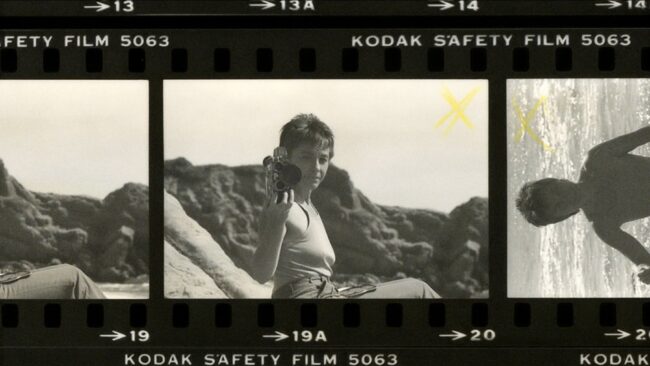
Barbara Forever opens at Laemmle’s Royal Sept. 11th. Director Brydie O’Connor will participate in Q&As following the 7:30 p.m. shows at the Royal, moderated by Cameron Esposito on September 11 and Fenton Bailey on September 12.
There’s a scene in the film that’s been featured heavily in its trailer, in which Hammer, addressing a class of elementary school students, prepares them for the new kind of film she’s about to show them: an experimental film. She screens it – fortunately for all involved in that moment, it isn’t one of her many films full of female nudes – and the kids, while not necessarily knowing what to make of it, engage the material. One says he liked it; others simply try to describe what they’ve seen. But they all take away something, and none dismisses it out of hand.
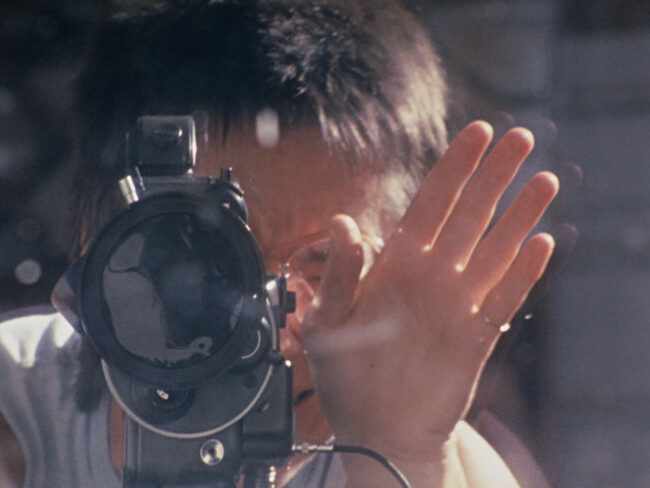
That’s the way to approach Barbara Forever – wide-eyed and with childlike curiosity — which isn’t a conventional biographical documentary, but one made in the spirit of its subject, a pioneering lesbian avant-garde director. Not unlike Ross McElwee, she turned the camera on herself many years before social media had us all doing it. Unlike him, she was a queer woman who set out to make more abstract visual art about her sexuality, which was a combination of factors considered mutually exclusive in the ’60s when she began doing it.
Director Brydie O’Connor, expanding on her own short “Love, Barbara,” became fast friends with Hammer’s widow Florrie R. Burke after Hammer’s death. Given access to her archives, which had been donated to Yale, O’Connor put together Barbara Forever from bits of Hammer’s films, outtakes, new footage, old photographs, audio interviews, and more to create a subjective portrait of the director through her own images, textures, and editing rhythms. Hammer’s voice narrates; one gets little sense of O’Connor as a distinctive voice, but more a sort of vessel or medium for the spirit of her artist muse to communicate again.
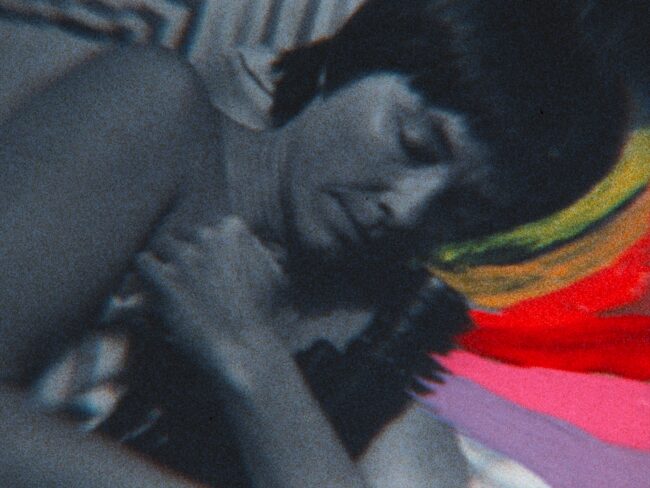
As mentioned, there is a lot of nudity in Hammer’s body of work – normalizing lesbian sexuality was a huge motivating factor in her directing, including what many consider the first true lesbian lovemaking scene in her 1974 film Dyketactics. Later, as she documents her own cancer, Hammer literally goes beneath the skin, showing us her own x-rays in motion. It’s just another extension of her emotional nakedness, and after all, isn’t that often more challenging than the physical?
Hammer’s best-known film is arguably the 1992 documentary feature Nitrate Kisses, a history of LGBT repression since World War I. If you aren’t even familiar with that one, Barbara Forever offers an immersive entry point into her filmography highlights. In trying to sum up the reasons her life mattered, it necessarily covers a lot of ground, and does so creatively, but leaves many avenues open for newly converted fans to discover more on their own.
In some of Hammer’s final interviews, she made clear that she wanted to be remembered and respected for the work that she knew was important at the time. O’Connor gave her that respect due, and through her eyes, many more will now too.
“Like Hammer’s films, Barbara Forever is a polyphony of image and sound, sex and love, life and death; a radiant treat for the senses.” — Joseph Dimacchia, In Review Online.
“A beautifully assembled introduction to Hammer’s adventurous life and work.” — Zachary Barnes, Wall Street Journal.