
Breaking up is hard to do, and it’s only made harder when Vladimir Putin gets involved. In Andrius Blaževičius’ satirical drama How to Divorce During the War, a failed marriage is complicated by the Ukraine invasion beginning the day after a wife decides to call it quits.
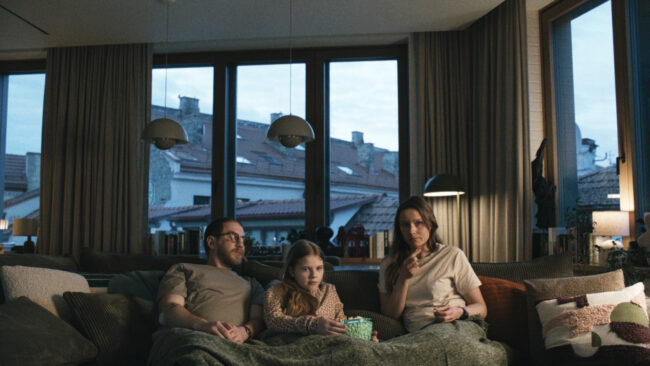
How to Divorce During the War opens Friday, Aug. 28th, at Laemmle’s Royal, Glendale, and Town Center 5. Catch director Andrius Blaževičius on the latest episode of Inside the Arthouse with Greg Laemmle and Raphael Sbarge.
How to Divorce During the War is Blaževičius’ third feature, and like the other two, stars Marius Repšys as a man named Vytas who finds his life going out of control. Returning from his second feature, Runner, is Žygimantė Elena Jakštaitė as girlfriend Marija, now his wife. You don’t need to have seen the prior films, and it isn’t clear that they’re in any way connected narratively – in fact, the less you know about this incarnation of Vytus and Marija, the better, as the film slowly unfolds all the important details about who they are and why they might be having problems.
Vytas and Marija live in Lithuania – this film is the country’s official Oscar submission – which is a NATO country, and thus traditionally protected against Russian attack. Yet with the current U.S. administration’s casual attitude towards the alliance, and Russia’s invasion of Ukraine, Lithuanians fear they’re next on the hit list if Ukraine falls. These anxieties move to the forefront once the war officially begins, but they don’t eliminate the practicalities of how to execute a divorce, especially with a child involved.

Marije simply says she doesn’t love Vytus any more. No particular reason is given, at least at first. It seems to be an accumulation of little things: the fading of youth, the vicissitudes of entertainment industry careers, the responsibilities of parenthood, or a same-sex crush in a coworker. Vytus is an old-school filmmaker and screenwriter, which means in practical terms that he’s broke and serves as a house-husband; Marije works in new media, producing viral shorts for the web, and makes enough money doing that to pay all the family bills, though it also surrounds her with young and single people.
TV commentary on the war, about how neither side can come to a compromise, doubles and even triples in meaning, as it could easily be referring to the couple, or to a former Soviet society that becomes violently divided in its sympathies. In their own ways, Vytas and Marije demonstrate performative support for Ukraine, only to backslide the moment their bold stances start to actually cost them anything. It is, as always, the children who suffer most: daughter Dovile acts out at school, and tries to mirror her parents in the best ways, inadvertently holding a mirror up to their behavior that they may be too stubborn to gaze into.
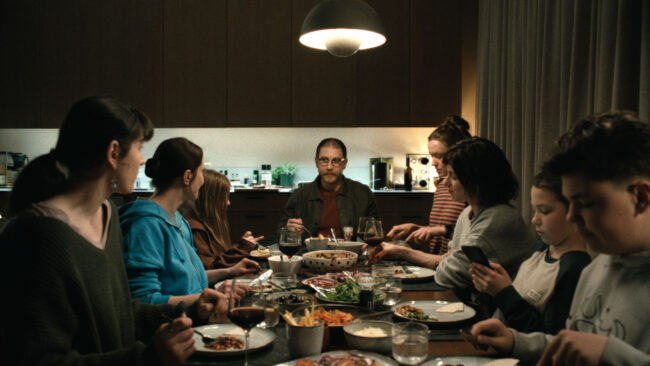
Blaževičius’ signature stylistic move is the slow camera push in towards a character or characters sitting in a car – it’s the one part of their environment they can control, or so they think. He also loves the dining room table as a source of drama: in one of the film’s standout scenes, Vytas subtly undermines Marije with the Ukrainian refugees she’s taken in, by speaking to them in Russian which she doesn’t understand, and pretending it’s all good.
The story begins and ends with the same, still cityscape, suggesting that life goes on regardless, and many of our gestures are futile. Yet so, the film suggests, is our selfishness – in the grand scheme of things, little of it matters, so why not consider the comfortable option? No easy answer is offered, but as everyone onscreen tries to figure it out, their foibles, however “foreign,” may start to look amusingly familiar. To cite but one more example, a scene where Vytus tries to remove his parents’ satellite TV so they won’t watch propaganda “news” channels should resonate just as strongly with American audiences.
“The results are sometimes dramatic but often dryly amusing, capturing the leads’ cushy lives and their often warped sense of altruism in a series of droll vignettes.” – Wilson Chapman, IndieWire.
“A drily witty, subtly searing comedy from writer-director Andrius Blaževičius, “How to Divorce During the War” is both empathetic and surgical as it examines both partners’ attempts to sublimate selfish angst into social activism.” – Guy Lodge, Variety.