The Official Blog of Laemmle Theatres.

Laemmle Theatres

Film Reviews & Previews

  • All
  • Theater Buzz
    • Claremont 5
    • Glendale
    • Newhall
    • NoHo 7
    • Royal
    • Santa Monica
    • Town Center 5
  • Q&A’s
  • Locations & Showtimes
    • Claremont
    • Glendale
    • NewHall
    • North Hollywood
    • Royal (West LA)
    • Santa Monica
    • Town Center (Encino)
  • Film Series
    • Anniversary Classics
    • Culture Vulture
    • Worldwide Wednesdays
  • Facebook
  • Instagram
  • TikTok
  • YouTube

“A haunting, elegiac reverie,” THE BURMESE HARP opens at the Royal on November 1.

October 23, 2024 by Jordan Deglise Moore Leave a Comment

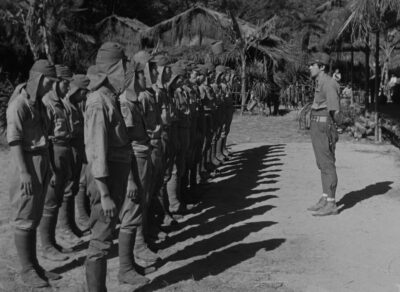
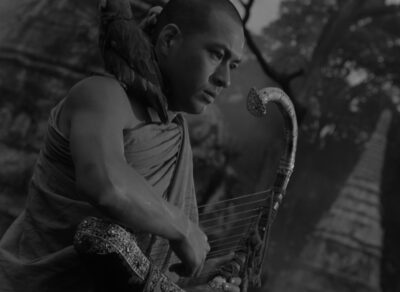
In the last days of World War II, a Japanese platoon sustains morale through the Burma campaign by singing traditional songs, accompanied by the delicate harp-playing of Private Mizushima. After the unit surrenders to British forces, Mizushima is tasked with convincing a holdout of cave-dwelling Japanese soldiers to lay down their arms; when his mission fails, he is counted among the dead. Mizushima survives, however, and becomes a monk who dedicates his life to providing proper burials for his fallen comrades. Meanwhile, his former platoon attempts to track him down by using music to express a shared sense of separation and longing for home. Adapted from Michio Takeyama’s classic novel, and renowned for legendary composer Akira Ifukube’s haunting score, Kon Ichikawa’s The Burmese Harp is an epic humanist masterpiece—a profound contemplation of suffering, redemption, and spiritual fortitude during the darkest periods of violence.

“A HAUNTING ELEGIAC REVERIE.” – Kevin Thomas, Los Angeles Times

“Poetically photographed… brilliantly dots the players against the looming terrain.” – Howard Thompson, New York Times

Production history (via Janus Films):

In the early 1950s, Kon Ichikawa was toiling away for Toho Studios,  churning out several films a year (in 1951 alone, he directed six) and  settling into the role of a dependable if unremarkable metteur en scène. It was during this period that Ichikawa read The Burmese Harp— Michio Takeyama’s popular children’s novel from 1946—and “felt this  strong sense of mission, a call from the heavens” to adapt it on film.  This fascination would transform the director’s career, catapulting  him into the upper echelons of Japanese cinema.

At the time, Ichikawa was working closely with his wife, screenwriter Natto Wada, who authored or coauthored many of his scripts.  Whereas Takeyama’s novel was conceived as a “fairy tale for adults,”  Ichikawa intended a grittier take on the human suffering of World  War  II and the Japanese military’s self-destructive nationalism.  Ichikawa and Wada also shifted the dramatic emphasis by having the  protagonist, Private Mizushima (Shoji Yasui), decide earlier in  the story to remain in Burma to bury his dead comrades, after Japan’s  failed campaign there. And while in Takeyama’s tale, cannibals nurse  Mizushima back to health in hopes of eating him—“exotic” details  from a novelist who had never set foot in Burma—in Ichikawa’s  version, the soldier is saved by a Buddhist monk, whose noble compassion in service of others is one of the film’s major themes.
 "A haunting, elegiac reverie," THE BURMESE HARP opens at the Royal on November 1.

Ichikawa inked a three-picture contract with Nikkatsu in 1954, but— since he was still a novice—he hesitated to pitch such an ambitious  project. When he finally did, he found himself on the outside of the  deal: the studio’s higher-ups initially selected veteran Tomotaka  Tasaka to helm the picture on the strength of his successful war films  Five Scouts (1938) and Mud and Soldiers (1939). Ichikawa stepped  in when Tasaka took sick, but the younger director would have to  compromise his initial vision. At the time, Nikkatsu used Japanese  Konicolor stock, combining three strips of film to render a full color  palette. However, this process was expensive, a Konicolor-friendly  camera would be too cumbersome to bring to Burma—and there  would be no way to fix it if it broke down. Harp would have to be shot  in black and white instead of his desired color.

The Burmese Harp would also have to be largely shot in Japan; Nikkatsu  ruled out Burma for most of its location footage, as it would be finan cially and logistically impossible to transport the actors there. Only  Yasui would travel to Burma, for his more solitary scenes; locations  in and around Odawara, Hakone, and Izu backgrounded the other  actors, forcing Ichikawa to trick Japanese environments into evoking  the tropical foliage and intense heat of Burma. Meanwhile, the black-and-white stock inspired Ichikawa, with the help of cinematographer  Minoru Yokoyama, to shoot with strong contrasts—a decision that led  them to alternate flat and angled lighting, employing telephoto lenses  for long shots and wide angles for close-ups.
"A haunting, elegiac reverie," THE BURMESE HARP opens at the Royal on November 1.

For the cast, Ichikawa sought someone who could convey Mizushima’s  innocence, idealism, and sincerity. Nikkatsu didn’t have many young  actors then, but Yasui, in his mid-twenties, was one; though he hadn’t  yet taken on many big roles, Ichikawa liked this very gentleness and  inexperience for Mizushima. The film’s other major part, Captain  Inouye, was played by Rentaro Mikuni, who had waged fierce con tract battles with various studios. On the set of Harp, he engaged in a weeklong standoff with Ichikawa: a former soldier in World War II,  Mikuni knew that his character, according to military rank, shouldn’t  wear a certain badge on his uniform, and he refused to proceed  until the detail was changed. Ichikawa eventually gave in, and any  remaining tension between them vanished when Mikuni turned in a  powerful performance for the film’s climactic scene, in which Inouye  reads Mizushima’s emotional letter to his former comrades. For this  moment, Mikuni called upon his own traumatic memories of combat.

Ichikawa also clashed with composer Akira Ifukube over the tone of  The Burmese Harp’s titular instrument. During shooting, the harp that  Mizushima plays to accompany his singing comrades was just a prop,  so its distinct tonality had to be dubbed in during postproduction.  Ichikawa and Ifukube tried out dozens of Western harps and Japanese  instruments until they agreed on one with an appropriately “beautiful  sound.” The film’s main musical motif—a sentimental song called  “Hanyo no yado,” or “Home! Sweet Home!,” performed by Inouye’s  platoon—was recorded via sync sound and later mixed with a choir of  “regular people,” including some who were tone-deaf, to realistically  evoke the troops’ lack of musical training.

Nikkatsu distributed The Burmese Harp by dividing the film  into two sections that were released three weeks apart in early  1956. After its initial Japanese run, the 143-minute Harp was  trimmed to 116 minutes for re-release and international markets— a version that Ichikawa never sanctioned. (The original cut of  the film has unfortunately been lost.) Ichikawa also didn’t know  that Nikkatsu had submitted the film to the Venice Film Festival,  where it was awarded the San Giorgio Prize and an OCIC Award  (Honorable Mention).

The Burmese Harp was nominated for an Academy Award for Best  Foreign-Language Film, securing Ichikawa’s and Wada’s global  renown. In 1985, when Ichikawa remade Harp in color, it became the top-grossing film of that year in Japan, reinforcing the original’s status as an enduring classic—and one of the greatest anti-war tales ever committed to celluloid. 

Leave a Comment Filed Under: Cinematic Classics, Featured Post, Films, Repertory Cinema, Royal, Theater Buzz

0 Comments
Newest
Oldest Most Voted

Search

Instagram

This is the way. 🍿 Exclusive Mandalorian & Grogu p This is the way. 🍿 Exclusive Mandalorian & Grogu popcorn tins and collectible figurines. Yours with a Mando Combo purchase! Very limited supply. 

@LaemmleNewhall & @LaemmleNoHo

🎟️Tickets: laem.ly/4aoKwRb
🖌️Sandwich board art by @mikaelparis_

#StarWars #TheMandalorian #Grogu
☘️ WEAR GREEN ☘️ $AVE GREEN ☘️ $2 OFF your concess ☘️ WEAR GREEN ☘️ $AVE GREEN ☘️ $2 OFF your concessions order!

⭐ St. Patrick's Day! Tuesday March 17th Only!

-Movie ticket purchase not required
-Like and show this post!
🎟️ laemmle.com/discounts
🚀 PROJECT HAIL MARY, AN EPIC PRIZE PACK GIVEAWAY! 🚀 PROJECT HAIL MARY, AN EPIC PRIZE PACK GIVEAWAY!
👉 ENTER in BIO!

#ProjectHailMary — starring Academy Award® nominee Ryan Gosling and directed by Academy Award®-winning filmmakers Phil Lord & Christopher Miller. Based on Andy Weir's New York Times best-selling novel.

🎟️ GET TICKETS in BIO!
For the 21st consecutive year, Laemmle will be scr For the 21st consecutive year, Laemmle will be screening the Oscar-Nominated Short Films, opening on Feb. 20th. Showcasing the best short films from around the world, the 2026 Oscar®-Nominated Shorts includes three feature-length programs, one for each Academy Award® Short Film category: Animated, Documentary and Live Action.

ANIMATED SHORTS: (Estimated Running Time: 83 mins)
The Three Sisters
Forevergreen
The Girl Who Cried Pearls
Butterfly
Retirement Plan
 
LIVE ACTION SHORTS (Estimated Running Time: 119 minutes)
The Singers
A Friend Of Dorothy
Butcher’s Stain
Two People Exchanging Saliva
Jane Austin’s Period Drama

DOCUMENTARY SHORTS (Estimated Running Time: 158 minutes)
Perfectly A Strangeness
The Devil Is Busy
Armed Only With A Camera: The Life And Death Of Brent Renaud
All The  Empty Rooms
Children No More: “Were And Are Gone”

Please note that some films may not be appropriate for audiences under the age of 14 due to gun violence, shootings, language and animated nudity.
Follow on Instagram


Laemmle Theatres

Laemmle Theatres
Tickets: http://laemmle.com/film/viaggio-travels-pope-francis | Subscribe: http://bit.ly/3b8JTym | IN VIAGGIO: THE TRAVELS OF POPE FRANCIS is a decade-long chronicling of the head of the Catholic church, from Academy Award® nominated filmmaker Gianfranco Rosi (FIRE AT SEA, NOTTURNO). In the first nine years of his pontificate, Pope Francis made trips to 53 countries, focusing on his most important issues: poverty, migration, environment, solidarity, and war. Composed mostly of archival footage, the documentary grants rare access to the public life of the pontifical.<br /><br />Tickets: http://laemmle.com/film/viaggio-travels-pope-francis<br /><br />RELEASE DATE: 3/27/2023<br /><br />-----<br />ABOUT LAEMMLE: Since 1938, Laemmle [Theatres] has been showing the finest independent, arthouse, and international films.<br /><br />Subscribe to Laemmle's E-NEWSLETTER: http://bit.ly/3y1YSTM<br />Visit Laemmle.com: http://laemmle.com<br />Like LAEMMLE on FACEBOOK: http://bit.ly/3Qspq7Z<br />Follow LAEMMLE on TWITTER: http://bit.ly/3O6adYv<br />Follow LAEMMLE on INSTAGRAM: http://bit.ly/3y2j1cp
Tickets: http://laemmle.com/film/somewhere-queens | Subscribe: http://bit.ly/3b8JTym | Leo lives a simple life in Queens with his wife, their son "Sticks," and Leo’s close-knit network of Italian-American relatives and friends. Happy enough working at the family construction business, Leo lives each week for Sticks' high school basketball games, never missing a chance to cheer on his only child, a star athlete. When Sticks gets a life-changing opportunity to play college basketball, Leo jumps at the chance to provide a plan for his future. But when sudden heartbreak threatens to derail things, Leo goes to unexpected lengths to keep his son on this new path.<br /><br />Tickets: http://laemmle.com/film/somewhere-queens<br /><br />RELEASE DATE: 4/21/2023<br /><br />-----<br />ABOUT LAEMMLE: Since 1938, Laemmle [Theatres] has been showing the finest independent, arthouse, and international films.<br /><br />Subscribe to Laemmle's E-NEWSLETTER: http://bit.ly/3y1YSTM<br />Visit Laemmle.com: http://laemmle.com<br />Like LAEMMLE on FACEBOOK: http://bit.ly/3Qspq7Z<br />Follow LAEMMLE on TWITTER: http://bit.ly/3O6adYv<br />Follow LAEMMLE on INSTAGRAM: http://bit.ly/3y2j1cp
Tickets: http://laemmle.com/film/severing | Subscribe: http://bit.ly/3b8JTym | The Severing, from filmmaker Mark Pellington, is a visceral, powerful feature-length dance film. This cathartic movement piece was created in collaboration with the brilliant choreographer Nina McNeely (Gaspar Noe’s Climax), Dutch cinematographer Evelin Van Rei, and editor Sergio Pinheiro. Inspired by the Wim Wenders' Pina, Pellington was interested in expressing feelings and emotions through a ‘narrative of movement and text,’ told through the physical expression of dancers’ bodies and souls.<br /><br />Tickets: http://laemmle.com/film/severing<br /><br />RELEASE DATE: 4/17/2023<br />Director: Mark Pellington<br />Cast: Danny Axley, Allison Fletcher, Maija Knapp, Courtney Scarr, Ryan Spencer, Blake Miller<br /><br />-----<br />ABOUT LAEMMLE: Since 1938, Laemmle [Theatres] has been showing the finest independent, arthouse, and international films.<br /><br />Subscribe to Laemmle's E-NEWSLETTER: http://bit.ly/3y1YSTM<br />Visit Laemmle.com: http://laemmle.com<br />Like LAEMMLE on FACEBOOK: http://bit.ly/3Qspq7Z<br />Follow LAEMMLE on TWITTER: http://bit.ly/3O6adYv<br />Follow LAEMMLE on INSTAGRAM: http://bit.ly/3y2j1cp
Subscribe
This error message is only visible to WordPress admins

Cannot collect videos from this channel. Please make sure this is a valid channel ID.

Recent Posts

  • Haifaa Al-Mansour’s ‘Unidentified’ and the Women Hidden in Plain Sight
  • Homoerotic Hitchcock: ‘Strangers on a Train’ at 75
  • The First Artists: Herzog’s ‘Cave of Forgotten Dreams’

Archive

Featured Posts

An “embrace of what makes us unknowable yet worthy of forgiveness,” A LITTLE PRAYER opens Friday at the Claremont, Newhall, Royal and Town Center.

Leaving Laemmle: A Goodbye from Jordan