
Over the past decade, Haifaa Al-Mansour has become one of the most important cinematic voices to emerge from Saudi Arabia. Her breakthrough feature Wadjda followed a young girl determined to buy a bicycle in a society that discouraged such independence. The Perfect Candidate centered on a woman running for local office. With Unidentified, Al-Mansour again focuses on a female protagonist navigating institutional barriers, but this time she does so through the framework of a murder mystery.
Catch Unidentified in theaters beginning June 19th at the Laemmle Royal and Town Center.
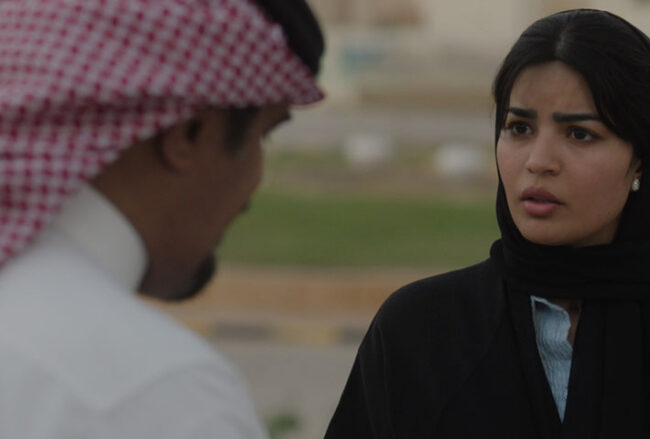
The film opens with the discovery of a teenage girl’s body abandoned in the desert outside Riyadh. The victim has no identification, few clues, and seemingly little chance of receiving justice. When the case crosses her desk, Nawal (Mila Alzahrani), a recently divorced police clerk and devoted true-crime listener, sets out to uncover the girl’s identity.
What follows is part detective story, part social portrait, as Al-Mansour uses the familiar structure of a procedural to explore larger questions about gender, autonomy, and social expectation. As Nawal begins asking questions, she encounters a world of silences, evasions, and unspoken assumptions. School administrators, family members, and community figures each possess fragments of information, yet the deeper she digs, the clearer it becomes that solving the crime means understanding the circumstances that allowed the victim to disappear in the first place.
One of the film’s strengths is its refusal to present Saudi women as a monolith. Throughout Nawal’s investigation, she encounters women of different generations, backgrounds, and beliefs, each navigating the constraints of their society in distinct ways. Some push against those limitations; others accommodate them, and many exist somewhere in between.
Mila Alzahrani, reuniting with Al-Mansour after The Perfect Candidate, anchors the film with a performance that balances determination and vulnerability. Nawal’s interest in the case is clearly fueled by her own personal losses, but the film wisely avoids reducing her to a simple symbol or crusader. Instead, she emerges as a complicated individual whose search for answers becomes inseparable from her effort to reclaim agency in her own life.
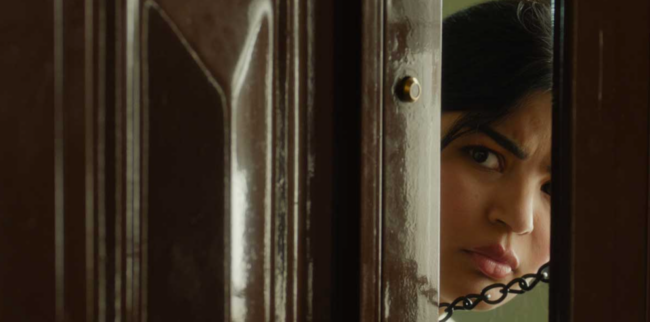
Stylistically, Unidentified represents a somewhat more commercial turn for Al-Mansour. The film embraces suspense, red herrings, and genre conventions more readily than her earlier work. While the mystery itself remains engaging throughout, the film’s lasting impact comes less from the mechanics of the investigation than from the social realities it reveals along the way.
In the end, Unidentified works as both a compelling thriller and a continuation of Al-Mansour’s long-standing interest in the lives of Saudi women. The mystery may provide the engine, but humanization remains the destination.
“Unidentified… utilizes the death of a young woman to explore how Saudi Arabia’s crushing patriarchy creates both victims and criminals out of its female population. – Jordan Mintzer, The Hollywood Reporter
“Al-Mansour not only reminds us that movies are supposed to generate empathy, she shows us precisely how.” – Beandrea July, IndieWire