
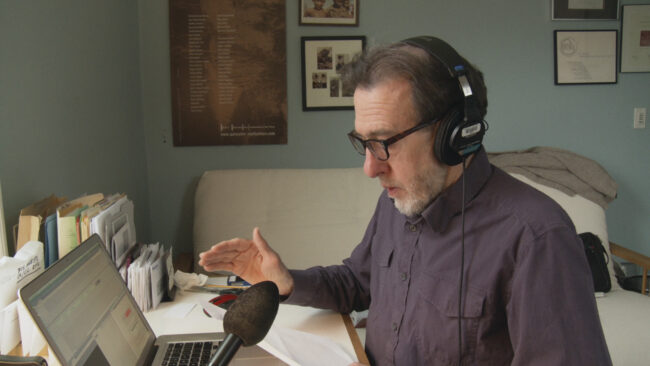
Long before blogging and social media, Ross McElwee was turning a movie camera on his own life, processing his own reality through the films he made, like 1985’s groundbreaking documentary Sherman’s March. His latest, Remake, offers the biggest personal challenge to date – emotionally coming to terms with the death of his son.
Catch both Remake and a new restoration of Sherman’s March this Friday, July 17th at Laemmle’s Royal.
Whatever the ostensible, assigned topic of McElwee’s documentaries – be it General Sherman or Big Tobacco – the real pleasures of his movies come when he tends to get sidetracked and return to the subject of his own life. For his last couple of films, In Paraguay and Photographic Memory, he cut directly to the chase and started with his family. Photographic Memory spotlighted his complicated relationship with his son, Adrian; fourteen years later, he’s dealing with Adrian’s death from drug addiction.
There is an originally assigned topic to Remake – Sherman’s March was being considered for a Hollywood remake as a fiction film, and McElwee signed a deal that allowed him to make a film about the making of the new film. As the movie stalled in development, however, Adrian spiraled downward and ultimately died. Adrian was himself an aspiring filmmaker, and Remake is made up of footage shot by him as well as his father.
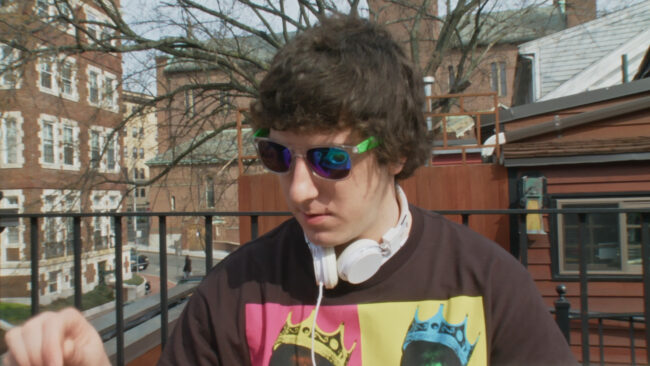
McElwee’s narration remains as steadily deadpan as always, like he can reason his way through anything, but in this case he only comes up with more questions that require answers from the heart rather than the head. He’s always been masterful at self-analysis, yet it’s clear that he now realizes its inadequacy in the face of such a blow. The best he can do is keep Adrian alive on film, and try to understand him by seeing the world through his camera. At a certain age, Adrian stopped wanting to be the subject of his father’s films – in death, his shared credit as cinematographer and editor offers a glimpse at the artist he might have become. It’s clear that he followed somewhat in his father’s footsteps, trying to understand his own life through the camera lens, but having his own addiction as a topic didn’t allow him enough distance. The elder McElwee, naturally, wonders how much of this is his fault as a father.
The reuse of footage from his older films is a common McElwee technique, done both because he doesn’t assume audiences have seen all his films, and because the footage takes on new context when viewed as flashback rather than contemporary commentary. In Remake, he takes short side quests to catch up with some of the characters from Sherman’s March, now four decades older, using the old scenes for contrast. Audiences don’t have to make do with those snippets, as Sherman’s March in its entirety, now remastered in high definition, will be playing alongside Remake in theaters. Indeed, it is even more effective as a time capsule than it was as contemporaneous Boomer self-reflection. Particularly in light of all McElwee’s subsequent movies about himself as a family man, filmed evidence of his awkward single life during the Reagan administration stands as a slice of verite Americana, unpolished by the image-consciousness of the era.
“Even in a film as sombre as “Remake,” one of the joys of [Ross] McElwee’s method is the freedom with which he constructs his movies. “ – Richard Brody, The New Yorker.
“Both an elegy for a son and a meditation on artistic purpose, this autobiographical documentary transforms unbearable personal loss into a powerfully intimate probe of memory, creativity, and family legacies. “ – Todd Jorgenson, Cinemalogue.