
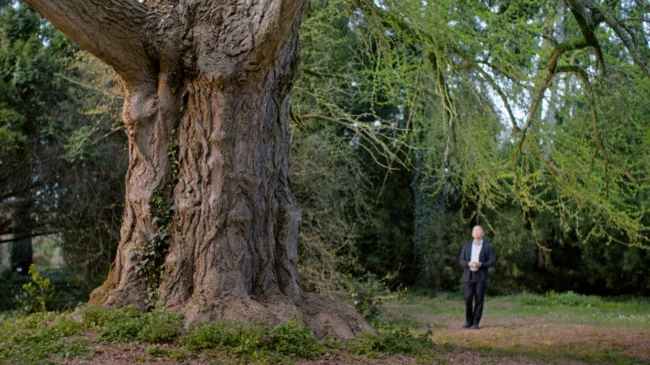
What if the world around us were constantly speaking, and we simply lacked the patience to hear it? That question drifts through Silent Friend, the latest feature from Hungarian filmmaker Ildikó Enyedi, though “drifts” may be too passive a word for a film so alive with wonder, sensation, and absurd, unexpected connections. Moving across three timelines linked by a towering ginkgo tree in the botanical gardens of Marburg, Germany, Enyedi’s film unfolds less like a conventional drama than an act of gradual attunement: to nature, to loneliness, and to the hidden rhythms that shape human lives whether we notice them or not.
Catch Silent Friend in theaters beginning May 15th at the Laemmle Royal.
If Enyedi’s Oscar-nominated On Body and Soul explored intimacy through dreams, Silent Friend projects that fascination outward onto the natural world. The film’s modern-day thread follows neuroscientist Tony Wong, played by Tony Leung Chiu-wai in a beautifully understated performance. Stranded on an empty university campus during the first COVID lockdown, Tony turns his attention away from human cognition and toward the silent life of plants, becoming increasingly fascinated by theories suggesting that trees may communicate in ways that science is only beginning to understand. As he enters into remote correspondence with a French botanist played by Léa Seydoux, the film opens itself to increasingly provocative possibilities about the porous boundary between human and nonhuman life.
Before long, Enyedi masterfully weaves Tony’s story with two earlier narratives set decades apart: one following a pioneering female botany student in the early twentieth century, the other centering on a shy student swept into the idealism and experimentation of the 1970s. The connections between these strands are less narrative-based than emotional and thematic, united by a shared sense of curiosity and by the imposing ginkgo tree quietly observing generations pass beneath its branches.
That openness gives Silent Friend much of its distinctive texture. Enyedi approaches science not as something cold or rational, but as a form of wonder and of looking more closely at the world. At times, the movie feels almost mischievous in its insistence that humans might not be as separate from the natural world as we tend to imagine.

Visually, the film is equally rich. Cinematographer Gergely Pálos shifts fluidly between varying textures and formats, moving from striking black-and-white photography to saturated color and crisp digital imagery depending on the era and emotional register. Combined with the film’s immersive sound design and score, the result is markedly sense-based, a movie less interested in driving its plot forward than in creating an atmosphere that its viewers can sink into.
Like the ancient tree at its center, Silent Friend asks for patience. But in return, it offers something increasingly rare in contemporary cinema: the feeling of slowing down long enough to see the world in a new light
“[A] beguiling, wildly original ode to better living through botany.” – Guy Lodge, Variety
“A movie that thinks outside the box, proffering a world view that’s open to new, unusual connections at a time when many people seem to be shutting themselves down.” – Jordan Mintzer, The Hollywood Reporter