
The Andes mountains stretch out as far as the eye – and the camera – can see in the land of the Quechua people. The view suggests infinite horizons and possibilities, yet the people live in small, thatched houses, sometimes with only one room. In Alvaro Olmos Torrico’s The Condor Daughter, these contrasts come to the fore.
The Condor Daughter opens at Laemmle’s Royal and Glendale Sept. 18th. Director Alvaro Olmos Torrico will participate in Q&As following the 7:20 p.m. show on September 18 at the Glendale and after the 4:20 p.m. and 7:00 p.m. show on September 19 at the Royal.
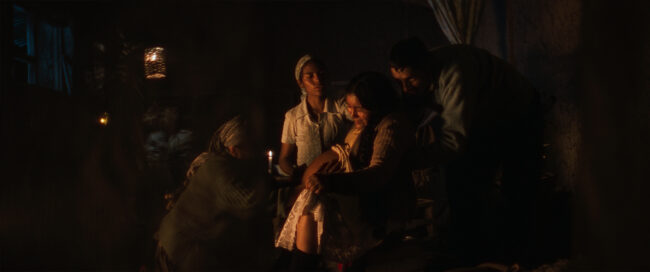
The movie begins in the dark interior of one thatched house, warmly lit and cosily filmed through thin curtains. A woman is giving birth at home, with the aid of a traditional midwife – Ana, played by first-time actress María Magdalena Sanizo. Her daughter, Clara (also first-timer Marisol Vallejos Montaño) sings while she works, and indeed, seems to enjoy that part of the job most. In her village out of time, the radio is practically the only tie to modernity, and modern music in particular. Ana, at her age, says she now prefers silence.
The scene where the rebellious child leaves home is a trope of the coming of age film; here, Clara silently gets out of bad, packs her stuff, and makes it all the way to the door before her mother is revealed sitting up on the bed behind her, making intense eye contact. Nothing need be said, and nobody tries to stop anything – there’s an understanding that this is how it must go, and only later will Ana pursue her to the city.
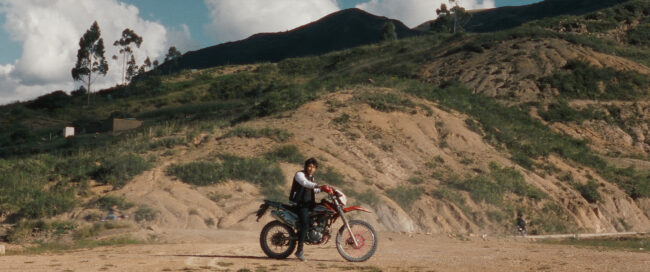
We are told by the neighbors that condors don’t attack – they only eat things that are already killed. In many ways, Ana’s village seems to be the dead meat she was nourished on. It’s scarcely known to exist, its retrograde politics include forcible and extreme haircuts for young women who dare talk to men outside their families, and the midwife role is soon to be phased out by the closest hospital, which wants to ensure safer childbirths by law. As residents leave, and crops die, some suspect a curse, and one that has come about all due to Clara leaving.
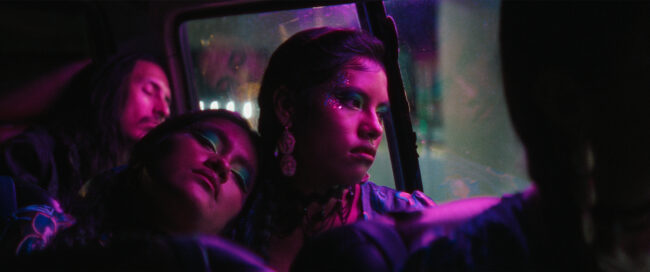
In the city, houses are jammed together, yet interiors and rooftops are far more spacious – there’s visual room here for people to grow even if nature cannot. The rooms are lighter, as even the dark ones at night are drenched in neon. Both urban and rural worlds are imbued with their own beauty, as director of photography Nicolas Wong (La Llorona) shoots the country like a painting, and the city like a photo book.
Torrico’s previous feature, Wiñay, told the opposite story: two city girls headed for the country in search of silence. Here, Clara and her best friend Flora seek the noise, and the ability to make a living in a party setting. Montaño, though new to acting, has some experience with this scene as part of an all-girl group. That she makes this aspect look the most naturally awkward attests to her quick study as an actor, and Torrico’s skill at directing her.
The writer-director has points to make, but he sees the good in both close-knit rural tradition and open urban career frontiers, ultimately coming down on the side of personal choice. Become who you are because you want to, not because you were conditioned to. It’s a universal truism that undoubtedly helped this film to become Bolivia’s official entry for the Best International Feature Oscar.
“The Condor Daughter is, without a doubt, an experience that invites us to approach the Andean world with new eyes, not only to question its harmful patriarchy but also to revalue the contributions of its women” — Gustavo Herrera Taboada, Cinencuentro.
“The Condor Daughter is a story anyone can relate to, even if they’re not familiar with the setting or the language.” — Lissete Lanuza Sáenz, Fangirlish.