
Artificial intelligence has long been a staple of science fiction, but as AI becomes an increasingly familiar part of everyday life, filmmakers face a new challenge: how to tell stories about technology that no longer feels wholly speculative. Writer-director Madeleine Rotzler’s O Horizon approaches that question from an intimate angle, using a near-future premise to explore the ravages of grief.

Catch O Horizon in theaters beginning June 19th at the Laemmle Royal.
Maria Bakalova, the Oscar-nominated breakout actress from Borat: Subsequent Moviefilm, stars as Abby, a neuroscientist struggling with the death of her beloved father (David Strathairn). Months after his passing, she remains emotionally adrift, unable to fully connect with her family, her work, or her own future. Then she discovers an unusual service called “Seeking a Friend,” which uses personal data—messages, videos, recordings, and emails—to create an AI facsimile of a deceased loved one. Soon Abby finds herself speaking regularly with a digital recreation of her father.
The premise recalls classics such as Her and episodes of Black Mirror, but O Horizon is less interested in providing dystopian warnings than in exploring the emotional complexities of loss. What begins as a source of comfort gradually becomes something more complicated as Abby confronts unresolved feelings, old frustrations, and the question of whether technology can truly help us heal or merely postpone the process of actually moving forward.
Running parallel to Abby’s personal journey is her groundbreaking neuroscience research, which explores the possibility of artificially recreating human sensations and experiences. Together, these storylines examine a common theme: If pain, loneliness, and grief can be technologically softened, what might be lost along the way? The film raises provocative questions without insisting on easy answers.
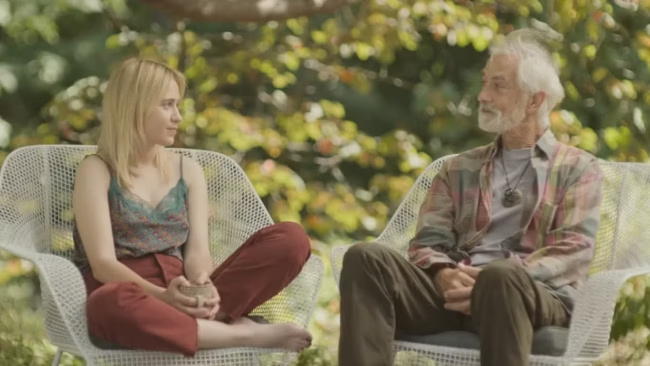
Much of the film’s appeal rests on Bakalova’s nuanced performance, which brings emotional authenticity to Abby’s complex journey through loss. David Strathairn, for his part, makes a strong impression despite limited screen time, lending warmth and humanity to both the memories of Abby’s father and his AI-generated counterpart. Together, the two actors ground the film’s speculative premise in recognizable human emotions, helping transform a contemporary technological thought experiment into something more personal and universal.
Beautifully photographed and deliberately understated, O Horizon favors reflection over spectacle. Rather than presenting artificial intelligence as either salvation or catastrophe, it uses emerging technology as a lens through which to examine love, memory, and the lingering bonds between parents and children.
At a moment when AI is rapidly moving from science fiction into daily reality, O Horizon offers a timely and deeply personal meditation on what it means to hold on—and when it may finally be time to let go.
“A moving lead performance from Maria Bakalova.” – Alex Harrison, ScreenRant
“Sort of a Black Mirror premise… [but] more of a fable.” – Alissa Wilkinson, The New York Times