
What do Luchino Visconti’s White Nights, Jane Campion’s The Piano, and Gregg Araki’s Mysterious Skin all have in common? Aside from critical acclaim, not much. Except this: they’re all returning to the big screen in new restorations over the next few weeks.
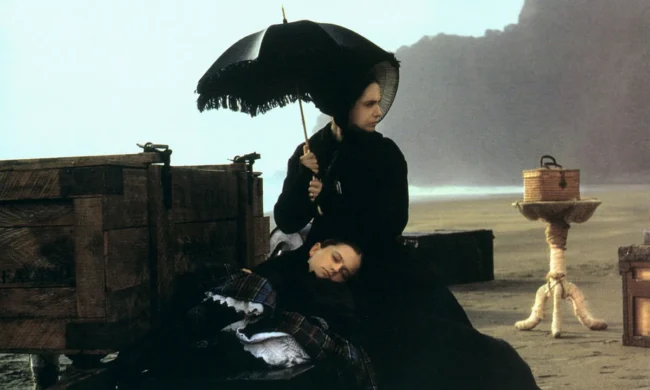
Catch The Piano starting July 31st at Laemmle’s Royal, White Nights August 7th also at the Royal, and Mysterious Skin August 21st at the NoHo.
Not to be confused with the 1985 American film of the same name, White Nights (1957) marked a transition in Visconti’s style. Previously known as a master of neorealism, he shot the entirety of White Nights on a large set in a Roman soundstage, giving the production a dreamlike quality in line with the Dostoevsky short story it’s based on. Based on the Tuscan city of Livorno, the set used netting to give the street lights a nighttime haze, and included a functional mini-canal, for a key moment in a rowboat.
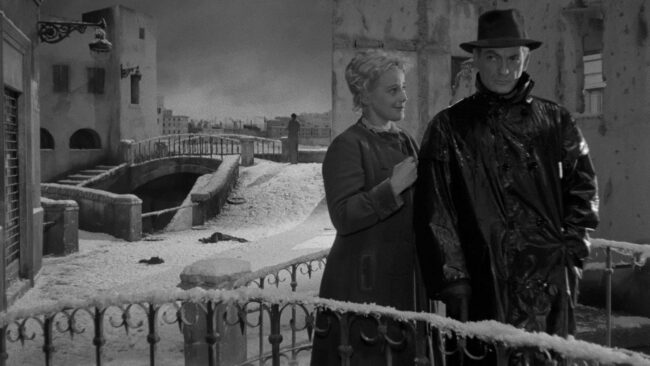
Italian acting icon Marcello Mastroianni turns on the charm as Mario, a man on a late-night walk who encounters a crying woman, Natalia (German cinema star Maria Schell). Over the next couple of evenings, he attempts to woo her despite her fealty to a man who left a year ago, with a vague promise to return. Visconti originally planned to dub Schell, but she impressed him with her Italian and got to keep her voice.
At the center of The Piano, on the other hand, is a relationship not serendipitous but pre-ordained. From an early age, Ada (Holly Hunter), from Scotland, is promised into an arranged marriage with New Zealand settler Alisdair Stewart (the late, great Sam Neill). By the time she’s old enough to actually wed, she already has a daughter (Anna Paquin), and is either unable or unwilling to speak…except through the emotional music she plays on her piano. When her new spouse fails to put a priority on her signature instrument, she’s drawn to a man who does – George Baines (Harvey Keitel), a Scottish sailor who has gone native with the Maoris.
Hunter and Paquin both won Academy Awards for acting – unable to use words, Hunter’s Ada conveys everything through her eyes, stomps, and slaps. Paquin’s Flora comes off as a realistically mercurial kid, mostly loyal to her mother but capable of ruining everything in a fit of pique. Writer-director Jane Campion scored the film its third Oscar for Best Original Screenplay, and the film’s frank depiction of sexuality from a female gaze pushes the boundaries of what the MPAA typically allows in an R-rated film.
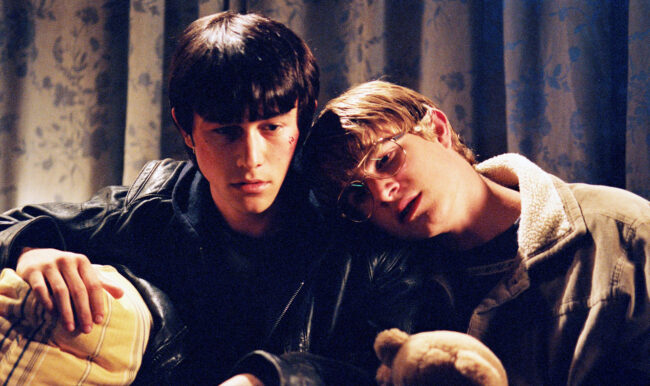
Filmmaker Gregg Araki has always pushed boundaries of sex – and violence — from his breakthrough film The Doom Generation onward. Mysterious Skin is less overtly outrageous, but almost more shocking for it, as it follows two childhood friends, played by Joseph Gordon-Levitt and Brady Corbet, who process childhood sexual abuse in very different ways. Gordon-Levitt’s Neil becomes a hooker in New York City at the height of the AIDS crisis, while Corbet’s Brian, who believes his abuse may have been an alien abduction, increasingly has his repressed memories manifest as physical symptoms.
With a supporting cast that includes Michelle Trachtenberg, Richard Riehle, Elisabeth Shue, Chris Mulkey, and Mary Lynn Rajskub, Mysterious Skin is acclaimed as one of Araki’s finest and most sensitive films, but with its unflinching look at the damage done by child abuse, it isn’t for the faint of heart.
All three of these movies will have regular runs – not just one-off screenings – of at least a week, starting July 31st with The Piano. If you’ve never seen them before on the big screen, or it’s been a while, come and see them look better than ever. Three very different films, by three great directors…and there’ll be more where that came from.