
Grief is rarely a solitary experience. Even when family members mourn the same loss, they often do so in profoundly different ways. That tension lies at the heart of Lilian T. Mehrel’s deeply felt debut feature Honeyjoon, a warm, observant drama about a mother and daughter struggling to find one another in the aftermath of loss.
Catch Honeyjoon in theaters beginning June 12th at the Laemmle Royal.
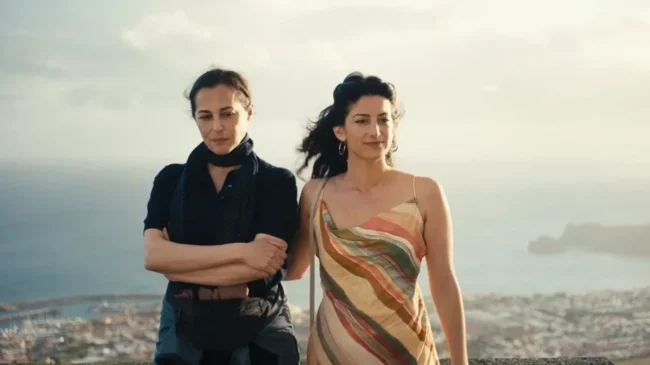
Set against the lush volcanic landscapes of Portugal’s Azores Islands, the film follows June (Ayden Mayeri) and her Persian-Kurdish mother Lela (Amira Casar) as they mark the first anniversary of the death of June’s father. The destination is not arbitrary: It is a place he’d once visited and loved, making the trip both a memorial and a search for connection. Yet from the outset, it is clear that mother and daughter have arrived carrying vastly different emotional agendas.
Lela wants to sit with her grief, to revisit memories and honor what has been lost. June, meanwhile, seems eager to keep moving, whether through flirtation, distraction, or simply avoiding conversations that might force her to confront feelings she has spent months suppressing. Their differing approaches create moments of tension, but Mehrel wisely avoids turning those disagreements into melodrama. Instead, Honeyjoon finds poignancy in smaller misunderstandings: the comments that sting more than intended, the silences that speak volumes, and the quiet realization that even those closest to us may experience the same event in dramatically different ways.
What distinguishes the film is the compassion it extends to both women. June’s restlessness and Lela’s yearning emerge not as opposing forces but as parallel responses to the same wound. Mayeri and Casar share an easy, lived-in chemistry that makes their relationship feel authentic, capturing the complicated blend of affection, frustration, obligation, and love that often defines parent-child relationships well into adulthood.

The Azores themselves become an essential part of the film’s emotional texture. Mehrel and cinematographer Inés Gowland make full use of the islands’ dramatic coastlines, green hills, and volcanic terrain, creating a setting that feels both idyllic and reflective. The landscape’s beauty never overwhelms the story, but it quietly reinforces the film’s central concerns with memory, change, and the passage of time.
At just over eighty minutes, Honeyjoon unfolds with a light touch, resisting grand revelations or tidy emotional resolutions. The result is a modest but affecting debut that understands grief not as something to overcome, but as something we learn to carry—sometimes alone, and sometimes, if we are fortunate, alongside the people who know us best.
“A story of Iranian diaspora, of sexual and emotional repression, and of culture and politics experienced at a distance.” – Siddhant Adlakha, Variety
“A quietly powerful exploration of grief, family, and the small moments that connect us.” – Rachel West, ThatShelf.com