
If there’s a quiet thrill in encountering a late-period film from the great Steven Soderbergh, The Christophers delivers it almost immediately. Set largely within the cluttered confines of a once-great artist’s London home, the film trades spectacle for something knottier and more intimate: a duel of personalities, ideas, and unresolved histories.
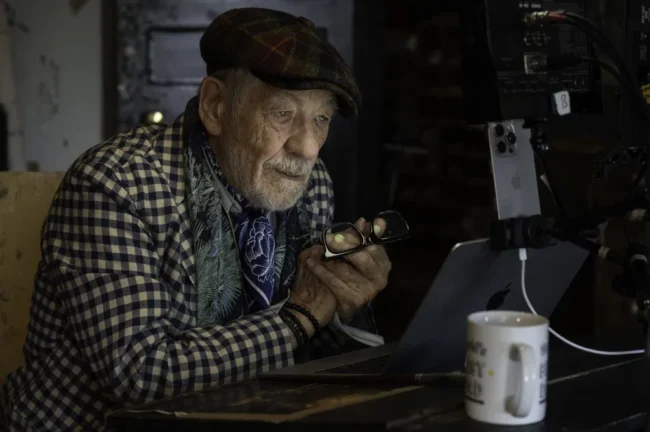
Catch The Christophers in theaters beginning April 17th at the Laemmle Monica, NoHo, Town Center, and Glendale locations.
At its center is Julian Sklar, played with ferocious precision by Ian McKellen. A celebrated painter turned cultural relic, Julian has retreated into a self-made mausoleum of past successes and private grudges. McKellen inhabits him as both tyrant and ruin: acerbic, theatrical, and faintly ridiculous, yet never less than human. His performance resists easy sentiment; whatever sympathy he manages to arouse is accomplished in spite of Julian’s relentless abrasiveness, not because of any softening.
The premise initially suggests a familiar caper. Julian’s estranged children, eager to secure their inheritance, recruit Lori Butler, an art restorer who moonlights in forgery, to infiltrate his home and complete a set of unfinished paintings that could be worth a fortune. But the film quickly pivots away from such familiar Soderberghian mechanics and toward something more elusive as what unfolds between Julian and Lori (played by an electric Michaela Coel) is less a traditional con than a prolonged negotiation of identity and authorship.
Soderbergh, working with a script by Ed Solomon, keeps the narrative in constant motion—not through action, but through nonstop reversals of power. Conversations shift, allegiances blur, and what begins as manipulation gradually takes on the contours of recognition. Lori is not merely an intruder in Julian’s world; she is, in certain respects, his reflection. Both are artists stalled in different ways, each confronting the uneasy distance between creation and self-worth.
Formally, the film is deceptively loose. The camera drifts, lingers, and reacts, giving the impression of spontaneity while maintaining a careful sense of rhythm. The confined setting only heightens the sense of volatility, as if any exchange might tip into revelation or collapse. It’s a reminder of how much Soderbergh can do with minimal space when the material gives him something to push off against.
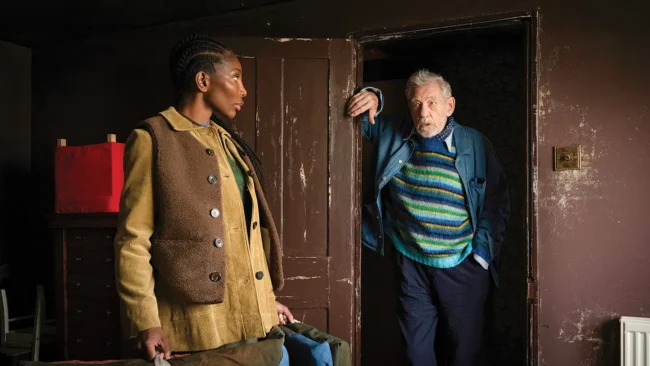
What ultimately distinguishes The Christophers is its preoccupation with legacy—not as a settled inheritance, but as something negotiated in real time. Who owns a work of art? Who gets to define its meaning? And what do we really leave behind: objects, or impressions? These questions animate every scene, giving the film a momentum that extends far beyond its deceptively contained setting. Anchored by two exceptional performances and a script that relishes every turn of the knife, The Christophers is a sharp, engaging showcase for Soderbergh at his most quietly confident.
“The Christophers feels as rich and expansive as anything Soderbergh has ever done.” – Seth Katz, Slant Magazine
“[The Christophers] bats about ideas pertaining to art, commerce, ownership and legacy with dexterous aplomb and boasts two equally superb leads who make the material crackle.” – David Rooney, The Hollywood Reporter