
Ariel has left his past behind. After growing up in the close-knit Jewish community of Buenos Aires he has built a new and to all appearances successful metropolitan life as an economist in New York. He has come back to his native city to meet his distant father Usher, but for days they miss one another as Usher continues to issue instructions to Ariel for a plethora of errands. Usher’s life’s mission, often to the detriment of his family, is the running of a Jewish aid foundation in El Once, the old Jewish neighborhood of Buenos Aires. Ariel is drawn back into the community and the very role his father plays in it. Along the way, his New York existence is gradually stripped away. After a few days, literally standing in the clothes that he once wore, he meets Eva, a mute, intriguing woman who works at the foundation.
Not coincidentally, Ariel’s visit coincides with Purim, a holiday commemorating the salvation of the Jewish diaspora from annihilation. It is a day of rejoicing in face of the averted disaster, a humorous, carnivalesque occasion that forms the subtext for a comedy of errors of missed and found people and connections, and a rumination on the extent to which we can ever really leave our past behind.
THE TENTH MAN director, producer, and screenwriter Daniel Burman is a founding member of the Academy of Cinema and Audiovisual Arts of Argentina. He is considered one of the most important Argentine filmmakers of his time, with great success both at home and internationally. Burman has directed eleven films and has produced more than seventeen movies. Throughout his work, he consistently utilizes the artistic touch and sophistication needed to explore existential issues with authenticity, always adopting a light yet profound tone at the same time.
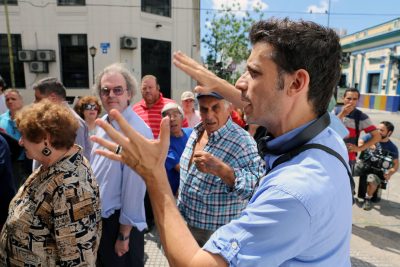
He has been awarded the Silver Bear at the Berlin Film Festival; Grand Prix of Public in Biarritz; FIPRESCI Prize at Valladolid; Coral Prize in Havana; Audience Award, Iberoamerican Film and SIGNIS, in Mar del Plata. In recognition of his humanitarian vision, Burman was awarded the Robert Bresson Award at the Venice Film Festival, an honor he shares with Wim Wenders, Alexander Sokurov and Manoel Oliveira. In 2008 he received the Achievement Award from the Israel Cinematheque during the Jerusalem Jewish Film Festival. In 2011 he received the Visionary Award, from the Washington Jewish Community Center at Washington International Jewish Film Festival.
Mr. Berman recently gave the following interview:
Q: In THE TENTH MAN, you return to Once, the old Jewish quarter of Buenos Aires. How did you come to make this film?
Daniel Berman: THE TENTH MAN was born when I met Usher, the head of the foundation in my film, who is a real person. I wanted to join a trip that a group of friends from Russia, Ukraine and Poland take every year to visit the graves of Sadikin, Jewish mystics who lived between the seventeenth and eighteenth centuries. These spiritual leaders, according to tradition, had a direct connection with God. And although Judaism is devoid of any forms of a death cult and neither leaves flowers in cemeteries nor builds monumental tombs, there is an exception in the worship of this army of holy men whose graves began to be seen as doors to the divinity. Direct contact with the stones in which the souls of the Sadikin are embedded is thought to put you in immediate contact with God by followers of certain Orthodox movements. And when I heard there was a group of Argentines who were undertaking a kind of pilgrimage to these tombs I wanted to do a documentary (“Tzadikim – Los 36 Justos”, 2011). The group traveled about 4,000 kilometers by bus, through villages where Jewish life endures, paradoxically, through those abandoned cemeteries.
Was it difficult to be accepted by the group? How did you manage to do that?
They told me that the gatekeeper was Usher, who basically had to like the idea. So we got together one day in the food court of Shopping Abasto, in what was a kind of a summit. Both of us ordered kosher pizza and initially Usher examined me, let me speak, almost ignoring me. After a while, we exchanged a few words and for some reason that even today is not clear to me, he finally accepted me. And I began to be so fascinated to get to know him that the actual journey through the Russian steppes took a back seat. During the trip, I shared with them a Jewish life that for me is unusual. And in that intimacy I
met this amazing person, and I began to establish a first closeness that was not yet a
friendship.
How did you keep contact after that experience? When did this relation evolve into a real friendship?
I stopped seeing him for a while, until one day he called me in New York and without giving much explanation he asked me to get him a velcro sneakers in size 47, for a man who was half out of his mind in a public hospital. They were about to operate and he had no shoes in case he survived the intervention. And I was honored to help and started looking for velcro shoes in a 47, but did not find them anywhere. I ended up buying very good moccasins. I thought it would be important for this person to have some nice, good quality shoes, but when he saw them, the first thing Usher said was that they lacked the
velcro. And the second was that I had to take them to the hospital myself. Then he hung
up.
This actually ended up in the film…
Yes what followed is told in the film, I went to Argerich Hospital to the man before he was operated on, he took the shoes and some cookies and I understood why the velcro: the man did not have good motor coordination, and he could not tie his shoelaces. Some time later Usher called me and we went out for coffee, and suddenly he threw a shoe at my head. I looked at the shoe and I realized it was the one I had bought. Usher then told me that the man had survived the operation but one of his legs had to be amputated, so he only needed a single shoe. And since it was the only one he had, he used it all the time,
and now it was broken and he needed another one, so he returned the old shoe to me. I have kept the shoe, because it represents the beginning of that connection.
What did strike you mostly about this person?
There was something about Usher that I found fascinating, and this feeling only grew when I learned more about his kingdom, his army of volunteers, that mysterious world of people giving without a special satisfaction beyond. Something provided by the fact of doing what needs to be done, as part of a particular logic of aid. In the Foundation the others who are being helped are not an undifferentiated mass that needs just anything. The help there is about the uniqueness of each individual. In order to give somebody exactly what he needs, there has to be an intention to understand why he needs this and nothing else. That world captivated me and motivated me to write the story. Because I had always been rather suspicious of those who gave their lives for others, I thought that most of these people wanted to get away from themselves or escape from something. And Usher made me change this outlook.
What happened when you realized that you wanted to make a fiction film?
We did not recreate anything but assembled a fiction within an existing world, in a fairly documentary register. Making a film to tell this story was a fact in itself so extraordinary that it did not matter how it was acted, or lit, or whatever. The figure of Usher haunted me, and at some point I began to wonder what the life of the son of a father who gives so generously would be like. Somebody who gives all his love to others when children always want to monopolize the love of their parents. I wondered what would be the link between the father and the son, and from that completely fictional construction I started writing the script.
How did you work in the real environment of the Foundation? How difficult was it to enter into their lives?
I really enjoyed invading their reality as little as possible. Reducing the fictional elements to the minimum needed to sustain the story, articulated as a documentary as much as possible. And it was a huge challenge, because it involved contact with people who had nothing to do with the dynamics of a shooting but with the dynamics of life, and accept that this dynamic was more important than ours, and that we had to adapt to it. I approached the film as a process and ended up establishing a deep emotional bond. I do not know how it is for other directors, but for me, my films are more and more processes
than results. Of course I always want audiences to like my films and give me a hug after seeing them, but I increasingly experience them as processes that are shaped by and occur at certain times of my life, and the imprint of life for me is stronger than the story, however wonderful the result may turn out to be.
Could you tell us something about your approach to the shoot?
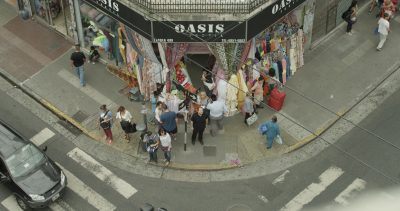
I wanted to make a light film capable of incorporating the moment, and, for example, when we met a group of guys who were going to a party and wanted to participate we included them in the scene. I wanted to have that freedom of movement. And I wanted to shoot in Once , even though at the time I wasn’t consciously aware that I was referring to “El abrazo partido”. There is a dialogue between “El rey del Once” and and my first film. At a minimum there are issues that are touched upon in one and taken up again in the other. The truth is that I am the same person, even if ten years have passed. But the dialogue that occurs is more internal, between who I was – and who no longer exists – and
who I still remain.
How did you come to cast the real Usher in the film?
Because he is a great character and only he could play himself. Thinking of an actor for the role depressed me, I felt that it would not really work and I never doubted that Usher could do much better. The same is true for Hercules, the lieutenant in the humble and mighty army of Usher. An indispensible sidekick, carrying frozen chicken and beef back and forth through Once with his Citroen in the scorching heat without concern for alimentary rules and attentive only to the strictures of necessity and urgency, I thought he was an incredible character. Overall I was deciding who to work with in a fairly intuitive way. Many of the beneficiaries of the foundation I got to know also ended up in the film. What made it all work was that I felt comfortable with each person I was adding, as simple as that.
What about the opposite process: when did you choose to cast real actors instead of the
real people for certain roles?
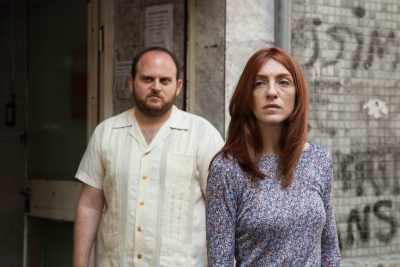
The characters I imbued with higher dose of fiction are those who come from the outside, and I tried to make sure that they fit naturally into the environment. I wanted to work with Alan Sabbagh for some time. I thought he had a special gift for this role, because he was someone who could perfectly have left that universe only to return in the end. He could have taken this journey away and back. For the character of Julieta Zylberberg it never occurred to me to work with an Orthodox woman because it would have been impossible. Julieta did a great job of observing and above all managed to go beyond the stereotype. Because at first glance it is very easy to judge, but then if you look more closely, it is important to understand why a woman takes shelter in the way she does. There are people who choose the shelter of religion, as in this case. We try to understand why that woman takes cover, and why this guy played by Alan somehow is able to draw her out, how this match that initially seems highly improbable finally works out. So I thought of a very good actress able to channel this character without being judgmental.