
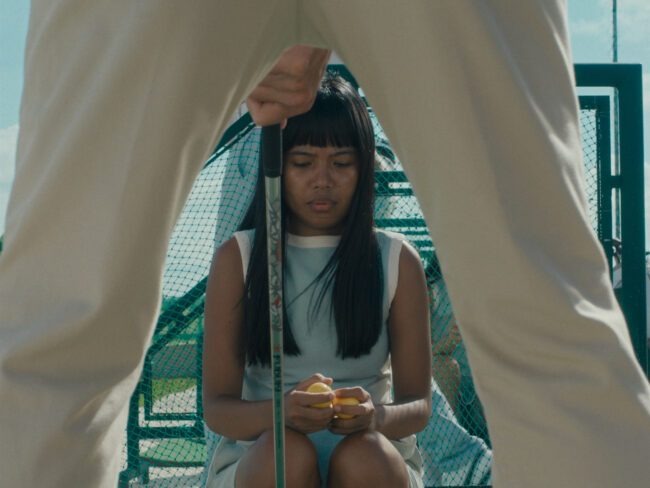
Writer-director Rafael Manuel has made a debut feature to immediately command attention with Filipiñana, a deadpan, day-in-the-life look at an elite golf course through the eyes of the teenage country girl who works there on the lowest rung of the service scale.
Filipiñana opens Friday, Sept. 4th at Laemmle’s Glendale and Monica Film Center. In person Q&As with writer-director Rafael Manuel after a special 7 p.m. show on Sept. 2nd at the Royal, a 7 p.m. show on Sept. 3rd at the NoHo, and after the 7 p.m. shows Sept. 4th and 8th in Glendale!
As the title of the movie appears onscreen, Filipiñana delivers an edit that recalls the famous matchstick-to-desert cut in Lawrence of Arabia, but deliberately, ironically in reverse. The hot, crowded streets of Manila, where families line up for limited water rations, instantaneously transition to a view of sprinklers on a vast golf course. The water here is freely given away – to the plants rather than the people – while the fruit trees drop their mangoes that nobody is allowed to pick, to be eaten by ants on the ground. From a high angle, the rows of golf carts traveling in unison along the designated paths look like nothing more than the world’s most expensive model train set.
Earlier this summer, Gail Daughtry and the Celebrity Sex Pass riffed on The Wizard of Oz for comedic effect. Here, Manuel gives us a verdant Emerald City of sorts more akin to the original Baum novel, or perhaps Wicked, complete with all-female caddies in Glinda-pink uniforms. It’s an impressive kingdom – the movie’s golf resort was filmed using eight different courses to create the impression of one massive one. And it suggests opulence and luxury, yet it’s a fraud at heart, just like its very own “wizard,” Dr. Pelanca (Teroy Guzman). Like the nation of the Philippines itself, it’s built on colonization and exploitation, and its artificial space allows the richest clientele the luxury of not having to pay attention to anything else.
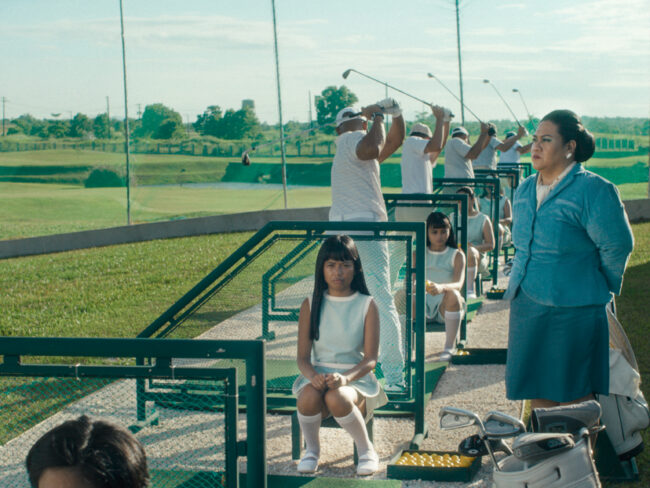
Seventeen year-old Isabel (Jorrybell Agoto) is new to the job, from the northern, rural region of Ilocos, which has a distinct culture and language (and was home to dictator Ferdinand Marcos). She’s a tee girl, whose job it is to ensure there is always a ball ready for players on the driving range to hit. Tee girls aren’t allowed on the actual course, but its vast size makes that an impossible rule to fully enforce. In the morning, as she cools off lying on the grass, a smaller girl walks into her field of vision, greets her, and then runs off. Later in the day, that girl will be reported missing, and almost nobody will care.
Cinematograoher Xenia Patricia shoots mostly long, static shots in 3:4 aspect ratio – not due to any expectation that Filipiñana will be screened in IMAX, but to emphasize vertical power dynamics, and the trees on the course which represent the labor. Water is thrown at them until they die, at which point they are easily replaceable. Employees are frequently filmed either lying down or from higher angles, while Dr. Pelanca and his friends are forcibly looked up to. Like Michael Haneke, Manuel wants to see how manipulable you are as an audience member. The takes are slow, but blink and you might miss a clue. The ultimate test of this is the end credits – be sure you sit through them rather than walking away too soon (as every character onscreen does), in order to get the real ending.
Like Jonathan Glazer’s Oscar-winning The Zone of Interest, Filipiñana says as much with what it doesn’t show as what it does, which is mostly luxury and comfort if you don’t look too closely. The caddies are old enough to speak truth, but only among ears that will hear it. Music is sparse, and mostly in the form of bands playing stereotypical “exotic” music they imagine the mostly Chinese guests will want to hear.
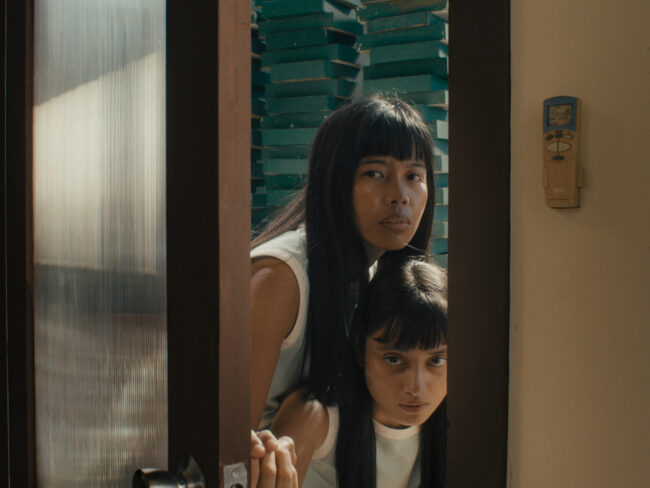
The feature is an expansion of Manuel’s thesis short film at the London Film School, and produced by Jia Zhangke (Still Life) who served as his mentor for two years. Filipiñana won the Special Jury Award for Creative Vision at this year’s Sundance Film Festival, rewarding everyone’s faith in the material. It should similarly reward viewers in theaters this fall.
“An incisive, slow-burning satire of capitalism and powerful men with far too much hubris — basically, a story for our times.” – Aisha Harris, NPR.
“Through heightened control of imagery and mood, attention to composition and texture and sound, Manuel turns this simple, languid setting into something far more sinister without ever betraying the beauty of what’s onscreen.” – Bilge Ebiri, Vulture.